THE HARVEST OF CHVRCH AND STATE VNION

3%

Pacific Press Publishing Company · Oakland, Cal., Kansas City, and New York · Nov 29, 1899

FromSigns of the Times, Vol. 25, Nos. 48, 49.

Read the full edition

THE HARVEST OF CHVRCH AND STATE VNION

By Leon A. Smith, Editor of "American Sentinel."
WHEN evil seed is sown in a land, there is the certainty of a baleful harvest. "Whatsoever a man soweth, that shall he also reap," is an unfailing rule, and because it is true of men, it is true of nations.
The evil seed of Church-and-State union was brought to the shores of the United States from the countries of the Old World, where for centuries that union had been fixed in the institutions of society. The early American colonists fled from persecution at home, but brought with them the very principle against which, under conscience, they had contended. They still held to the belief that the civil power ought to extend its prohibitions and penalties over "offenses against God and religion."
This principle was accordingly incorporated in the system of government which they established in the New World, and found ready access to the statute-books of the States; so that to-day, in nearly all these books, "offenses against God and religion" are prominently defined.

"A New Order of Things"

When the republic proclaiming "a new order of things," was set up, statesmen were in control who recognized the necessity of separating the sphere of the civil power from that of religion; and in the national system of government, this was done. The Constitution declares that no religious test shall be made a qualification for any public office under the United States, and forbids the national Legislature to make any law "respecting an establishment of religion, or prohibiting the free exercise thereof."
But, while the principle of separation between religion and the State was thus plainly set up in the Federal Government, the seeds of Church-and-State union already sown were not eradicated. The State statutes defining and punishing certain religious offenses, were still retained; and the State Legislatures were not bound by any express prohibition against touching upon religion in their enactments. Under the influence of the example set up in the national government, the religious statutes of the States lost much of their force, and the friends of liberty thought, for the most part, that they would lapse into a state of permanent quiescence. But human nature would be other than it is if these ready instruments of bigotry and intolerance could be long retained as dead letters. The onward progress of religious truth was ever precipitating religious controversies, and furnishing occasion for the religious majority to invoke the law as a ready means of silencing the opposition.
The national government itself soon deviated from the principle it had set up. Chaplains were hired for Congress and for the army; and the chief executives appointed days of national prayer and thanksgiving. To this was added, in time, the appropriation of public funds for sectarian institutions. Bigotry and fanaticism played their part in calling for State recognition of religion; and, finally, under the national stress of civil war, the movement to secure such recognition took organized shape.

National Reform Association

The National Reform Association was formed, and began to publish literature, hold conventions, and work with the Legislatures for the avowed purpose of so remodeling the government that "all Christian laws, institutions, and usages" would be placed "upon an undeniable legal basis in the fundamental law of the land."
That was in 1863; and since then this organized effort has steadily, and of late years very rapidly, gained in strength.
In 1887 it secured the alliance of the Prohibition party and the W. C. T. U.
In 1888 the combination was broadened by the formation of the American Sabbath Union. This new organization the same year secured the introduction of two religious measures into Congress, calling for the recognition of the Christian religion and the establishment of Sunday observance by law. The measures failed; but similar ones have since been pressed upon Congress at every opportunity.
In 1889 an alliance was sought and practically formed with the Roman Catholic Church.
In 1892 the National Supreme Court further strengthened the cause by a decision declaring that "this is a Christian nation."
In 1892 the National Legislature gave its voice and influence for the movement, in considering the question of closing the gates of the World's Fair on Sunday. By legislation then enacted, Congress officially recognized and established Sunday as the Sabbath of the Fourth Commandment, thus stepping into and assuming authority to decide a religious controversy.
In 1894 the highest authority in that church which stands ever for the fullest union of Church and State, declared the United States "to be a Catholic country," and "elevated" it "to the first rank as a Catholic nation."
In 1898 the government entered into negotiations with the Papacy regarding Spain, through the papal secretary of State, and continued these negotiations until the declaration of war.
And, meanwhile, within recent years, vast religious organizations have been growing up,—the Young People's Society of Christian Endeavor, Epworth League, Baptist Young People's Union, Christian Citizenship League, League for Social Service, and others,—all enthusiastically committed to the scheme of making the United States a Christian government by purifying American politics.
With all this in view, we are forced to contemplate a harvest of Church-and-State union—and that at no distant day—in the United States. And what will the harvest be?
The harvest will be reaped both by the Church and by the State. To the republic it will be a Harvest of Despotism; to the Church, a Harvest of Worldliness; and to both, a Harvest of Ruin.
The foundation principle of the republic is that of civil liberty,—the freedom of all its citizens to enjoy, under the protection of the civil power, their natural rights, such as "life, liberty, and the pursuit of happiness." By the union of Church and State this principle is totally denied; for union of Church and State is only another name for union of force with religion, which means enforced religion. Enforced religion is a denial of religious freedom, which is the highest and most sacred of human rights. That by which it is denied, therefore, can represent only the worst and most crushing despotism.
Upon every upright citizen—upon every one who values principle above mere policy, conscience above convenience—this despotism will lay its heavy hand, and will either silence him or drive him from the country, as the Huguenots were driven from France, Roger Williams from Massachusetts, and the Baptists and Quakers from the colonies of New England. With the central pillar of religious freedom thus thrown down, together with all those supports which represent conscience and moral integrity in government, what but a ruinous heap will remain of the beautiful fabric of free government reared by Washington and his fellow-patriots?
And the Church—what harvest will come to her? What worse harvest could come than a harvest of worldliness? The Church is in the world, but only to be the salt for its preservation, and the light for its guidance. As the ship at sea must keep the water of the sea outside or be engulfed, so the Church must keep worldliness without her fold, or sink beneath it. What worse thing, then, could the Church do than deliberately to join worldliness with herself by an alliance with the State? When worldliness comes into the Church, not as a thief into the home, to be cast out as soon as discovered, but with the Church's open welcome; when it comes heralded by the Church as righteousness, then bitter is put for sweet, and darkness for light, and just the opposite work is done by the Church to that she was commissioned to do.
THE HARVEST OF CHVRCH AND STATE VNION
For the Church to join hands with the State is to open the door to hypocrisy and every spiritual evil. It is to open the door to wolves who know how to wear sheep's clothing. When the sanction of the Church is necessary to success in politics,—when only those can hold public office who are religiously qualified, in the view of the Church,—what knave with whom ambition outweighs conscience will not want to join the Church? When all the conscienceless class with whom policy is first and principle last, come flocking from the world into the Church, to use their church connection as a stepping-stone for worldly ambition, to what more dreadful condition could the Christian Church descend?
Only the language of the Scripture can fittingly describe it; and then will the scripture be fulfilled which says, "Babylon the great is fallen, is fallen, and is become the habitation of devils, and the hold of every foul spirit, and a cage of every unclean and hateful bird." Rev. 18:2. Such is the baleful harvest that awaits the garner of the Church from the union of Church and State.
"And I heard another voice from heaven, saying, Come out of her, My people, that ye be not partakers of her sins, and that ye receive not of her plagues." The everlasting Gospel will be the final refuge of liberty, when government of the people, by the people, for the people, shall have perished from the earth.
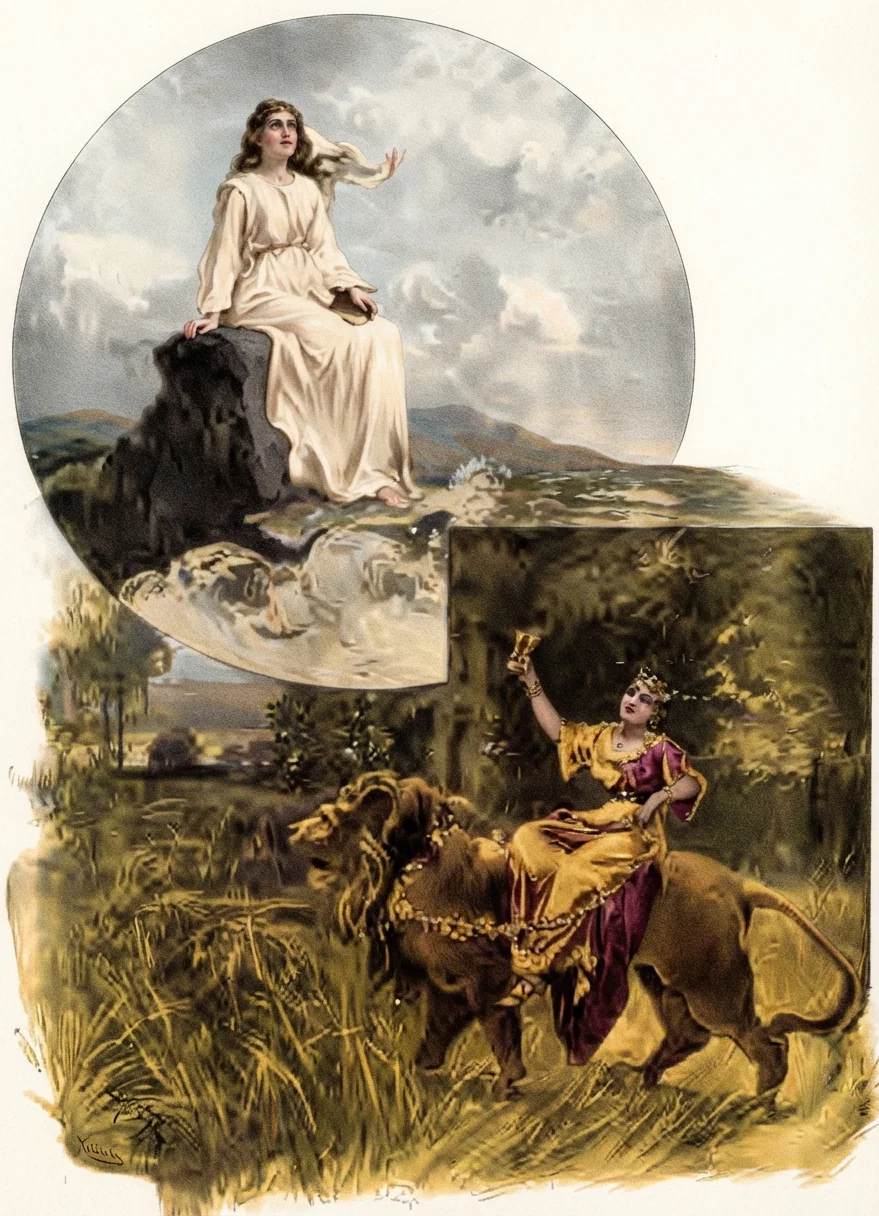
The Daughter of Zion, a comely and delicate woman. Jer. 6:2. A chaste virgin to Christ. 2 Cor. 11:2. Secure by faith on the Rock of God's Word. Acts 20:32; Luke 6:48. The Daughter of Babylon, an apostate church connected with the State; a woman supported to-day in triumph by a wild beast, which to-morrow may devour her. Revelation 17.