ALASKA INDIAN FETES

8%

Pacific Press Publishing Company · OAKLAND, CALIFORNIA · Nov 14, 1900

FromSigns of the Times, Vol. 26, No. 46.

Read the full edition

ALASKA INDIAN FETES.

IN the southeast part of Alaska it is the universal custom among the Indians to give entertainments about the time of the holidays, consisting of feasts, potlatches, and dances. Following is a description of one held last year. It was written for the Parish (N. Y.) Mirror, by Mrs. Adah Sparhawk Young, who was formerly a resident of this city:—
"It was held in a building about thirty by forty feet, built especially for the occasion. A ten-foot square in the center contained a fire on the ground, with an opening in the roof for the smoke to escape, or at least a part of it escapes. A large feast was given each day, with a dance and potlatch at night, which sometimes continues until the small hours of the morning.
"Previous to the feast a few of the Indians went down to Seattle and purchased about three tons of provisions, beside purchasing about two tons here at the store, also a quantity of calico, blankets, etc. The big feast is given about noon each day. Just before it is ready the loud boom of the cannon is heard to call them together. Sometimes a young man goes through the principal part of the town ringing a bell, after the manner of an auctioneer. It reminds one of the parable where the servant was told to go out into the hedges and highways and compel them to come in.
"Each one carries a large dishpan or large earthen wash-bowl, and a teacup for their coffee. The food usually consists of pilot bread, or 'hard tack,' candy, apples, and coffee, which is passed around to each guest (all seated on the floor, as they prefer that way to sitting on chairs). Then the large vessel of each guest is filled full to take home. Each meal lasts about three hours, during which time they converse, tell stories, and give toasts, and loudly and briskly the speaker is cheered.
"The potlatch is a part of the regular program, or entertainment. It is a ceremony to which invitations are issued the same as to any social event.
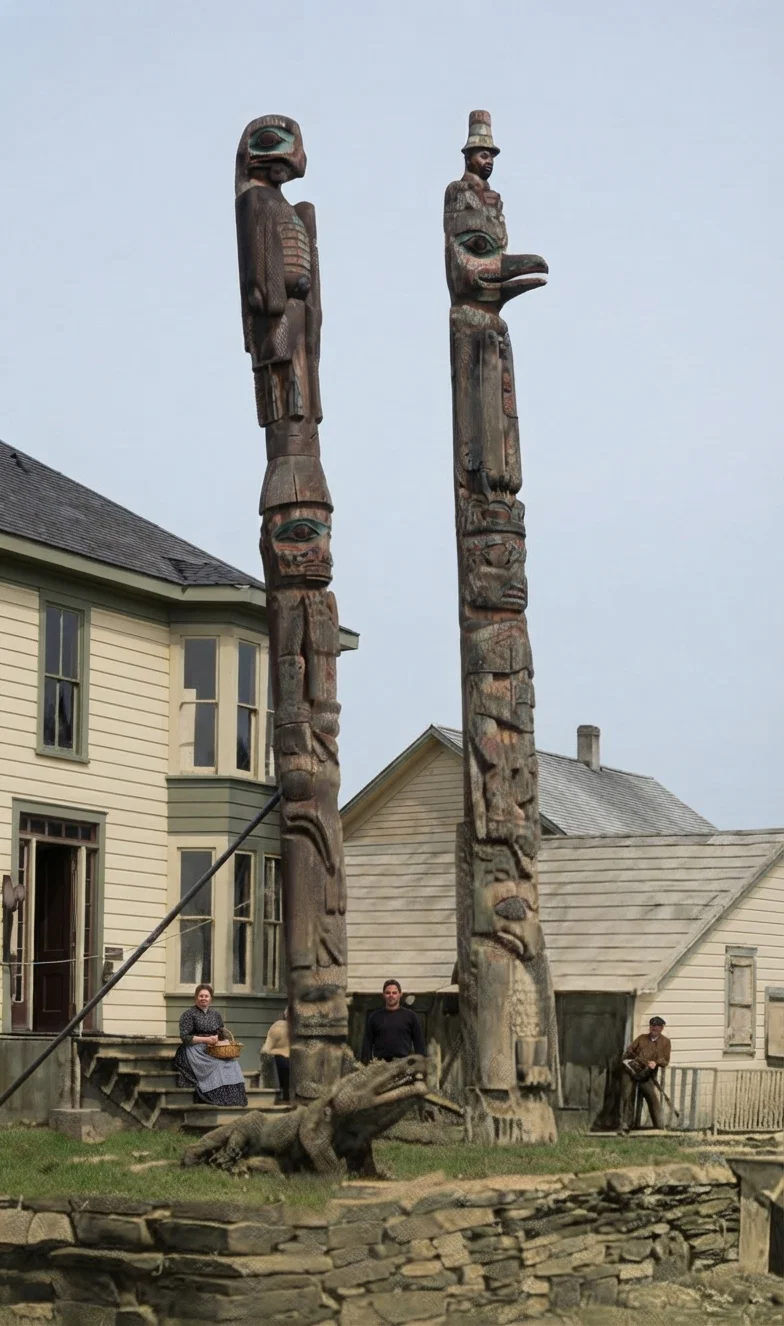
Totem-posts, emblems of nature-worship, usually connected with some animal believed to have kinship with man.
"Personal property of every description is given away. By giving away his property the host hopes to attain a reputation of liberality, and increase his chance of one day becoming chief. The distribution takes place in true Christmas style. The blankets and goods to be given away are stacked in a heap near the fireplace, just opposite the door. The host holds up the presents and calls the guest's name who is to receive it, and an attendant, who stands ready, delivers them. Each guest is remembered according to his own distribution in the past, or those which he is expected to make in the future. It is one man's duty to tear the rolls of calico, muslin, flannel, or whatever cloth it be, into strips about a yard long. Previously it was the custom to also tear the blankets into like pieces, but the missionaries have persuaded them to abandon this practise, so they only cut them apart into single blankets. On this occasion the potlatch consisted in giving away cigars, guns, blankets, money, and bleached muslin (or sail as they call it). One afternoon provisions were given away, nearly every one carrying home a large box of things, beside a gunny sack full, the women carrying their own share.
"One evening I had the pleasure of attending one of their dances. As I entered the room a hideous sight met my gaze. Three or four young men were dressed in their paraphernalia, with their faces painted in black streaks. The head-dress was a marked feature of their grotesque attire. It was trimmed with ermine skins, pending from the band, nearly covering the head and face, flying in every direction when in motion, with a girdle of sea-lion's whiskers about the top, pointing upward. The hollow in the crown was filled with swan's-down and feathers, which were showered about the room while dancing, as blessings upon their guests. Each one dresses as gorgeously as he can afford, in robes, furs, blankets, etc.
"Their peculiar costumes, fierce gestures, and monotonous singing were a scene of barbaric gorgeousness, which can not well be described. Louder and more exciting the singing and dancing go on. Wilder and more frantic grows the chanting; swifter becomes the motion of the dancers, and faster is the oil poured upon the burning heap. With frenzied yells and whoops they leap into the air, then suddenly crouch on the floor. They keep time to the drum with violent jerks and motions of the body. Their movements become more convulsive, until they become hoarse and exhausted; then they suddenly stop and face the host, who makes a sort of speech. The singing ceases, and all eyes are directed toward the speaker with utmost reverence, as the tradition or history of the tribe is rehearsed, after which another set of dancers takes their place.
"I do not think I will ever forget the strange sensation or spell which took possession of me during this gruesome and exciting scene. It was all my past imaginations about these strange people made real. Sometimes the beating of the drum and on the floor and the dancing are almost deafening. During these entertainments a few neighboring tribes were invited. They came in large canoes, fifty or sixty feet long, with the Stars and Stripes waving above them. They were welcomed by the firing of a cannon.
"All the Indians attending this entertainment were well dressed, many of the women being gorgeously attired. One young girl wore abright purple velveteen dress and fancy ribbons. Another wore a white dress with a red sash and neck ribbon. One young woman wore a black brocade silk dress. Most of them have nice jackets or capes, or very nice, heavy shawls and gay-colored, beaded fascinators, with an abundance of jewelry, usually silver. I have counted as many as fourteen rings on the fingers of one woman, beside a half dozen bracelets. They are all manufactured by native jewelers.
"An entertainment is sometimes given by one man and sometimes by several, all belonging to the same totem, who seek to strengthen their influence among distant tribes, as well as their own."