IS IT PEACE?

7%

Pacific Press Publishing Company · Oakland, California · Jan 24, 1900

FromSigns of the Times, Vol. 26, No. 4.

Read the full edition

"IS IT PEACE?"

IT is an old question, as old as war. Three times it was asked of Jehu, that zealous captain and furious driver, as he swept on in his warrior's chariot. "Is it peace?" asked the two messengers; and they immediately became a part of his company of war. "Is it peace, Jehu?" asked the wicked, profligate King Joram; and the reply was a rebuke for his wickedness, and a smiting to his heart.
"Is it peace?" thousands in the earth are asking to-day. Like fierce gladiators of old the nations of the earth stand, armed to the teeth, the sword half drawn from its scabbard, the great guns unlimbered and shotted, and their black mouths turned toward expectant enemies. More millions of men are connected with armies to-day than a century ago there were myriads! The people are groaning under the crushing weights of ever-increasing war expenses. The heaviest items in the annual financial budgets are not for the purpose of bettering the nation or conserving the equal rights of its citizens, but for the destruction of those who in the expected struggle may be counted as foes.
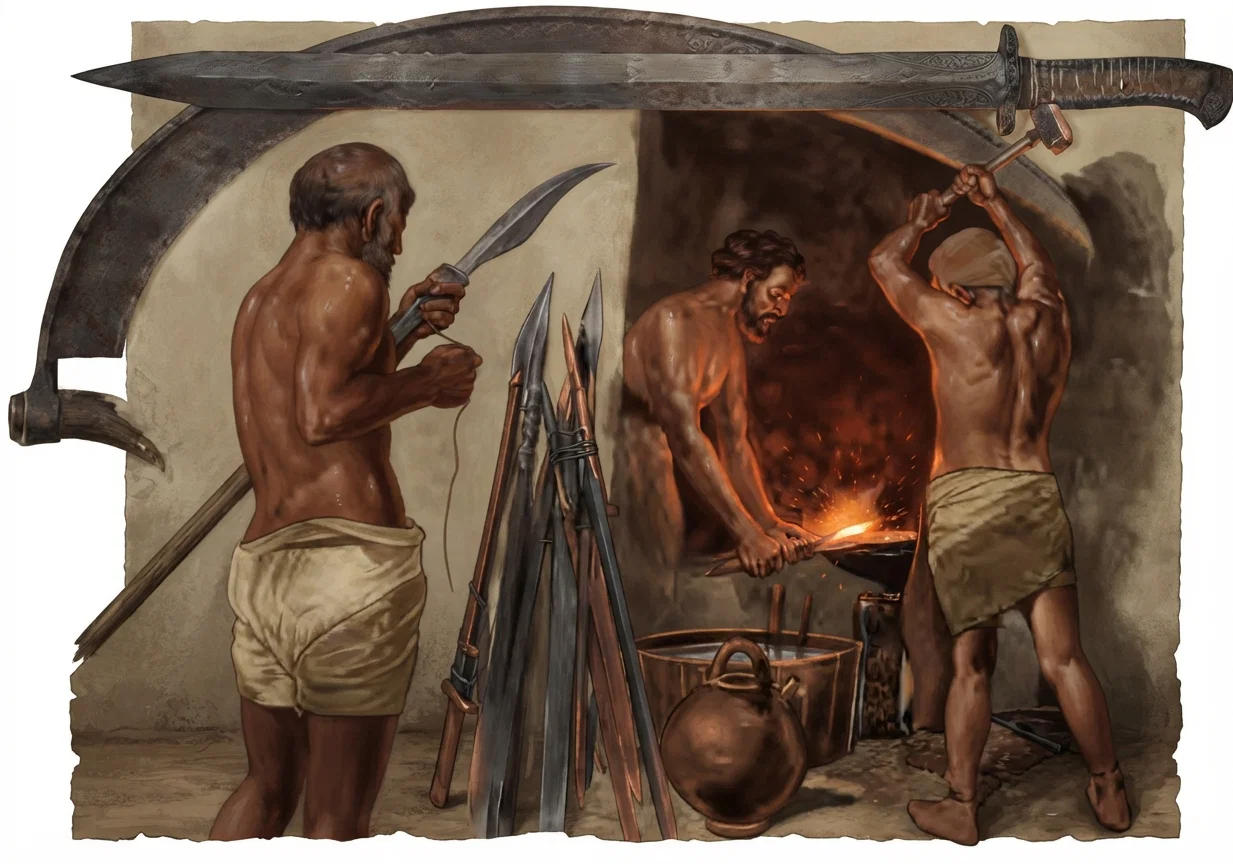
Proclaim ye this among the Gentiles: Prepare war, wake up the mighty men, let all the men of war draw near; let them come up; beat your plowshares into swords, and your pruning-hooks into spears; let the weak say, I am strong. Joel 3:9, 10.
NOT once but many times have these nations armed anew in the last half century. After the long season when the most powerful rifle was the old muzzle loader of powder and ball, came the era of invention and discovery,—invention of cartridge and breech-loader and needle gun and magazine rifle, ever lighter in weight and ever more deadly in execution; and discovery of greater and more terrific explosives, in the scale of which old-fashioned mortar powder ranked at 30; rifle powder, at 35; atlas powder, 54; dynamite, No. 1, 62.6; best quality nitro-glycerine, 73; Americanite, 82; Rossel's mixture, 89.5; perunite B, 100; and since that come Lyddite and Thorite, still stronger and more deadly in explosive power, and fatally noxious gases.
SMOKELESS powders have added to the uncertainties, and the old arts of war are in face of them obsolete. The problem is still further complicated by Krupp, Gatling, and Maxim long-range guns, quick-firing guns, machine-guns, the use of shrapnel and shells which explode in a thousand pieces, instead of thirty, as formerly. It is now contended that a three-millimeter bullet is possible, instead of about seven, as at present, enabling the soldier to carry several hundred more cartridges. This means new armaments, and increased financial burdens. Great battle-ships have been built during the last quarter century, with many of smaller types, costing millions and millions of dollars, which have grown obsolete waiting for war; and at tremendous expense new and more expensive ones are being built. What will the end be? Is it peace?
YES, it will be peace, responded the adorers of the Peace Conference which lately adjourned at The Hague. Yet hardly had the benedictions pronounced upon its farcical proceedings died away, from which peace-loving and war-burdened souls hoped so much, ere two of the most Christian nations were using unheard-of and more powerful explosives,—the one against the ignorant natives of Central Africa, the other against the natives of the islands of the sea who had fought for two centuries for liberty from medieval intolerance.
JUST recently a work in several volumes has been issued by M. Bloch, a Polish-Russian economist, on "The Future of War." In it the author elaborates, in its economic, destructive, strategic, and various phases, the complex and appalling condition of the present war status of the world, and what a future war would mean,—suicide to all nations who entered it. His arguments are forcible. Looking at the matter from the author's view-point alone, one is impressed with his argument. His contention is that, as no nation wishes to commit suicide, and as no nation can engage in a great war without committing suicide, there will be, therefore, no great war. And he has made others hope that time would confirm his words of peace. But how finite is man!
AS LONG as men are at strife with God, there can be no peace with one another. As long as nations are made up of such men, there will be strife and bloodshed among nations. As long as there are chances of winning, nations, or the few who rule but do not do the fighting, will take the chances. Human life is cheap compared with the glory of empire, many think; let it be sacrificed if deemed necessary or expedient. This has been human nature in all the past; it is human nature to-day. And so, hardly before the ink was dry and the signatures gathered in the last volume of M. Bloch's six-volume work, rendered into English, the greatest nation of the world was engaged in war, a war taxing all her resources to the utmost in men, provisions, and money; a war in which a larger army has been transported across the seas than modern history knows. That war is waged against, nominally, two small States; yet we are told that it is against not only the little republics of South Africa, but against many thousands of Russians, and French, and Germans, and Americans. It is a war being fought for very existence by the principals, a war which, if England should be defeated, would greatly affect the world, and the work of missions in the world. The war dogs of other nations are held in leash. All the nations are prepared; it is a crisis of the ages.
NAY; in the very nature of things, and from the world's standpoint, it is not peace. The new year dawns with blood-red streaks across its sky, betokening the mighty storms that are to follow. The demand in all the nations of earth is for ships and guns and men and explosives. The plethora is great, but the demand is for more.
Is it peace? What says the Guide-book of God? The world is dark. Rulers and statesmen and commanders rush on in blindness, knowing not whither they are going. The blind are leading the blind. God has given His Word, a "lamp" to the "feet," a "light" to the "path." His prophecy is as a "light in a dark place until the day dawn and the day star arise in your hearts." What does the "more sure word of prophecy" say as to "the future of war," as to peace?
HERE it is: Eight hundred years before Christ, God gave a seer of His a vision of the future, which included this time, just before the impending "day of Jehovah" shall burst upon the world. This is what he heard and saw concerning this time: "Proclaim ye this among the nations; prepare war; stir up the mighty men; let all the men of war draw near, let them come up. Beat your plowshares into swords, and your pruning-hooks into spears; let the weak [like little Transvaal] say, I am strong. Haste ye, and come, all ye nations round about, and gather yourselves together; thither cause Thy mighty ones to come down, O Lord. Let the nations bestir themselves, and come up to the valley of Jehoshaphat [Jehovah judgeth]; for there will I sit to judge all the nations round about. Put ye in the sickle, for the harvest is ripe; come, tread ye; for the wine-press is full, the fats overflow; for their wickedness is great. Multitudes, multitudes in the valley of decision! for the day of the Lord is near in the valley of decision." Joel 3:9-14, R.V.
ANOTHER prophet names many of these nations thus possessed by a spirit of war, even "all the kingdoms of the world, which are upon the face of the earth." The Lord tells us that because of the sins of the earth, "I will call for a sword upon all the inhabitants of the earth." "Evil shall go forth from nation to nation," and the slain "shall be at that day from one end of the earth even unto the other end of the earth." See Jer. 25:15-38, R.V.
STILL another prophet declares that the ultimate battle fought in this great preparation, is "the battle of the great day of God Almighty," the great conflict of Armageddon, and that the actuators of this strife are the "spirits of demons," which are out in all the world, preparing men for the sanguinary conflict. We have noted the fulfilment first; the prophecy is demonstrated. There are other prophecies as clear as these to which we have referred. Men may prophesy peace; God has told us that "many people" and "many nations" would do this; and they have been doing it; they endeavor to persuade themselves that in various ways, by choice or necessity, peace will be brought about; but peace, as regards this earth, lies dead in the dissecting room of nations. Men may try to galvanize her into life; there may be fitful, uncanny, gruesome signs; but peace, worldly peace, is dead; and over her remains are heard, not the joyful songs of rest, but the booming of cannon or the sharp crack of the rifle.
"AND is there no peace?" you ask. Yes; there is peace, blessed peace. It is not originated by pope or czar or emperor or president, or by all these and the nations they represent, combined. It is all in Jesus Christ; "for He is our peace." He says to all who would be His children, who unconditionally surrender to Him, "Peace I leave with you, My peace I give unto you; not as the world giveth, give I unto you." God is not at enmity with man; He pities and loves man so that He gave His only-begotten Son to save him. But carnal man is at enmity with God, and is not subject to the law of God. This is all that prevents peace between God and man,—the enmity of man's carnal heart, man's sin, and his love of it. Let man give it all up, and God gives pardon and peace. "Being justified by faith we have peace with God through our Lord Jesus Christ." Christ has purchased peace with the blood of the cross. He has abolished in the flesh the enmity. He offers it all to you. Blessed peace—nothing between the soul and God to separate from His life and love. It is a peace which lifts above all earthly strife. He says of the sinner, "Let him take hold of My strength and make peace with Me, and he shall make peace with Me," and concerning such, "Thou wilt keep him in perfect peace whose mind is stayed on Thee, because he trusteth in Thee." It will be peace amid all the world's strife, the peace and rest of God. And then, when the world's strife is ended, and the baubles men fought for are perished, and the warrior's little day of glory is passed forever,—then, and not till then, "the meek [the peace-loving] shall inherit the earth; and shall delight themselves in the abundance of peace."