THIS is one of the latest schemes of men to bring about a much-talked-of Christian unity. But it is only another proof of the truth of God's Word: "My thoughts are not your thoughts, neither are your ways My ways, saith the Lord. For as the heavens are higher than the earth, so are My ways higher than your ways, and My thoughts than your thoughts."
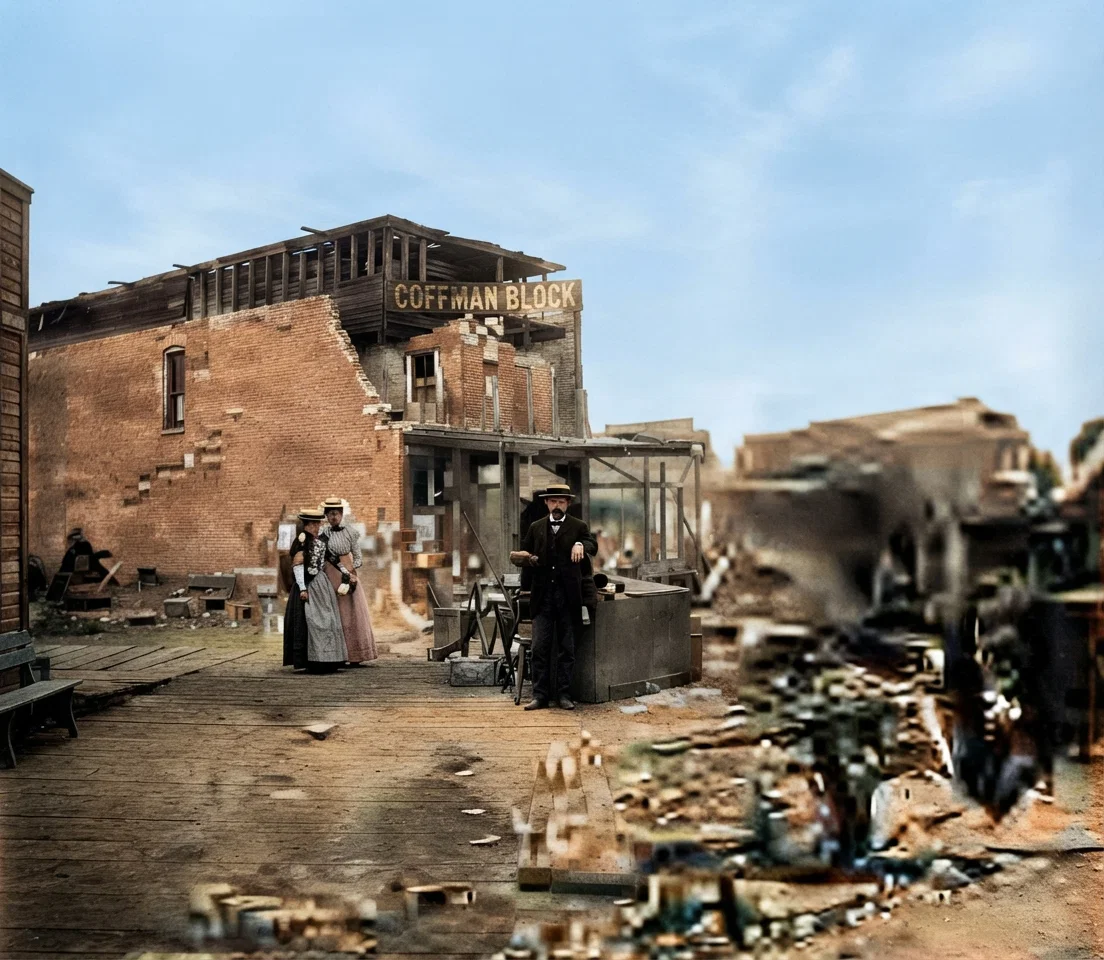
Building Owned by Mr. Rouengia, Chinese Laundry in Lower Story.
God's way of uniting Christians so that the world might be influenced by them for good, is to sanctify them through His Word. John 17:17. Jesus says positively, "They are not of the world, even as I am not of the world." Verse 16. Again, "As Thou hast sent Me into the world, even so have I also sent them into the world." Verse 18. But He did not send them into the world to form political parties, nor to contend with evil by means of worldly schemes. His way is higher than that.
Christ wanted, and still wants, His people to be united; but His prayer, and therefore His purpose, is that they all may be one, as He and the Father are one. "I in them, and Thou in Me, that they may be made perfect in one." There is nothing of the spirit of human political party union in that.
The further purpose is "that the world may know that Thou hast sent Me, and hast loved them, as Thou hast loved Me." Verse 23. When the professed Christians set up a political party and enter into political strife with the world for the world's honors, the world's advantages, and the world's emolument, will such a contest be liable to engender love in the world for those who thus contend with them? Will it inspire a love for the One in whose name such selfish contest is waged? Did worldly contest ever engender love? If the world should imbibe any reverence for the God of heaven, would they know that He had sent Christ to love them, if Christ should send His followers to contend with them for the world's honors and possessions? Such a course on the part of Christ or His disciples would not be proof of love for those with whom they waged such a warfare.
The unity which Christ designed for His disciples was a union in Him, by the Holy Spirit, not to contend with the world for the things of the world, but to show to the world a spirit of sacrifice, and to manifest the life and charity of Christ in the daily walk and conversation. He did not plan to have His people govern this world; His commission to them bears no such idea; He set for them no such example. He did not in any sense indicate that they were to be the lawmakers of the world.
It was centuries after the earthly ministry of Christ and His apostles before the church actually undertook to rule the world politically, altho the spirit of political religion (the "mystery of iniquity") had begun to work in Paul's day. See 2 Thess. 2:7. The "United Christian party" came into power and began active operations when Rome was nominally "converted" to Christianity by imperial decree in the time of Constantine. It had always been the custom among nations who knew not the true God, as well as in apostate Israel, for the government to dictate the religion of the people. Rome had always done so, and in such dictation, policy (politics) was the ruling influence. When the Christian church had grown numerically, and had fostered the political spirit of the heathen, to such an extent as to wield a great political influence, the emperor and the Senate deemed it good politics to cater to the Christian element. Hence the policy of declaring the Christian religion to be the religion of the government. To carry out this policy, the principal offices were, to a great extent, filled by men who were influential in the church. Thus the "United Christian party" principle had a practical test in the government of Rome, and, as Rome was a universal government, the test was world-wide. The power of political Christianity grew till the political church fully dominated the government, and the many centuries of that domination are now known as the Dark Ages.
It was fully demonstrated that the policy of a "United Christian party" as a political scheme was a disastrous failure as far as disseminating the truth of Christianity was concerned. It was fully demonstrated that such a scheme is not God's way, not His idea of Christian union. However, as a means of getting churchmen into office, it was a great success. But the true church of God—those who realized the fact that "we ought to obey God rather than men" (Acts 5:29)—had a hard time of it, as the record of millions of martyrs to God's way of uniting Christians for practical Christian work amply shows.
The Coffman Building in San Jacinto, Main Street, Looking East.
Looking Past.
The Reformation was a protest against this Christian party political régime; and, in so far as the true spirit of the Reformation was maintained, there was a reaction. To this extent there was relief for the downtrodden disciples of Christ, and great light dawned upon the world. But, alas! too many who connected with the reform movement conceived the idea that, in order to overcome Roman influence, Protestantism must wield not only spiritual influence but political power as well. And where nominal Protestants, working on that principle, succeeded in wrenching the political power from the Catholics, the same spirit of intolerance and persecution was continued. So that from every standpoint the idea of advancing the interests of Christianity by political means has been shown to be a failure, utterly inimical to the work of the Gospel.9
There can not be a united Christian party unless there be first united Christians; and the professed Christians who advocate Christian party politics are not by any means united Christians. Therefore any party assuming to form a united Christian party of persons who are not united Christians must necessarily fail; for at best the union would only be a union of politicians. Add to this the fact that there is no attempt to unite Christian factions in the matter of doctrine on the basis of truth, and the purpose is reduced to a mere scheme for union of professed Christians on political lines for political advantage. In purpose Christianity is left out of the party program; therefore the name "Christian" is manifestly a deception. If divided Christians form a united political party, surely it is not a Christian party at all. It is evidently an attempt to pose as righteous above their fellow-men, and is taking the name of the Lord in vain.