Untitled article

8%

Pacific Press Publishing Company · Oakland, Cal. · Jul 18, 1900

FromSigns of the Times, Vol. 26, No. 29.

Read the full edition

FROM SOUTH AMERICA.

Papal Benedictions—The Marrying of Priests—South American Morals and Politics—The United States and South America.
IN his bull—In Dei Coetera—published in 1493, Pope Alexander VI. gave all South American countries to the kings of Spain and Portugal. Between fifty and ninety years ago, these same lands rebelled against their masters, constituted themselves into a number of republics, and made for themselves presidents. Recently, the pope sent to these presidents his apostolic benediction without a word about their sinful (?) usurpation of the lawful (?) authority of Spain. The church that "never changes nor errs" knows, however, how to submit to the inevitable.
This is illustrated in the matter of allowing priests to marry, which was presented to the pope by South American prelates at their Latin-American council last year. The matter is not settled yet, and it is not likely to be for some time, altho it is known that it was and is strongly urged by the archbishop of Mexico—Mgr. Santiago Subiria y Manzanera, and by others. Rome does not discuss things openly and on their merits. Things new, if they must come about, and there is no way out of it, come in on the sly, by dint of precedent and of tradition. When well established in custom, then comes a pontifical decree. Diplomacy, not principle, is the motto.
In the meantime, the scandalous lives of the clergy will go on. But that can well be allowed for a time yet, it seems, inasmuch as the people themselves have loose habits of living. Not long ago, in Peru, a priest was expostulating with a poor man for not getting the church to bless his matrimonial relations. That was before civil marriage came in and when the priest charged what he pleased for marrying. The man told him that he would state his reasons before the magistrate. They both repaired thither. The explanation of the poor man was: "When the priest, who is known to have two wives, shall get married, so will I."
This is a fair illustration of the moral, or rather immoral, situation. A large measure of the loose living must be attributed to the criminal advantage taken by the priesthood in absolutely refusing the people the marriage ceremony unless they are willing to stand their exorbitant charges. Fortunately, civil marriage is now making its way into our South American republics, notwithstanding the dire opposition of the church, which has made marriage a sacrament, and calls civil marriage a concubinage. This deters a great many from being content with a civil marriage. On the other hand, the priest expects to get a large sum of money if he performs the ceremony at all. The consequence is that all through these countries thousands of families are formed without the marriage ceremony. This sad condition tends to make this sacred relation a temporary arrangement, which either party can break at any time.
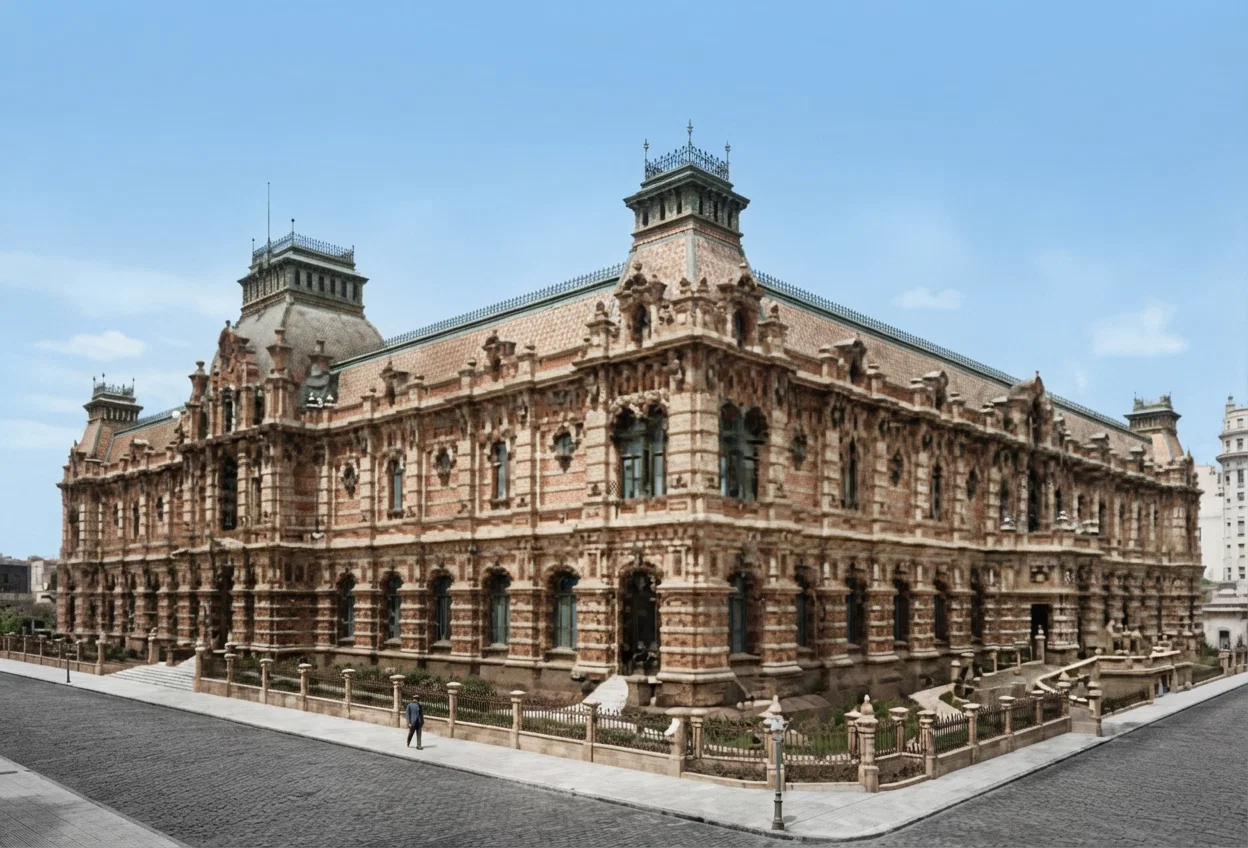
Water-Works, Buenos Ayres, Argentine Republic.
The same greedy spirit which has been shown by the clergy, and which has always characterized these South American countries, is manifested in their political life. It is not to be wondered at. How can people who have never been accustomed to think and act freely on the most solemn and pressing questions that can come to the human soul—those of eternity—be expected to relate themselves properly to the rights of the people and the legitimate restraints of government? Political life in South America offers a sad spectacle indeed. Revolution follows revolution, and brawl succeeds brawl.
The great thing in politics is public money for personal uses. To get rich in a short time and without working for it, seems to be the goal of political happiness. This spirit is greatly fostered by national lotteries. Those in power are filling their pockets as quickly as they can, for they know not how soon they may have to step out of office. At the same time, they shamelessly control public elections to keep their own party in power. When the greed and indignation of the opposing party or parties is sufficiently warmed up, then revolution breaks out, which often succeeds in overthrowing the party in power. No scheme is too scandalous or too impudent to use in making fortunes out of a struggling nation. In all South American countries, so far as I know, paper money, issued by the various governments at par with gold, is now at a fearful discount, the difference being pocketed by the politicians, and lost, of course, by the people.
Still, such is the vitality of these lands, that many improvements are made, and lofty public buildings are erected, such as the Buenos Ayres water-works, shown in the accompanying picture.
But what will they do for money when they enter the armed peace steeple-chase with European or other countries? Will they ever do it? Until of late there were no indications of this, and it was a question as to how they could be induced to do so. The difficulties between Chile and Argentine caused some ruffle and some war preparations, but that was all peaceably arranged some time ago. Just now, however, our great and noble northern neighbor, whose Constitution and civilization are universally considered here as the ideal to reach unto, seems to change her peaceful disposition and goes into the expansion and conquering business. South American peoples are not great moralists, altho susceptible to good examples; but they can see the mote in their brother's eye quickly enough, and they will not be slow in abandoning their uphill march toward civilization and peace when they see their great political example, the United States, apostatizing from her God-given task among the nations.
The recent visit of President Roca to Brazil, and the contemplated reciprocation of President Campo Salles by a visit to Buenos Ayres, where he will meet both Roca of Argentine; and Errasurriz of Chile, may be a straw indicating which way the wind blows, and a proof that these gentlemen have seen a broad hint of truth in Cecil Rhodes' prophecy that the final task of the United States is to govern all of South America.
It is a great pity for South America, a greater pity for the United States, and an awful pity for the entire world!