WHAT is the status of the Chinese in Hawaii? This question may be divided into two parts: (1) What was their status prior to the annexation of Hawaii to the United States? (2) What is their present status?
To answer the first question in general terms, and in the language of the Hawaiian Chinese themselves, I will quote from a little document prepared by them in August, 1898, entitled "Memorial and Accompanying Data Presented to the United States Commissioners by Chinese, Resident in the Hawaiian Islands." The commissioners referred to were Senators Cullom and Morgan and Representative Hitt, of the United States, and President Dole and Judge Frear, of Hawaii, who were appointed by President McKinley to recommend legislation for the Hawaiian Islands. The memorial was printed five days after the raising of the American flag in taking formal possession of Hawaii for the United States, Aug. 12, 1898. Concerning the status of the Chinese in Hawaii, as viewed by themselves, it says:—
"Your memorialists would respectfully assert that under the laws of Hawaii they have, notwithstanding the fact that there never have existed treaty relations between the empire of China and Hawaii, fully and freely enjoyed the same rights and privileges in regard to person and property as the citizens or subjects of the most favored nation having treaty relations with Hawaii, with the exception that they have not enjoyed the privilege of political representation in the conduct of the affairs of the country."
In Hawaii the Chinaman is a welcome factor of the community. His person is guarded as sacredly by the courts of justice as is that of any other nationality. Compared with the Chinese in San Francisco, those in Hawaii are a very different people. "Their best race traits have had freer scope. They have had better opportunity to enter into the life of the people among whom they came, and into the civilization which surrounded them, and they have done so. The Chinese in Hawaii are an integral part of the population, and suddenly to banish them or to deprive them of the position they occupy, would be a severe blow to the community life of the population."
They enjoy the same immunities in the holding of property as other races on the islands. According to the census of 1896, 195 Chinese owned real estate, and 758 owned the house they lived in, it being the custom among the Chinese, as well as among other nationalities in Hawaii, including the American, to build on lands held under long lease. The total assessment of Chinese property was $125,274.31.
Tho not permitted to exercise the right of suffrage, they have been admitted to citizenship by naturalization. Since 1845, 722 applications for naturalization have been granted. Of these there are probably not more than 300 in the country at the present time. There have been about 1,600 children, out of a total of 2,234, registered at the foreign office as born in the Hawaiian Islands.
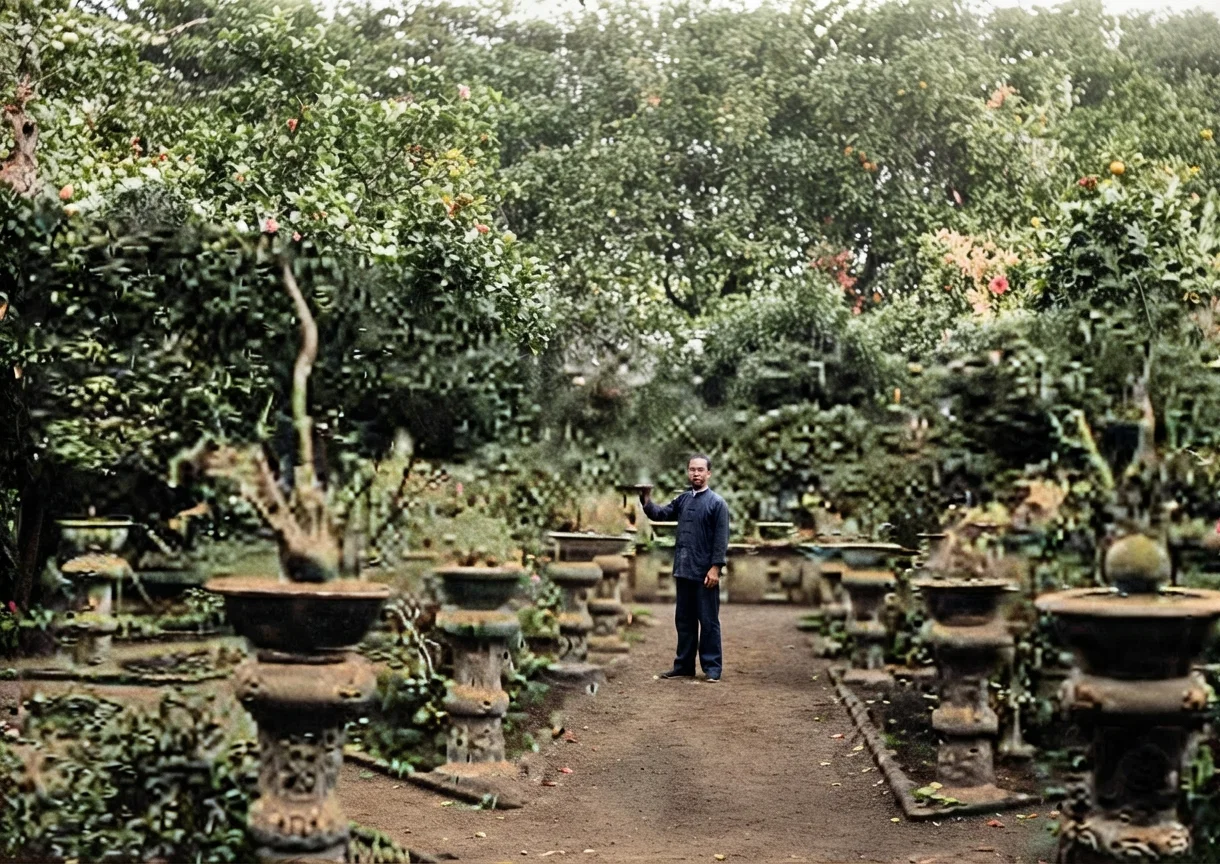
A Chinese Dooryard, Honolulu.
Socially the Chinese in Hawaii enjoy a freedom and exhibit an aggressiveness that are surprising to one who has been accustomed to look at them from this side of the Pacific. While the home and family life is conservative when measured by the American standard, and while it is not so widely established nor so well developed as that of other races, partially because of the limited number of women in the country, its privileges and progress are considerable. Tho it is not usual to see a Chinese man in company with his wife and children in public, yet women and girls move about upon the streets with measurable freedom, the poor on foot, the wealthier in carriages. On all state and on certain other public occasions, respect and courtesy to the Chinese are not wanting. At such times whites mingle freely with them, as they do on ordinary occasions in their places of business and assembly. There is a Chinatown in Honolulu, but many of their stores face or are adjacent to principal places of business among the whites; and one does not experience that social reserve in passing through the Chinese Colony of Honolulu that chills him in the Chinese quarters of San Francisco.
Morally, considerable advancement beyond that of which the Chinese are popularly supposed to be capable, has been made. Out of a population of 21,616 are 953 professed Christians (837 Protestants, 67 Roman Catholics, 49 Mormons)—nearly 1 in 20. There are 2 Chinese churches, 1 American, 1 English, supported by the Chinese; a Chinese Y. M. C. A., the first of its kind in the world; a well-constructed hospital, prepared to treat patients in either the occidental or oriental systems of medicine; with a number of clubs and societies having special aims, some philanthropic, some social, some educational.
As to education, 9,364 (nearly half) are able to read and write; 527 (about 1 in 40) read and write English; 226 (about 1 in 100) read and write Hawaiian. Under the Hawaiian law education is compulsory between 6 and 15 years of age, tho attendance upon government schools is not required. About 200 Chinese children attend government school, and 475 independent schools.
As to occupation, 10,941 (about half the total population) are unskilled laborers, and have employment chiefly upon rice and sugar plantations. Others are rice, coffee, and sugar planters, fishermen, mechanics, drivers and teamsters, merchants, salesmen, doctors, law, bank, and government clerks, etc., to the number of 5,769. Thus it will be seen that out of a total of 21,616, 16,710 are engaged in some definite occupation.
From these statistics it is apparent that, with the exception of political suffrage and some minor privileges, such as admittance to certain docks or to go aboard oriental steamers, the Chinese in Hawaii are extended equal privileges with other races. That they have made intelligent and effectual use of these privileges is also apparent.
What is the present status of the Chinese as affected by the annexation of Hawaii to the United States? The operation of the "Chinese Exclusion Act," passed by the United States in 1892, has been extended to Hawaii, and is rigidly enforced through a special agent sent down to the islands by the Treasury Department. Some restrictions were placed on Chinese immigration prior to annexation, but that is interpreted by some as a mere pandering to the American sentiment on the question, and a courting of Congress to hasten the acceptance of Hawaii's proffered hand. The Treasury's agent began his work by excluding even those Chinese who had received return permits from the Hawaiian Government prior to annexation. His action was not sustained by the Treasury, tho it worked a great amount of hardship before a decision on the matter could be secured from Washington. Quite a number entitled to land, and who had business interests in the islands, were sent back to China; others were held at the quarantine station for weeks, awaiting a decision on their cases; and cases like the following, which came under the writer's personal observation, were not uncommon. The wife of a leading merchant, who had returned with properly-accredited papers, was compelled to sit on the wharf for one or two hours, being made a gazing stock and an object of comment to the motley crowd gathered on the dock, and was finally put back aboard the steamer on which she came, and carried on to San Francisco, expecting to be returned to China.
Contracts with the plantation laborers are of three years' duration, and as many of these11men return to China at the expiration of their contracts, and as no more contract laborers can be brought in, one or two years more will suffice to put an end to Chinese contract labor service. In time this must affect the merchant class more or less, for many of the merchants handle Chinese goods only, and depend quite largely on the numerous laboring class for the consumption of their stuffs.
It remains to be seen whether the United States will in any way modify her legislation for Hawaii on the Chinese question. From all present prospects there is little hope that she will. But, altho the Chinese in Hawaii can not increase their numbers by immigration under the present law, they will ever remain an important factor in Hawaiian community life.
Honolulu, Hawaii. W. E. HOWELL.