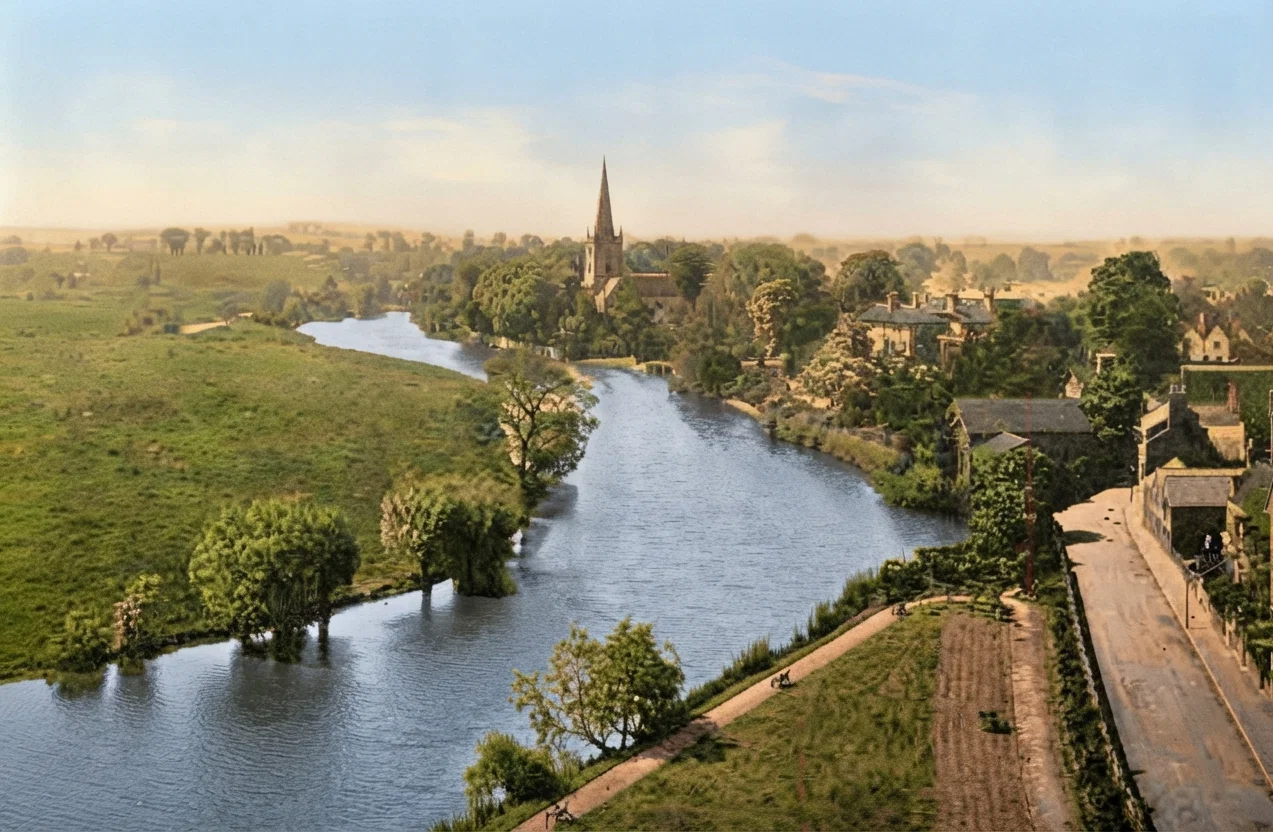
In the center of beautiful green England rises the River Avon, which, flowing south-westerly through the county of Warwick, empties its waters into the Severn. In the southwest part of Warwickshire, situated upon the Avon, is the little town of Stratford,—Stratford-on-Avon,—famous the wide world over as the birthplace and home of one of the very greatest of English poets, Shakespeare. Here is the house where the poet was born, the house in which he lived, now a national property and suitably restored, and his tomb. The house within preserves its 16th-century character, and an interesting museum has been founded there.
In quaint old Stratford the poet first saw light April 23, 1564. His father belonged to the yoeman class, and was by trade a glover. He was evidently a man of worth of character. His mother was a woman of some property, education, and refinement. Shakespeare's principal school education seems to have been largely obtained at the free grammar school in Stratford before he reached the age of fourteen, for at that time he left school. But he seems to have improved his time in getting a fair knowledge of English, and to some extent at least of Greek and Latin. For five years he probably worked at what he could, reverses having come to his father in business. At nineteen he was married to a woman, Anne Hathaway by name, eight years his senior. At twenty-two he went to London, where his writing and dramatization of plays began. The latter part of his life he lived at Stratford-on-Avon. He possessed some of the vices of his time, but was known also as a man of generosity and nobleness of character. He was called among literary contemporaries "Gentle Will."
STRATFORD-ON-AVON, THE BIRTHPLACE OF SHAKESPEARE.
Of his works it is superfluous to speak. They form a wonderful treasury of trite apothegms, maxims, short and pithy sayings, revealing remarkable knowledge of human nature. Because of this he is quoted more largely than any other author. While filled with moral precepts, it can not be said that his remarkable genius has brought the world much if any nearer heaven than it found it; for the morality found in his works is largely counteracted by the coarseness, vulgarity, and lewdness they contain. Much of this is doubtless due to the environments in which his poems were written, to their purpose to portray and please human nature, and to the way in which the age expressed itself. He has ministered much to the pleasure and entertainment of the world, but little to its true edification. According to Mr. Ward, a vicar of Stratford, he died as the result of a fever after a convivial feast with kindred friends, at which the vicar tells us, "Shakespeare, Drayton, and Ben Johnson, had a merry meeting, and drank too hard." Thus closed the career of this brilliant man at the early age of fifty-three.
And yet God has used the remarkable genius He gave William Shakespeare, altho it was not consecrated to Him. It is good to recall that the sayings of Shakespeare used most are generally of a moral and philosophic character. Besides this, he has kept alive the good old Anglo-Saxon tongue. It has been said at times that the common version and also the Revised Version of our Bible is the language of three hundred years ago; but the English of three hundred years ago, with the modifications which have been met in the above versions, is the best English to-day. Among the Bible readers that Book has kept alive and current the simplest, the strongest, the best of English; and among another class of non-Bible readers, a class of strong writers, among2the chief of which is Shakespeare, have performed the same office. The Bible therefore still speaks the language of the common people, with rare exceptions so sweetly and clearly that the child can understand its blessed words of life.