Report from an Eye-Witness—In the Harbor of St. Pierre—Ancient Appearance of the City—Scenes and Incidents.
THE Dixie left New York at 9 o'clock on the evening of May 14, and at 3 o'clock in the morning of the 21st we sighted Mount Pelee. We were about twelve miles off shore at the time. The force of the second eruption, which started about five o'clock of the day before, had partially subsided; but the picture presented to us was an impressive one. Night was just giving way to gray dawn. The mountain was faintly silhouetted against the horizon. At its summit a bright glow was flashing a steady, yellow light into the heavens, and indicating that the old cauldron was still acting. Away above the top of the mountain lay a heavy fall of smoke, which curled up from the crater, and spread out like a huge umbrella, while from a thousand crevices on its sides columns of steam spurted forth.
As daylight advanced, the brilliancy of the picture faded, the golden glow died out; but even in the daylight the smoke and the steam continued to pour forth in a lazy sort of way, giving testimony of an immense reserve force which might manifest itself with renewed energy at any moment.
As we passed the harbor on our way to Fort de France, the town, or the ruins of the town, could hardly be distinguished from the gray film which lay over the water. Between 7 and 8 o'clock the Dixie arrived at Fort de France, and saluted several vessels in the harbor, including the French cruiser, Suchet, and the Dutch iron-clad, Konigin Reregentes.
There we also found the swift government tug, Potomac, to which Captain Berry transferred us as soon as the quarantine doctor had completed his examination, and the captain and Governor L'Huerre had exchanged mail. The Potomac immediately started for St. Pierre, having on board a large party of scientific men, as well as a number of correspondents and photographers. As we entered the harbor of St. Pierre, we could just distinguish the tops of the masts of one of the vessels which had been sunk by the violence of the storm.
In the city not a sign of life was visible. It looked like a relic of a thousand years ago, and this appearance of desolation was heightened by a closer inspection, after we had been landed in small boats. The air was stifling with the gaseous fumes from the volcano, which we could see above us, belching forth volumes of black smoke, and covering us with a coating of gray ashes. It was almost impossible to distinguish streets, so completely had the debris and ashes changed even the geographical aspect of the place. It was ashes, ashes everywhere. We waded through it as one would wade through snowdrifts.
Comparatively few of the bodies of the victims were visible, but occasionally we came across some of them. The odor which permeated the atmosphere, however, furnished indisputable testimony of their presence. Occasionally, as we plodded along, we would stumble over a skull, an arm, or a leg, and not infrequently we came across hideously distorted bodies. Every new encounter seemed more horrible than the one preceding.
One place we passed seemed to have been a bakery, and into one of the ovens a man had crawled, apparently thinking that at least there he would escape the avalanche. But even there the deadly sulphureted hydrogen found him, and asphyxiated him. Farther along we came across an immense bath, or a fountain, and here was another body, evidently that of a man who had jumped in there to escape the deadly hot blasts. But he, too, fell a victim. At another point along the roadway we came across a dead body lying in front of one of the little wayside shrines. Such gruesome incidents might be multiplied many times.
On this first expedition Lieutenant Wilner, executive officer of the Dixie, was my companion, the rest of the investigating party having broken up into many groups. Lieutenant Wilner is an enthusiastic photographer, and we were in the midst of our work when the whistle of the Potomac warned us that it was time to return. The commander of the Potomac had agreed to do guard duty from his point of vantage in the bay, and to summon us in case Pelee displayed any further signs of anger. In such an event we were to respond to a whistle, and make haste to the shore, there to embark with the least possible delay. As the heavy volume of smoke from the crater seemed to be increasing in density, we stood not upon the order of our going, but hastened with all possible speed.
Even if we had not been recalled, it is doubtful if we could have continued to work much longer than the hour we spent on shore, as we were almost stifled by the smell of gas, the odor from the bodies, the terrific heat, and the choking dust which we kicked up at every step. Before the recall sounded, however, we managed to get several good views.
The Potomac took us to Fort de France for the night, but early the next morning carried us back to St. Pierre, where we were given an opportunity for further investigation. During our researches we came across many fine specimens of jewelry and silverware; but these were not touched, as we had strict orders not to bring away any loot.
Our second day's sojourn was longer than that of the first, altho Pelee was still throwing up columns of steam and smoke, and giving forth threatening, rumbling noises. We were allowed to work about two hours before the whistle again recalled us. It would have been suicidal to have attempted to ascend Pelee, altho a party of the scientists subsequently accomplished this most difficult feat.
On our second day's trip we came across the ghastly spectacle of a number of negroes making a funeral pyre of the dead bodies, under the direction of some French officers from Fort de France. This crude process of cremation was employed because of the lack of better facilities, and because of the imperative necessity of disposing of these bodies in order to prevent a pestilence.
Heavy Stone Walls Like Cardboard.
It is impossible to comprehend the awful force which must have been employed to destroy the city. The buildings were nearly all of stone, and in some cases the walls were several feet thick. These would have offered a long resistance to an ordinary bombardment, but to the force of the tornado they succumbed as if they had been built of the thinnest cardboard.
The town had formerly been beautified by several parks or plazas, in which were some magnificent specimens of tropical trees, but nowhere could we see a sign of foliage. The force of the tornado had torn these trees up by the roots, and whirled them in every direction. Occasionally one would be found which had offered a partial resistance to the blast, but in these instances its limbs had been torn off, and its foliage incinerated in the fiery furnace fed by the sulphureted hydrogen.
Death evidently came almost instantaneously to the people of St. Pierre. Apparently there was no protracted suffering. The noise of the explosion followed the flash of the volume of gas with the suddenness of a peal of thunder after a flash of lightning. In a moment 30,000 souls had been translated from life to death. Some persons in adjoining villages have attempted to describe in detail what they saw, but all such stories should, in my judgment, be accepted with the proverbial grain of salt. One might as well attempt a detailed description of the direction and spurs of a flash of lightning during a thunderstorm.
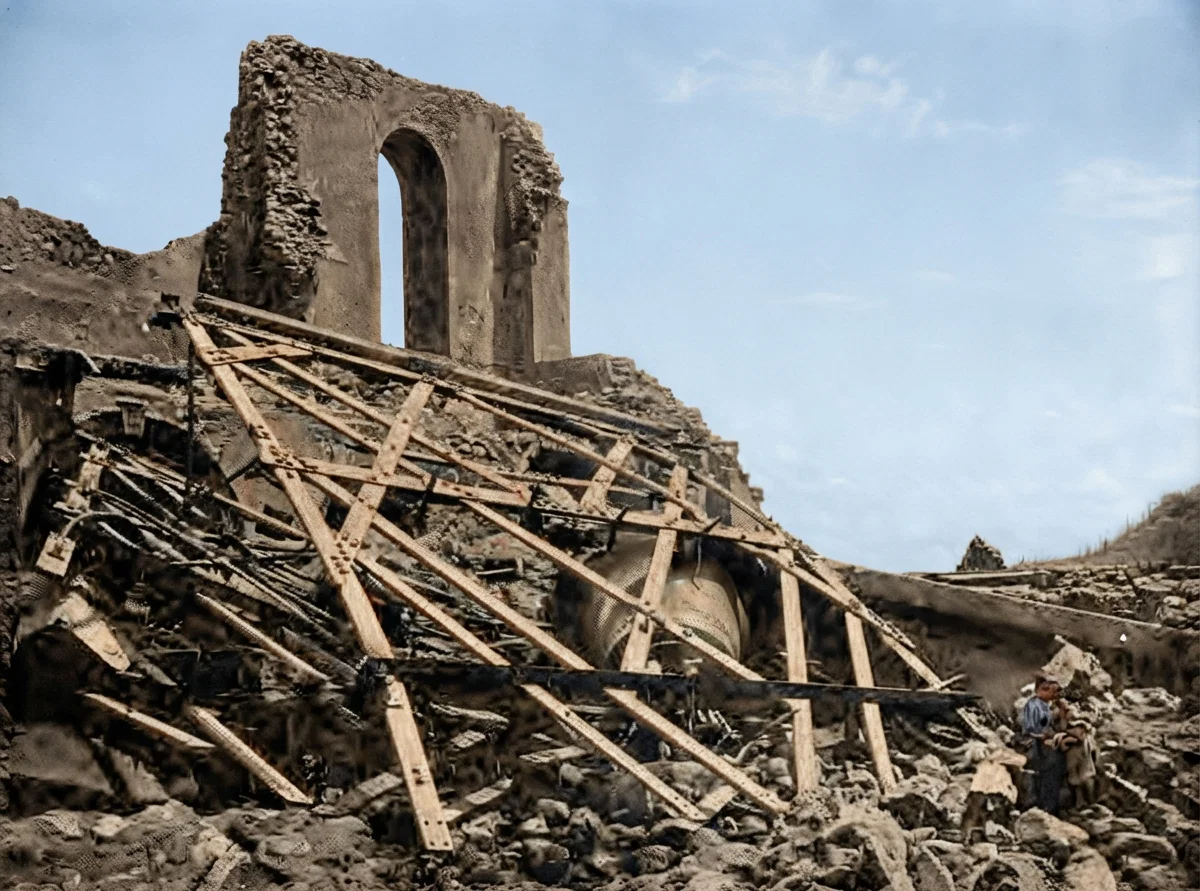
Ruins of Cathedral, Showing One of the Famous Chime of Bells. (See illustration on page 11.)
Pelee instantly killed its victims, and then proceeded to bury them by pouring down a shower of small stones and fine gray ashes. The first eruption occurred on the morning of May 8, and the second on the afternoon of May 20. The latter was more violent than the first. It shook to the ground such walls as had been left standing after the first shock, and added such a quantity of ashes that, with very few exceptions, all the bodies were completely buried. During our two-days' stay in St. Pierre, altho we visited all parts of the town, I do not believe we came upon more than a score of exposed bodies.
Leaving St. Pierre after this second trip, we returned to Fort de France, and immediately the Dixie started for Kingstown, on the island of St. Vincent, to deliver the balance of its stores for the benefit of the sufferers from the eruption of the Soufriere volcano. SAMUEL R. HONEY.