EVOLUTION AND GEOLOGY

3%

Pacific Press Publishing Company · Mountain View, California · Jan 25, 1905

FromSigns of the Times, Vol. 31, No. 4.

Read the full edition

EVOLUTION AND GEOLOGY

By Geo. McCready Price

VIII. THE EVIDENCE OF ARCHEOLOGY.

Part 11. Earlier Egypt. CONTINUING the subject of ancient Egypt as set forth in the previous article, I quote from another author:
"The civilization of Egypt at its first appearance was of a higher order than at any subsequent period of its history, thus testifying that it drew its greatness from a fountain higher than itself. It was in its early days that Egypt worshiped one only God; in the latter ages this simple and sublime belief was buried under the corruptions of polytheism. The greatest pyramids were built by the fourth dynasty, and so universal was education at that time among the people that the stones with which they were built retain to this day the writing of the workmen." — "Atlantis," p. 131, by Ignatius Donnelley.
When we consider the lofty ideals of the Egyptians as portrayed by their description of what they considered as justice between man and man, the motives they give as the basis of ethics, the high regard in which women were held among them, and their numerous examples of humanity in war, our minds are led back to that "fountain higher than itself" from which it drew its greatness. But their comparatively pure religion in the earliest days is even more conclusive proof of a very intimate connection with those who handed down the torch of truth from the long-lost Eden. On this point I present a quotation from the "American Encyclopedia" (Vol. VI. p. 463):
"In the early days the Egyptians worshiped one only God, the Maker of all things, without beginning and without end. To the last the priests preserved this doctrine and taught it privately to a select few."

The Hindus.

But in these things the Egyptians were not alone. Those marvelous books of the ancient Hindus, "embodying the earliest system of philosophy which we possess," reveal a similar state of affairs.
"The religion of the Veda knows no idols," says Max Müller; "the worship of idols in India is a secondary formation, a degradation of the more primitive worship of ideal gods."
The following also, from the Duke of Argyll, is to the point:
"We have found in the most ancient records of the Aryan language proof that the indications of religious thought are higher, simpler, and purer as we go back in time, until at last, in the very oldest compositions of human speech which have come down to us, we find the divine Being spoken of in the sublime language which forms the opening of the Lord's Prayer. The date in absolute chronology of the oldest Vedic literature does not seem to be known. Professor Max Müller, however, considers that it may possibly take us back 5,000 years. . . . All we can see with certainty is that the earliest inventions of mankind are the most wonderful that the race has ever made. The first use of fire, the discovery of the methods by which it can be kindled; the domestication of wild animals; and, above all, the processes by which the various cereals [oats, wheat, barley, etc.,] were first developed [?] out of some wild grasses—these are all discoveries with which, in ingenuity and importance, no subsequent discoveries may compare. They are all unknown to history—all lost in the light of an effulgent dawn."

Civilization an Inheritance.

To those who have never thought much along these lines it may not seem that the domestication of the horse, ox, sheep, goat, etc., and the cultivation of the grains, is anything very wonderful. But with a little further thought it will be seen that we have in these discoveries, or arts, or whatever we choose to call them, the broad and efficient foundations of civilized life, and without which civilization of any kind is impossible. But when we put with this the further fact that civilization is always an inheritance, that in no single case known to us has a savage race ever thrown off its savagery, and developed an agricultural life and a civilization of and among themselves, and without having learned it from some other people, we see the records of Genesis confirmed, and realize that man did not start on this world as a savage, but only a "little lower than the angels."
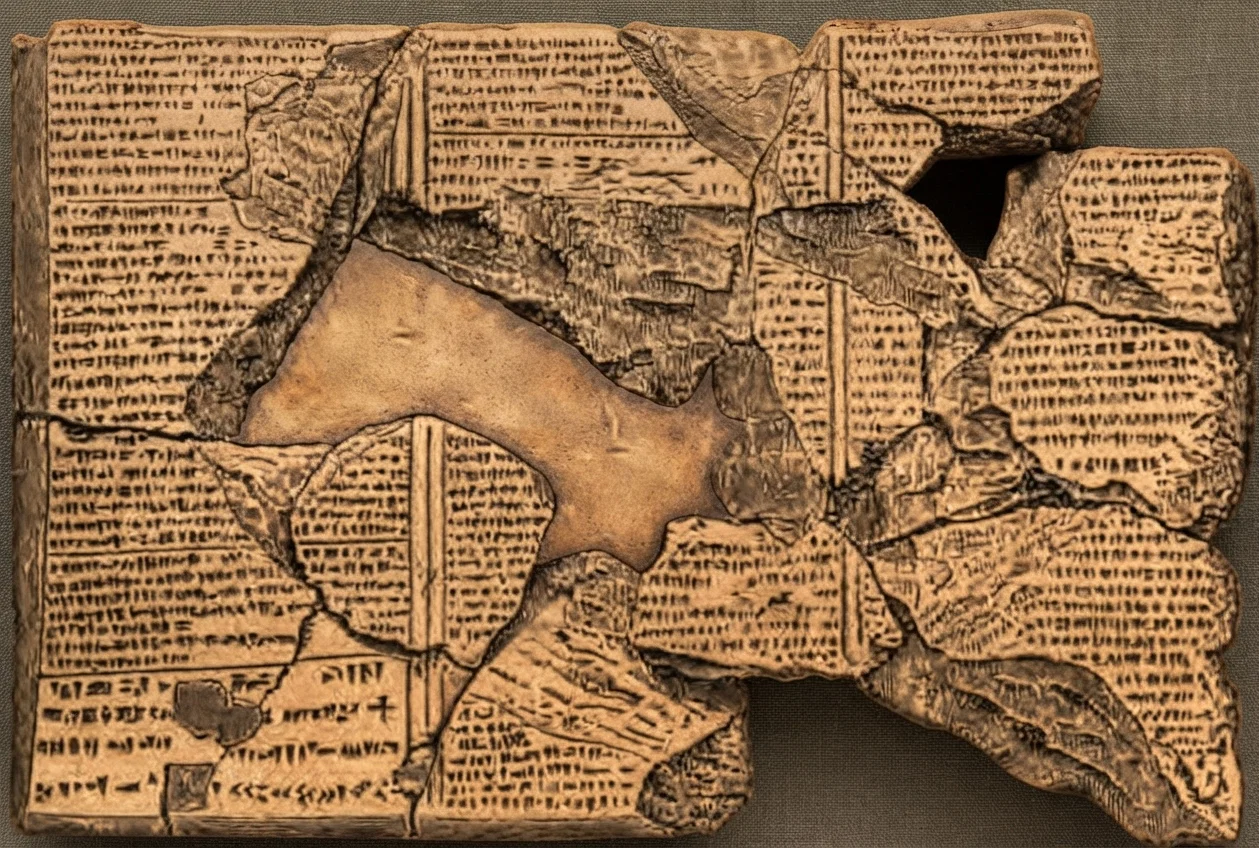
Back of Tablet with Account of the Deluge. A Chaldean Document. From "Chaldean Genesis," by Smith.

A Result of Character and Religion.

And the reason for civilization being always an inheritance and never self-originated, lies in the fact that moral development must come first. Civilization comes only as the result of character, not vice versa. The individuals of a people must acquire a certain amount of industry, perseverance, and self-control; they must learn how to work, and must exercise the determination to accomplish something before anything like civilization is possible. Thus civilization is the result of character training; character development is only the result of religious influences; and vital religion has never been self-originated by an individual or a people. As in biology life can come only from antecedent life, so are civilization and religion only received from those who already possess them.

Why No Advancement?

And since civilization is thus proved to be an inheritance, we see a reason why, for several thousand years, the nations made no advance on that received from the antediluvian world. The past century or so has witnessed a wonderful increase of knowledge and of mechanical power in the hands of man, as predicted in Dan. 12:4; but as we have seen, it is the result of Divine intervention for a special purpose, and is not in any sense the result of evolution or an inherent tendency to progress upward on the part of the race. If it had been the result of natural progress it ought to have come about somewhat gradually, and not be all crowded into the last minute fraction of human history. As it is, we know that up to about the age of Columbus the world possessed practically no arts, except that of printing (and this was then ancient in China), which were not known to the Babylonians, Egyptians, Assyrians, and Hindus.
In the words of Donnelley: "Phoenicia, Egypt, Chaldea, India, Greece, and Rome passed the torch of civilization from one to another; but in all that lapse of time they added nothing to the arts which existed at the earliest period of Egyptian history. In architecture, sculpture, painting, engraving, mining, metallurgy, navigation, pottery, glassware, the construction of canals, roads, and aqueducts, the art of Phoenicia and Egypt extended, without material change or improvement to a period but two or three hundred years ago." — "Atlantis," p. 130.

When the Domestication of Animals?

Returning now to the problem of the domestic animals and plants referred to in the above-quoted words of the Duke of Argyll, we have, I think, proof absolutely conclusive that they must first have been acquired by man in that vastly-more-favorable climate and soil of the ancient world, before the great catastrophe of the Deluge. The most common domestic food plants are not found wild in any spot on earth, and will not long survive without human care in any climate or soil that we now possess. Where did they come from, except from that old world, when, as Geology shows us, "the whole northern hemisphere enjoyed a kind of perpetual summer;" palms and other tropical plants grew in England; and luxuriant ivies, vines, oaks, walnuts, and magnolias grew in Greenland "within twelve degrees of the pole?" — (Nicholson, "Ancient Life-History," p. 310). I confidently affirm that no other explanation is possible.
Again I quote the words of one who felt the irresistible power of this argument: "Why is it that the origin of wheat, barley, oats, maize, and rye,—the essential plants of civilization—is totally lost in the midst of a vast antiquity? We have in the Greek mythology legends of the introduction of most of these by Atlantean kings of gods into Europe, but no European nation claims to have discovered or developed them, and it has been impossible to trace them to their wild originals. Out of the whole flora of the world mankind in the last seven thousand years has not developed a single food plant to compare in importance to the human family with these. If a wise and scientific nation should propose nowadays to add to this list, it would have to form great botanical gardens, and, by systematic and long-continued experiments, develop useful plants from the humble productions of the field and forest." — "Atlantis," pp. 177-8.
Mr. Donnelley thought something like this must have been done in his mythical island of "Atlantis," and it was only by the submergence of this land and the dispersion of the survivors that he could account for the simultaneous appearance in different countries of full-grown civilization. But we who believe the Bible will readily see in this theory only a parody of the true explanation, viz., that Noah and his sons brought these precious relics of the Antediluvian world safely over into this ruined one, and passed them along to their descendants.But again I quote from this author: "We can not consider all these evidences of the vast antiquity of the great inventions upon which our civilization mainly rests, including the art of writing, which, as I have shown, dates back far beyond the beginning of history; we can not remember that the origin of all the great food-plants, such as wheat, oats, barley, rye, and maize, is lost in the remote past; and that all the domesticated animals, the horse, the ass, the ox, the sheep, the goat, and the hog, had been reduced to subjection to man in ages long previous to written history, without having a conclusion forced upon us irresistibly that beyond Egypt and Greece, beyond Chaldea and China, there existed a mighty civilization, of which these states were but the broken fragments." — Ib. Id. p. 455.

Origin of Languages.

Very little more remains to be said about man's earliest history. I give two facts about the history of languages which, taken together, go very far to confirm the Bible record of Babel.
It must be recollected that language is not merely the conventional instrument of thought, but, to a great extent, its creator, and the mould in which it is cast. The mould may be broken, and races abandon old, and adopt new, languages by force of external circumstances, such as conquest, or contact with, and absorption by, superior races, but there is no instance of its being so transformed from within as to pass into a totally-different type. Nor can we very well see how root-words once attached to fundamental ideas, such, for instance, as the simpler numerals should come to be forgotten and new and totally-different words invented. — S. Laing, "Modern Science and Modern Thought," p. 102.
And yet this same author, evolutionist tho he is, is constrained to acknowledge that "the best authorities tell us that a list of fifty to one hundred languages could be made of which no one has been satisfactorily shown to be related to any other." — Id. p. 100.
No further comment on the above is needed here. They certainly confirm in a striking manner the record of Gen. 11:4-8, and are in accord with the old Babylonian inscription that "He [God] gave a command to make strange their speech," and that of Nebuchadnezzar, concerning "the most ancient monument of Borsippa," that "since a remote time people had abandoned it, without order expressing their words."

World-Wide Tradition of the Deluge.

I can not go into the subject of the world-wide traditions of the Deluge. The astonishing remains of antediluvian man found in the caves of southern France and elsewhere come rather under the head of Geology, and will be thus considered. My remarks on archeology are already too long, and all my readers know of the Chaldean Deluge Tablets, since the discovery of which no reputable scientist has denied that they must represent an actual fact which had burned itself into the memory of all the early races of the world. In the words of Lenormant, "Far from being a myth, the Biblical Deluge is a real and historical fact."
So much then for the testimony of history and archeology on the subject of Evolution. It is needless for me to sum up the matter by saying that they lend no countenance to this theory. Such a statement would be altogether too tame. Rather must we say that we could scarcely wish for more evidence confirming the scriptural record that "God hath made man upright, but they have sought out many inventions."
In our next articles we shall take up that phase of the general theory known as "Darwinism," or the bearings of "natural selection" on the origin of species among plants and animals.
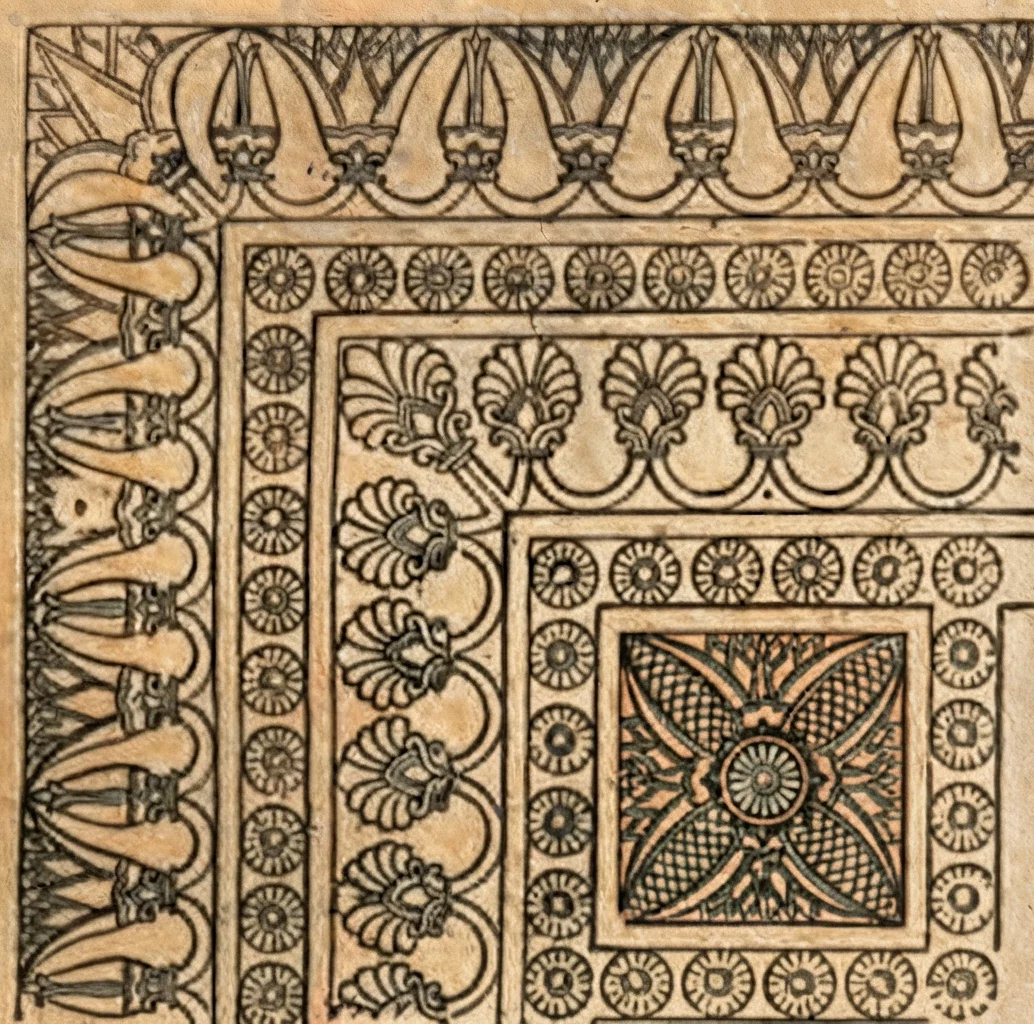
A Slab from the Ancient Pavement of Koyunjik, Assyria.