ALCOHOL; ITS HISTORY, AND ITS EFFECTS UPON SOCIETY.
By W. H. Riley
By W. H. Riley, M.D., Superintendent of Colorado Sanitarium, Boulder, Colo.
[All rights reserved.]
Economic Evils.
THE expenditure of such vast sums of money as go every year for alcoholic drinks is an important item for society to consider in connection with its own welfare and advancement. The investment of capital in useful industries, giving honorable and useful employment to the laboring classes, and increasing the wealth and civilization of the nation, is one of the greatest benefits of society. Plenty of useful, healthful employment brings the great mass of the people, those who form the strength of the nation, up to a higher plane, physically, mentally, and morally. In the absence of idleness, the temptations to crime are fewer, and poverty is not so prevalent. A feeling of harmony grows up between the various classes of society, and a step forward is taken to a better civilization.
The proper use of this capital brings material and permanent results. Not only are the wage-earners enabled to provide for the wants of their families and better their condition in life, but the results of this work remain in a substantial form. Conveniences and sources of pleasure are produced to satisfy the desires of society, and wealth increases. And as the desires of men are satisfied, new desires spring up, and the demand for labor increases.
If, however, a large amount of capital is invested in an enterprise which, altho it may give fair compensation to the employees and return the money invested, yet does not produce something, have some substantial result, society is a loser to the extent of what might have been gained. After all the labor of the workers, the employment of the money, and the use of time, nothing is to be seen as a fruit of this effort. Even tho the work has been honorable, and in no way detrimental to health or morals, yet there is a loss, and this loss affects the community. Such, in a measure, is the liquor traffic. Tho no money is lost, tho the country contains the same amount of gold and silver, yet no great public work or substantial private benefit stands as a product of the employment of this capital. So the money invested in the business is misapplied.
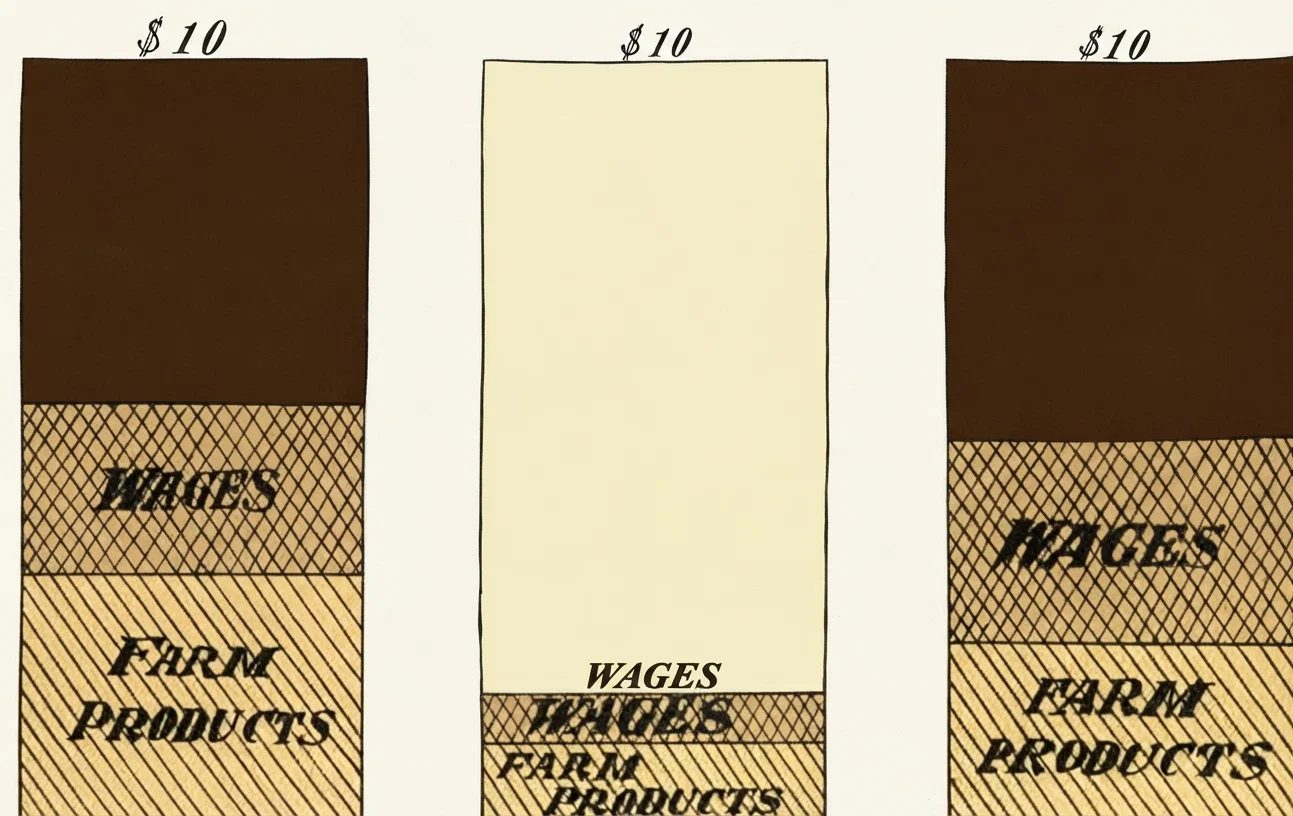
SPENT FOR BOOTS AND SHOES SPENT FOR LIQUOR SPENT FOR CLOTHING
But when we consider what a waste of means there is in the vast sum of one thousand million dollars spent yearly for drinks in our country, we see how society as a whole suffers from this habit. Society suffers to the extent of what this money might do if rightly used, and more. The education of the masses is not what it might be. The discontent of the laboring classes and the tendency toward socialism and anarchy, which at this very time portend much evil for the future, the prevalence of pauperism and crime, are all augmented by the waste of money for alcoholic drinks. True, this is by no means the one cause of these evils, but it augments the enemies of civilization and social progress.
The sober, industrious workman is affected by the drink habits of his fellow-workmen. Upon the wage-earners falls most of the expense for drink, and it affects them as a class. If intemperance were divided equally among them, the evil of which we speak would not be so great. A part of the wage-earners are sober and industrious, and another part are intemperate. Those who are intemperate are frequently incapacitated for work by their habits of dissipation, and when they are on duty their work is, on the average, of a lower grade than that of the sober man. The employer, looking over the general class of workmen, and estimating the value of their labor, will fix a wage which he thinks the poorer workmen will earn, and thus a sober workman’s wages are less than they would be were it not for the intemperate habits of his fellows.11
Again, $100 spent for distilled liquor pay in wages for the manufacture only $1.08, and for materials from other industries but $5.72, and give employment in manufacturing for but .61 day. On the other hand, if $100 be spent for boots and shoes, the sum gives employment for 14 days, pays in wages $22.50, and draws from other industries over $40 worth of materials. It is thus readily seen that if $100 be spent for boots and shoes instead of for liquor, employment is given to 28 men instead of 1, and other industries sell seven times as much material for the manufacture. Thus the money paid for boots and shoes helps the other industries far more than the same amount spent for whisky or beer.
The average of 27 representative industries, such as the manufacture of carpets, furniture, clothing, brick, iron, steel, lumber, leather, food, etc., shows that $100 spent for these commodities gives employment for 12 days, pays in wages $17, and draws upon other industries for $44 worth of material. Hence, if the $1,180,000,000 spent annually for liquor in the United States were spent instead for such staple articles as are mentioned above, it would give constant employment to 725,000 men in the manufacture alone, and would demand from other industries over $500,000,000 in materials, thus giving employment to 250,000 more workmen.
"Three workmen leave the shop Saturday night, each with a ten-dollar bill in his pocket to show for his week's labor. One spends his money to supply his family with boots and shoes; one buys a suit of clothes, and the third 'blows in' his money in a glorious drunk at the saloon. Besides the important difference that two men go home sober, and with their arms full of valuable goods, while one goes home a brute and empty-handed, there is the further difference that the spending of the money has upon other workingmen and the farmer whose labor produced the goods. What this difference is, is shown by the diagrams, each of which represents the value of a ten-dollar bill.
"Of the $10 that went for boots and shoes, tracing it back through the shoe factory and the tannery, it is found that $2.89 went to pay the farmer for his hides, and $2.91 went to the tanners and the shoemakers.
"So with the $10 that went for a suit of clothes, $2.28 paid the farmer for his cotton and his wool, and $2.77 went for wages to the spinner, the weaver, and the tailor. But of the $10 that was spent for beer and whisky, only 96 cents went to the farmer for his grain, and 38 cents to the men whose work produced the liquors.
"The farmer and the wage-earner received $5.80 from the man who spent his money for shoes, $5.05 from the man who spent his $10 for clothes, but only $1.34 from the $10 that went to the saloon. In each case the rest of the $10 went to pay transportation, rent, interest, taxes, profit, and cost of retailing.
"Every time a ten-dollar bill goes to the saloon instead of for shoes or clothing, the farmer and the wage-earner are losing about $4.00. There are about 100,000,000 of these ten-dollar bills squandered in the saloon every year, which means a loss to the farmer and the workingman of $400,000,000, to say nothing of the millions more that would go to the railroad men and the retail clerks, but which is now swallowed up in profits by the liquor men.
"The facts upon which these figures are based are from the census of 1890."—Prohibition Handbook.