HOW good it seemed to see land again, tho we had been away from the shores of New Zealand but four and a half days! Peeping through the porthole long before daylight I could see that we were passing one of the islands of the Fiji group. The next morning the island of Viti Sevu (Big Fiji) was in plain sight, its rugged broken peaks covered with tropical vegetation. Soon we could smell the odors from the trees, which furnished a delightful contrast to the steamer smells.
In a little while we were at the wharf in Suva, the capital of the group. Nearly nine years before this we landed at this same place from our missionary ship "Pitcairn." At that time we knew not a single person in the group; this time I found quite a company of native brethren and sisters who are "looking for that blessed hope, and the glorious appearing of the great God, and our Saviour Jesus Christ." How good it seemed, in the midst of the prevailing iniquity, in an island group which a few years ago was noted for its savagery, to find a little company meeting together on God's holy Sabbath to celebrate the work of creation!
Soon after reaching the wharf I was warmly greeted by Elders Fulton and Parker, our resident missionaries, who were accompanied by Brother Ambrose and Brother Pauliasi. The former is a roko, or high chief, of Fiji, and the latter a native minister.
Only a few months ago Brother Ambrose was noted for his intemperance and generally wicked ways; now every one testifies that something has made a wonderful change in his life. Wherever he has opportunity he tells of what "the truth" has done for him. Brother Pauliasi was an ordained minister of the Wesleyan Church, having spent ten years in mission work among the savages of New Britain.
As soon as he learned by the study of his Bible of the glorious truth of Christ's soon coming, he unhesitatingly accepted them, and now preaches them as the way opens.
The mission home is located across the bay from Suva, at Suva Vou (New Suva), where we found Sisters Parker and Fulton at work in the schoolroom, surrounded by a little group of half-naked Fijian children.
From the native village a few rods away several of the brethren and sisters came to greet me with warm handshakes, and bade me welcome to their homes. Very few could speak English, but I was not in any doubt about their kind feelings toward me.
Being very weary from loss of sleep on the steamer, after a little while I asked the privilege of taking a nap, but soon after lying down, I heard soft footsteps on the veranda as one after another the barefooted natives came to greet me. So the nap had to be given up for that time.
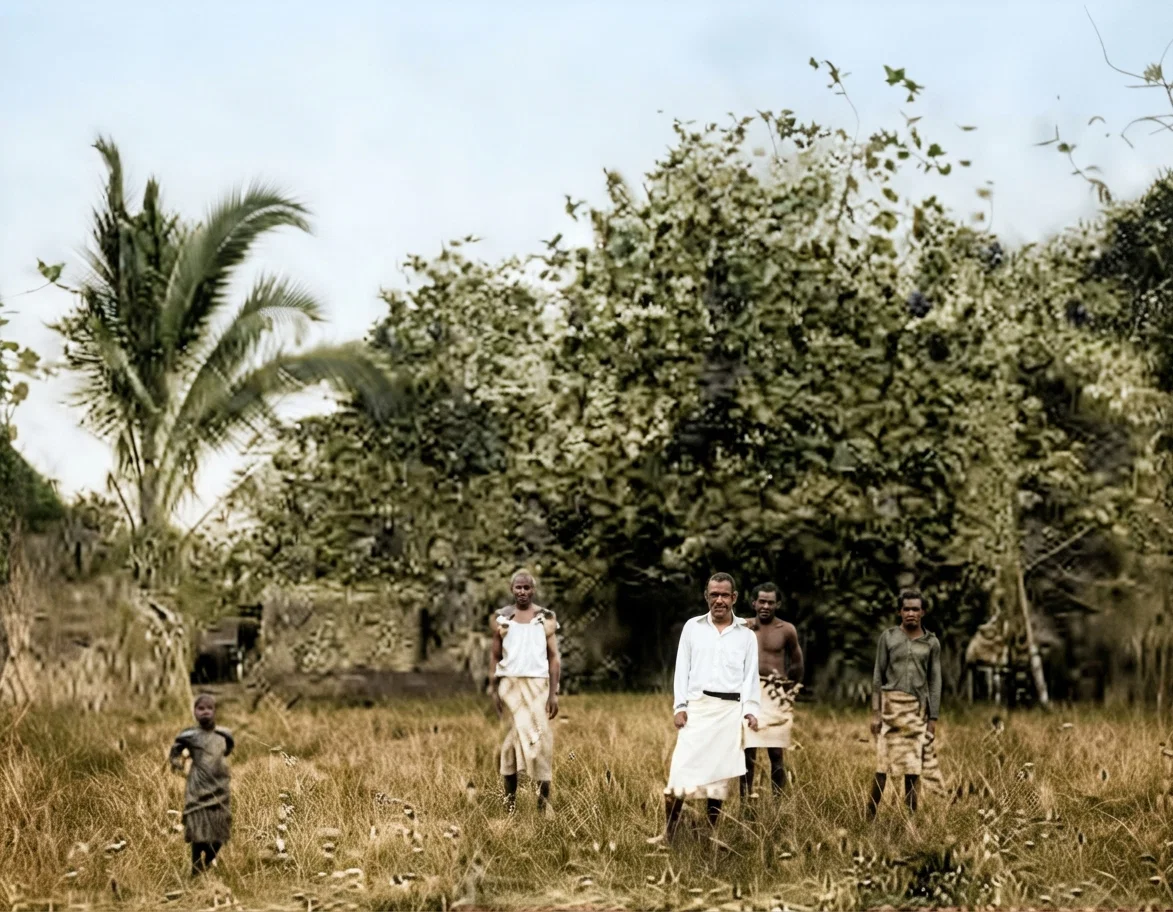
Group of Fiji Natives. Ambrose, the roko, central figure in the foreground.
My first Sabbath with this company was to me a very interesting occasion. The first service of the day was a prayer-meeting about sunrise. At 9:30 the lala (a log hollowed out and used as a bell) was sounded to call the people to Sabbath-school. A little before 10 a few English songs were sung by the mission family, and at 10 the school began with the singing of a hymn which had been translated into Fijian by Brother Fulton, and printed with a typewriter. A small book of hymns, set to music, will soon be printed in the native language. After a prayer in Fijian, all together chanted the Lord's prayer.
After another song and a review of the previous Sabbath's lesson, the school separated into classes, the adult class taught by Brother Pauliasi, the young men and women by Brother Parker, while Sisters Parker, Fulton, and Guilliard instructed the little folks. All seemed to take the deepest interest in the study of the lesson.
The greatest reverence is shown for the house of God, the most perfect order and quiet being maintained by all, even the little children kneeling in silent prayer before seating themselves on the mats spread on the floor.
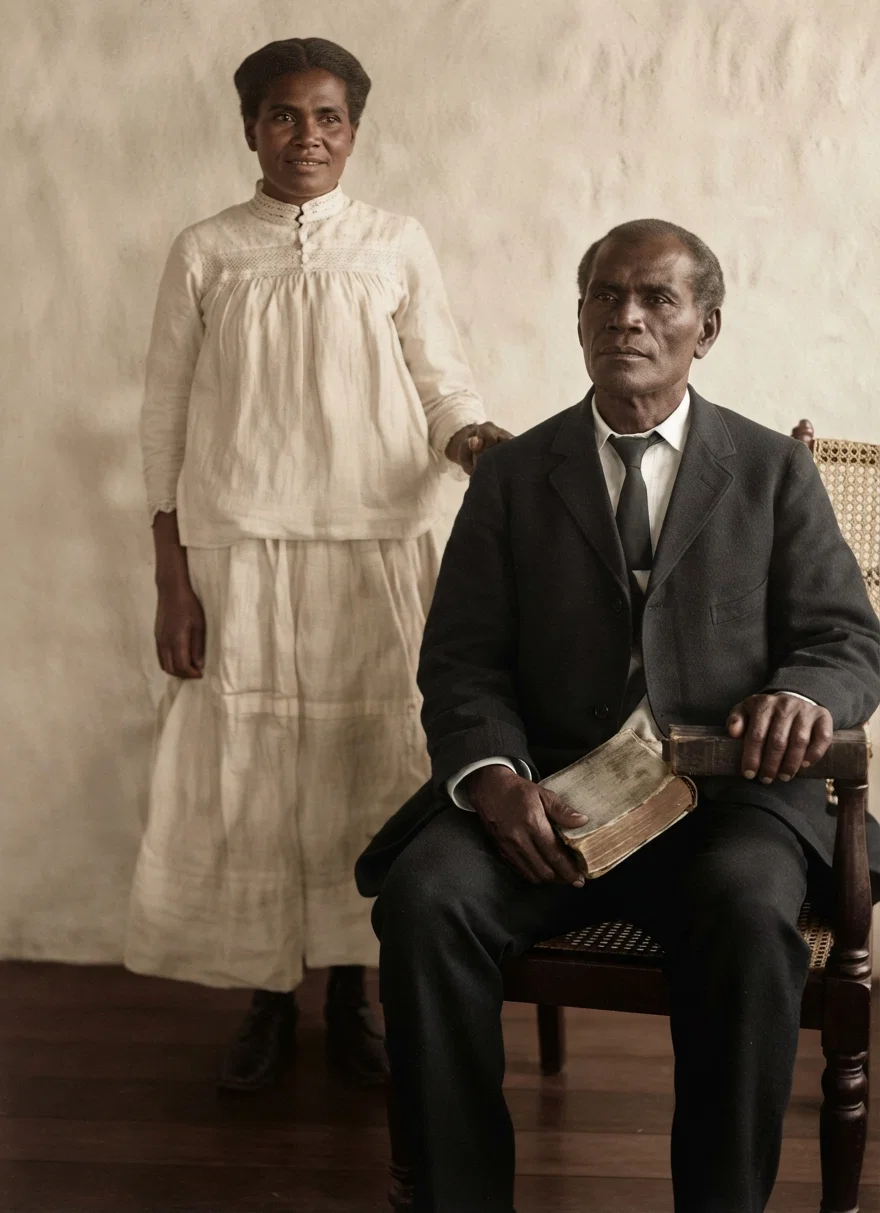
Tho the Fijians usually wear nothing but the sulu (a strip of cloth reaching from the waist nearly to the knees), I noticed that on the Sabbath all clothed the upper part of the body with neat, clean apparel. With the men this was usually a thin undershirt, tho a few wore white shirts with starched bosoms and collars. Nothing is ever worn on the head or feet. Brother Ambrose wore a neat tailor-made coat of some good, light-colored material, and a sulu made of cloth of similar appearance. Brother Pauliasi was dressed in a white sulu reaching nearly to his feet, and a long, black, clerical-looking coat. The women wore a sulu made of common calico, reaching below the knees, and over this a loose garment resembling a man's shirt, made with a yoke. Everything was neat and clean. I noticed that a few of the women wore dresses like those worn by white women, but looked stiff and awkward in such garments.
Pauliasi and Wife.
The children wore clothing like that worn by the older people, but one of the boys wore a common bath towel for a sulu.
After a short intermission I spoke to them a little while through Brother Fulton, who interpreted. At this service all followed the discourse closely, many turning to the Bible texts, while some wrote them down.
All the children sat directly in front of the pulpit, and were as quiet and orderly as any children I ever met.
Apparently they showed as much interest in the sermon as the parents.
At 3 P.M. another preaching service was held, and at sunset a prayer-meeting closed the Sabbath. The natives never tire of religious meetings, no matter how long they are held nor how frequently. E. H. GATES.