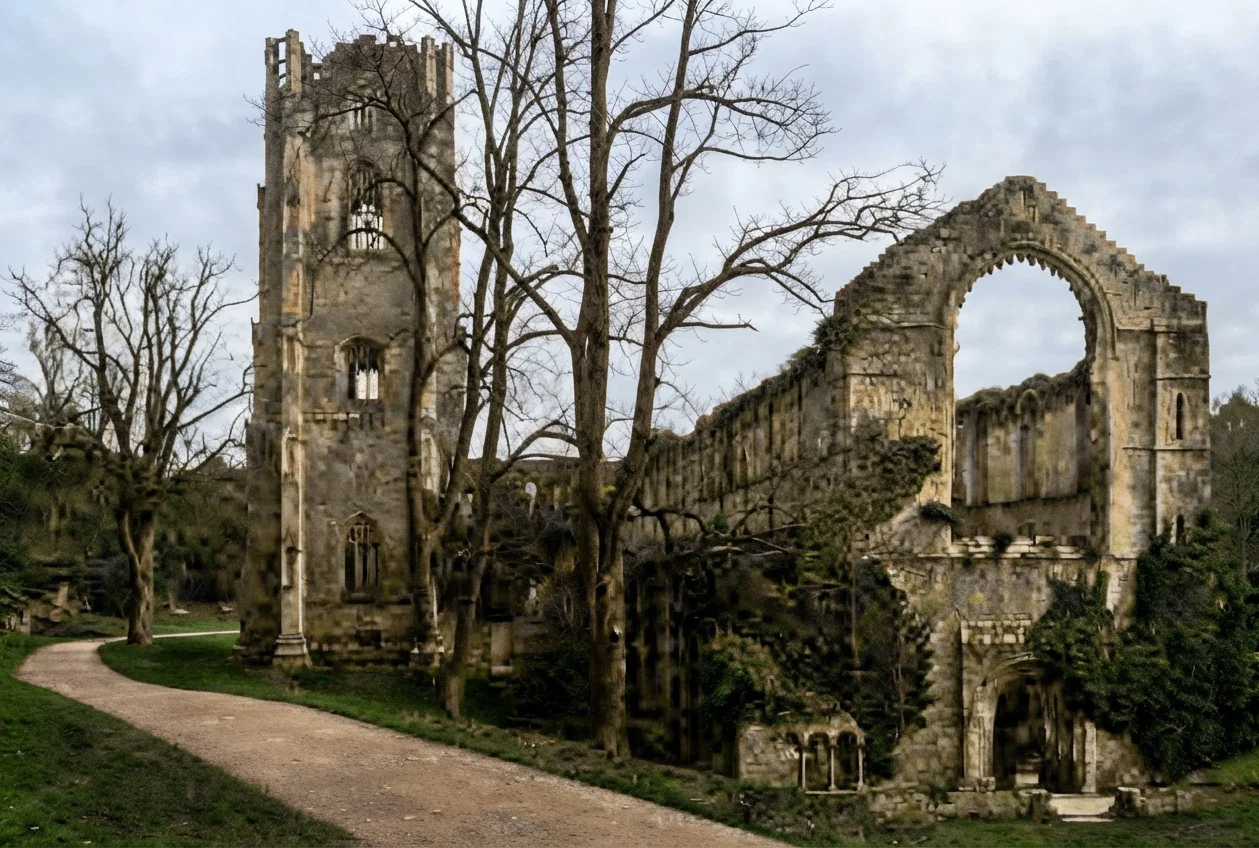
A LITTLE to the north and west of York, the county seat of Yorkshire, England, are the famous old ruins of Fountain's Abbey. It was builded not only on the banks of the River Skell, but across it, the buildings being on both sides of the stream. Our illustration presents the west front and tower. It is one of the largest and best preserved in England of the houses of the Cistercian order of monks.
FOUNTAINS ABBEY WEST FRONT AND TOWER
THE Cistercians (named from the original convent in the forest of Citeaux, near Beaune, France) were a religious order, of the rule of Benedict, founded by Robert of Molesme in 1098. When the order began, its devotees exercised more austerity than either the Benedictine or the Cluniac monks. Their fare was at first coarse and scanty, limited a great part of the year to one meal a day; a great amount of silence was imposed; the dress was very plain, the churches unadorned. The order spread rapidly, especially under the influence of Bernard of Clairvaux, till "it governed almost all Europe both in temporal and spiritual concerns." Within a hundred years it possessed 800 rich abbeys in different countries of Europe, each abbey embracing many benefices, that of Morimond alone possessing 700. The parent abbey of Citeaux had dependent upon it 1,800 monasteries and as many nunneries. The rigid rules of the order came largely from Stephen Harding, an English monk.
Its popularity was very great among all classes from princes to peasants. With popularity came great wealth and untold corruption. This was said to be especially true in England, where, in the time of the Reformation, so many of the houses were laid in ruins, the abbots judicially murdered, and the monks scattered. But this has been thought deserving, as Carlisle remarks that nothing is crushed from without that is not ready to perish from within. Certain it is that the order which was founded on the severest ideas of self-denial had waxed rich and luxurious. The house of the head of Fountain's Abbey was said to be "at the time of its erection the most spacious house of a subject in the kingdom, not a castle." The hall of the abbot's house (not the Abbey) measured 70x170 feet; the kitchen 38x50 feet. As Dean Milman declared: "The superior, once
a man bowed to the earth with humility, care-worn, pale, emaciated, with a coarse habit bound by a cord, with naked feet, had become an abbot on his curvetting palfrey, in rich attire, with his silver cross before him, traveling to take his place amid the lordliest of the realm."
BUT the great building made by hands, showing forth the glory of man, is now in ruins. Nave and transept, choir and chapel, tower and cloister, as well as prisons, are now empty and silent, save as the walls echo the voice of curious travelers. It is magnificent in its ruins, and speaks only of departed glory.
IT is well that it is so. It is well that there should be kept before us many of earth's mightiest monuments in ruins. It is well for men to see the ruins, that they may know that the things upon and within which so much of humanity have built their hopes are transitory and perishing. These are God's providential waymarks of warning to the ambitious who come afterward. Why place as a sacrifice upon the consuming altar of such ambition heart and mind and soul, to be consumed for that which so soon perishes? Why make a building that which will be the mausoleum of2all that is noble in man, even tho his body is buried elsewhere?
THERE is a better temple which under God all may build—the temple of enduring character. Its foundation is Christ Jesus. Its stones are noble, love-wrought deeds for the sake of the Master. Its cement is the life-force of divine truth which binds superstructure to foundation rock in one living, growing temple. From base to tower top, through nave and transept, choir and cloister, are the stones of truth, polished with the love of self-sacrifice. The superior of that temple is the Spirit of God. The rules for its members are the words of God. Not always sightly and beautiful is it here in the building; that is true of earth's grandest structures. But it is growing; and in eternity, when the building is finished, it will shine forth as the sun in the kingdom of our Father.
EACH temple of character, a beautiful, holy structure of itself, is but a constituent part of the greater, everlasting temple of Jesus Christ, of which He is the glorious Head, and of which the individual temples of character of all ages form the body and members. The great Master-Builder has been gathering out the stones from all the quarries of earth,—hewing, cutting, turning, testing, smoothing, polishing, by trial, by furnace heat, by heavy blow, by long, continuous, adverse environments, by obstacle, by all the various vicissitudes of life, by co-operation, till each reflects His beauty. Soon, praise God, the work will be over; the last shining stone will be fitted for its place; and His temple, His church, reflecting in herself all His glorious beauty, will be presented before the Father "not having spot, or wrinkle, or any such thing; but" "holy and without blemish;" not to fall into ruin, but to be an everlasting living monument of Christ's triumphal glory over sin.
SOUL, you may have a part in that glorious structure. "Know ye not that your body is a temple of the Holy Ghost?" God so designed it, a dwelling-place for Himself. Will you fill the temple of God with idols? Will you place Self on the throne of Love? Will you let Unrighteousness rule in the place of Righteousness? Will you choose Belial or Christ? O, in the light of all God's blessed promises, "let us cleanse ourselves from all filthiness of the flesh and spirit, perfecting holiness in the fear of God." "If any man defile the temple of God, him shall God destroy; for the temple of God is holy, which temple ye are." Let Christ Jesus in; let Him build, hew, polish, test, refine, till His beauty and life show forth from every side. So shall you be an eternal temple of beauty in a world that shall know no ruins.