CRYSTALS

6%

Pacific Press Publishing Company · Oakland, California · Feb 26, 1902

FromSigns of the Times, Vol. 28, No. 9.

Read the full edition

CRYSTALS.

OVER the ice go the skaters, little dreaming, perhaps, that they are having their enjoyment upon this solid water only because of the wonderful laws of crystallization. Crystals are far more numerous than is generally supposed. It is said that all the solid materials of the globe in their inorganic state are crystalline in grain, so it is no exaggeration to say that the earth has crystal foundations. In their perfection, the elements of all compounds are crystals. Thus the diamond is carbon that is crystallized. It has been thought that if oxygen could be reduced to a solid state, it would have no rival among nature's gems.
All of the metals crystallize. Now, what are crystals? In a previous article I said that plants grew from within and stones from without. Plants and animals grow by division, and thus the increase of the number of cells. Stones grow by the accretion or addition of particles of the same matter, but in the formation of crystals there is just as definite a law as there is in the formation of animals. We recognize that all the animal kingdom is formed according to some definite law—that nothing is done in a haphazard manner; and that if there are any misshapen creatures, it is due to the fact that nature's law has not had its opportunity to work. In the vegetable kingdom when we plant a certain kind of seed or a certain variety of a kind, we expect to get in return the same variety. So positive and so definite is our dependence upon this law of nature, that we can definitely count on the color of the kind we are to receive from the seed sown. We can plant corn of a certain color, and know that we are to receive corn of the same color.
In the inorganic kingdom—and by that we mean all that is not included in the animal or vegetable kingdoms, which are called the organic kingdoms—a specific form and structure belongs to each species. Definite laws govern the formation of each species, so that it may very properly be said that animal, plant, and crystal are the three kinds of structures in nature.
I said that the skaters, as they glide over the ice, think very little of what a wonderful law has been at work to produce this ice they are so enjoying; but the word "crystal" is appropriately derived from a Greek word meaning "ice," and the water is solidified by its being turned into a mass of crystals.
There are four modes of crystallization, and they each require freedom of movement among the particles which are being crystallized. The first mode of crystallization is that from solution, where some solid is dissolved, and thus the particles are set free so that this necessary movement can take place. The crystallization of sugar and alum when in solution is an example of this method. The second means is that of the removal of heat. It is thus that water becomes ice, and the water-vapor snow. Melted lead and sulphur (and other substances), when cooled, may come out in perfect crystals.
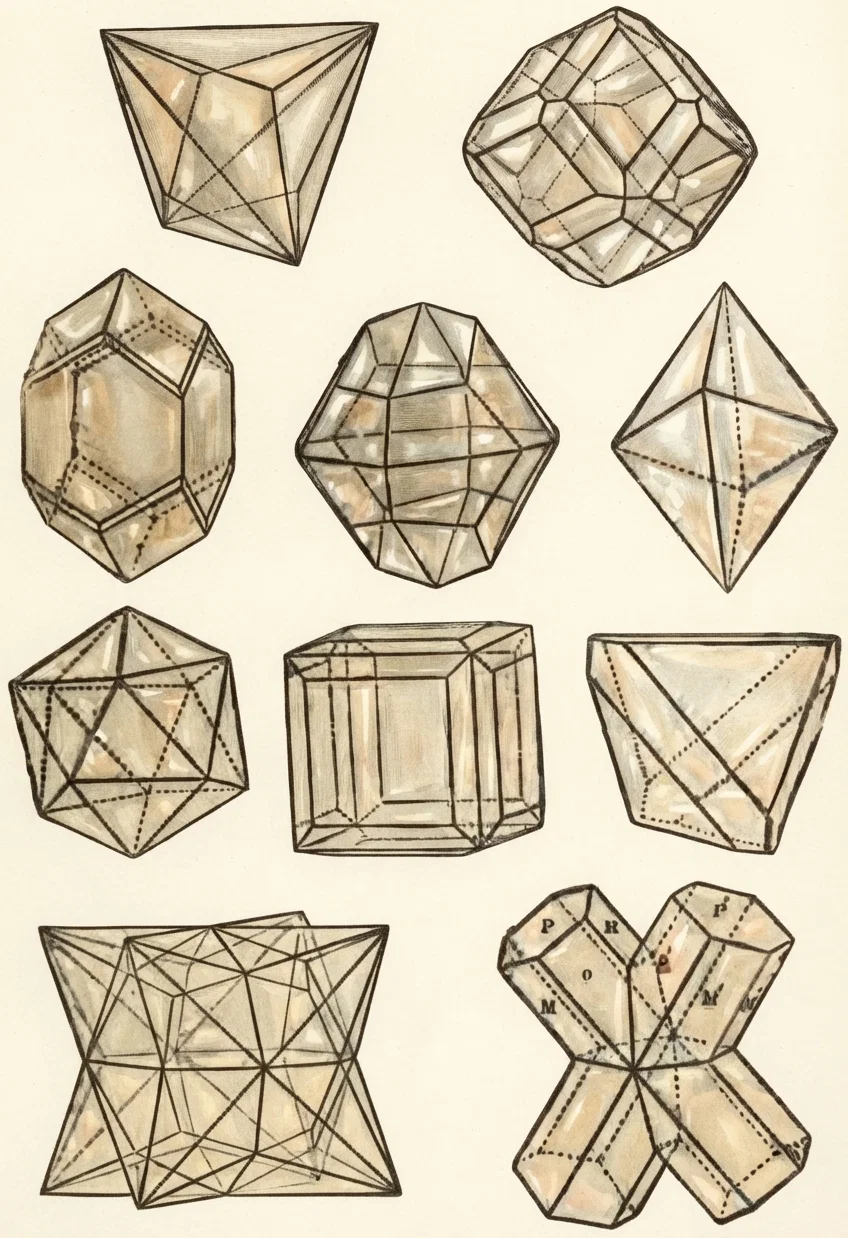
Illustrations of nature's work in the formation of crystals—typical forms and combinations.
The third mode is that of long-continued heat. Heat has crystallized beds of earth-sediment, and thus changed them into crystalline forms. The fourth mode is that resulting from the combination of certain elements of a compound. At the moment of the combining of these elements, the crystallization takes place.
I have spoken of ice as the result of crystals in the freezing of water. There is first a sheet of ice which is made by the prisms shooting out over the surface of the water. Then as the cold continues, these prisms shoot downward, and the ice is increased in thickness by their additions to the under surface. Consequently the ice is columnar in its structure, tho when we examine it in a firm state we do not detect this; but when the ice begins to melt, these columns are very distinctly seen. In some lakes, such as Champlain for instance, the ice quite invariably melts in such a way as to make these prismatic columns very decided. Even when it is yet strong enough to support a horse and sleigh, as the horse is traveling along his foot may occasionally strike through the ice, driving down some of these columns. When the ice gets into this condition, very often a strong gale will break it up entirely even during a day.
It will be a most interesting and profitable experiment to watch the process of crystallization. Several small bottles may be provided of about the same size. Fill each one nearly full of cold water, and label it according to the substance which is to be placed therein. Place in each bottle one of the following substances: common salt, saltpeter, washing soda, copperas, blue vitriol, sugar, and alum. Of course no one will have all of these materials on hand, but they can be purchased for a few cents at the druggist's. Drop a small amount of these substances, pulverized, into the different bottles, and notice what becomes of them. After having put in some that is powdered, put in some in the lump form. It will be interesting during the dissolving to note the temperature of the water by means of a small thermometer. Continue this addition of these minerals to the water until they begin to settle in the bottom of the bottles. Then gradually warm the water by placing the bottle in a warm bath. Do not heat it too quickly, and it will not crack. Notice that the substances which were resting on the bottoms of the bottles have disappeared, and more can be added. Why is it that when the water warms, more of these minerals can thus be added?
Now our liquids are ready for the process of crystallization. Pour a little of each of the above solutions into shallow dishes, and set them aside until the liquid evaporates. Then suspend a string in the solution remaining in the bottle. Observe whether the crystals which form in the solution remaining in the bottles are different from those which remain in the shallow dishes after the evaporation. Do these solid forms in crystals differ from the material which we placed in the water to be dissolved? Take some of the solutions and evaporate them by boiling. Does the rate of evaporation in any way affect the formation of crystals? Are the crystals which form from the various substances all alike?
If one can watch the process of crystallization by placing some water under a good microscope, he will see a very wonderful process taking place; for the various particles of matter, such, for instance, as the salt which had been placed in solution, are each coming to their particular places to form the crystals. The various particles of matter seem to have a definite place in every crystal, and march directly to that place as tho they were intelligent in their action. They even cross each other's path as they go to their place in the crystal. Here is a wonderful law of the Creator. We wonder and are amazed at the process of growth as we see it in the animal and vegetable kingdoms, and we likewise wonder and are amazed as we watch this process of growth and development in the mineral kingdom. Throughout the crystal that is thus formed, each particle of the internal structure is directly related to the external form. The various forms of crystals belong, mathematically speaking, to six systems of crystallization.
I said a little ago that the earth might be said to rest on crystal foundations because all metals do crystallize, but I afterward indicated that it was necessary to have one of four conditions present before they would do this. So while it is true that all metals do crystallize under certain conditions, yet because of the absence of these conditions we generally do not find the metals in these forms. But when the conditions are present, the particles operate according to the wonderful law of which I have spoken; that is, each molecule comes to its particular place to form the solid whole. Then we find these metals in their crystalline form.
The most perfect crystal, probably, which we have is that of the diamond. Crystals have been called the flowers of the mineral kingdom. Such they truly seem to be; for they are to be found in all colors, and permanent colors they naturally are too.
I should not omit to speak of the form of crystallization which sometimes takes place in the petrifaction of various substances of the vegetable kingdom. In certain portions of the West a chemical called silica is found in compound in the water and even in the air. As this acts upon wood which may be brought in contact with it, it changes its texture or its structure in such a way as to crystallize it, making it capable of taking a very high polish. It will thus present most wonderfully beautiful colors.
While we do not most readily observe these wonderful workings of our God in these solid formations, yet the investigation and study in these lines will amply repay all effort. So this experiment which I have suggested to the parents for the children may be a very profitable lesson.
So. Lancaster, Mass. FREDERICK GRIGGS.