Editorial

10%

Pacific Press Publishing Company · Oakland, California · Nov 25, 1897

FromSigns of the Times, Vol. 23, No. 46.

Read the full edition

Editorial

The Voice of the Deep.—It is impossible that any one who is acquainted to any degree with the Lord should stand by the sea without being reminded of the mighty power of the Creator. Yet many gaze upon the sea day after day with never a thought of its Maker, and even openly defy him.

God's Power.—To such the Lord says: "Hear now this, O foolish people, and without understanding; which have eyes, and see not; which have ears, and hear not: Fear ye not me? saith the Lord; will ye not tremble at my presence, which have placed the sand for the bound of the sea by a perpetual decree, that it can not pass it; and tho the waves thereof toss themselves, yet can they not prevail; tho they roar, yet can they not pass over it?" Jer. 5: 21, 22.

His Faithfulness.—But it is not in order to produce fright that the Lord reminds us of his mighty power, that can set bounds for the sea, so that it can not pass over in its fiercest tumult. No; it is that we may trust him. Perfect faith and love drive fear away. So the power of God over the sea is referred to as evidence of his faithfulness. "O,
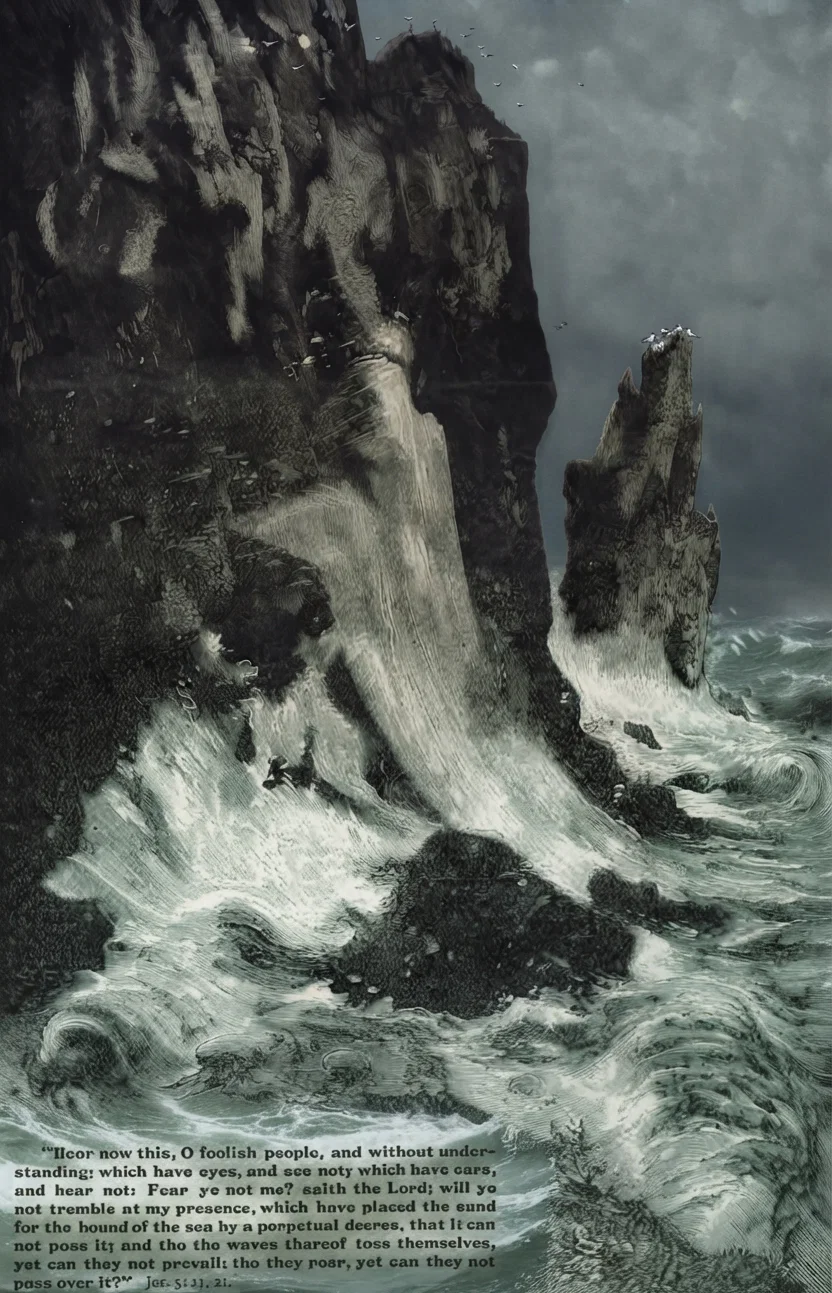
"Hear now this, O foolish people, and without understanding; which have eyes, and see not; which have ears, and hear not: Fear ye not me? saith the Lord; will ye not tremble at my presence, which have placed the sand for the bound of the sea by a perpetual decree, that it can not pass it; and tho the waves thereof toss themselves, yet can they not prevail; tho they roar, yet can they not pass over it?" Jer. 5:21, 22.
Lord God of hosts, who is a strong Lord like unto thee? or to thy faithfulness round about thee? Thou rulest the raging of the sea; when the waves thereof arise, thou stillest them." Ps. 89: 8, 9.
An example of this faithfulness is given in the description of the storm at sea, when the terrified disciples awakened Jesus and he "rebuked the wind, and said unto the sea, Peace, be still. . . . And there was a great calm." This was but the manifestation of the original creative power. He who created the heavens and the earth, the sea, and all that in them is, retains full control over all. In those words, "Peace, be still," we hear the same voice that said, "Let the waters under the heaven be gathered together into one place." And this is the Word which by the Gospel is preached to us; so we are to learn from God's power over the sea, which is his because he made it, his power over the waves of strife that surge through human hearts.

Peace in the Heart.—For the angry sea represents the wicked. "The wicked are like the troubled sea, when it can not rest, whose waters cast up mire and dirt." Christ is our peace. The word which he spoke to the Sea of Galilee that night is the word which he speaks to us. "I will hear what God the Lord will speak; for he will speak peace unto his people, and to his saints; but let them not turn again to folly." Surely here is comfort for those who have long struggled in vain with fierce passions.

Saving Forever.—Not only is God's power over the sea a symbol of his power to save men from the tide of sin, but it is also a pledge and surety of their final complete deliverance. It also shows the power with which God is going to clothe the preaching of the Gospel message in the last struggle preceding his second coming. Read the soul-thrilling words of Isaiah 51: 9-16. E. J. W.

"T H E floods have lifted up, O Lord, the floods have lifted up their voice; the floods lift up their waves. The Lord on high is mightier than the noise of many waters, yea, than the mighty waves of the sea."