Untitled article

9%

Pacific Press Publishing Company · Oakland, California · Nov 25, 1897

FromSigns of the Times, Vol. 23, No. 46.

Read the full edition

JOTTINGS FROM RUSSIA. NO. 1.

JUDGED by the course of events and the attitude of the other “great powers” of Europe, Russia occupies the first place among the nations of earth. After the leading nations of Europe, headed by England, had, during many tedious months, vainly attempted to bring the sultan to terms on account of the Armenian slaughters, Russia quietly took matters in hand, and, with one adroit sweep, “scooped” for herself decided benefits, leaving the other powers outside to look on and wonder. From that time it seems as tho the leading powers have made special efforts to court the favor of the czar.
The course of France in this direction is known to all. When the first step towards an alliance was taken, and the Russian marines visited France, the latter nation went nearly wild with enthusiasm; and when President Faure visited Russia, and the bare word alliance was uttered in a toast by the czar, the French, who had been waiting in breathless suspense to hear the word, burst forth again in uncontrollable ecstasy. Meanwhile England had made some advances towards greater friendship with Russia, and Germany has taken special pains to revive and cultivate the former good relations between the courts of St. Petersburg and Berlin. This general effort to court the favor of the czar is a confession of the estimate which these powers place upon Russia.
And the powers are not mistaken in their estimate. Russia is a great nation and possesses wonderful resources; and these resources are being rapidly developed. In general, marked improvement can be observed. Since my first visit to this country six years ago decided changes for the better have taken place. Russia is “coming up” fast. There are great possibilities before the nation. Russia is practically independent of the rest of the world. She possesses in resources everything that a nation needs. And when it is considered that she is just beginning to develop these resources, one involuntarily asks, What will the nation yet become if time permits their full development?
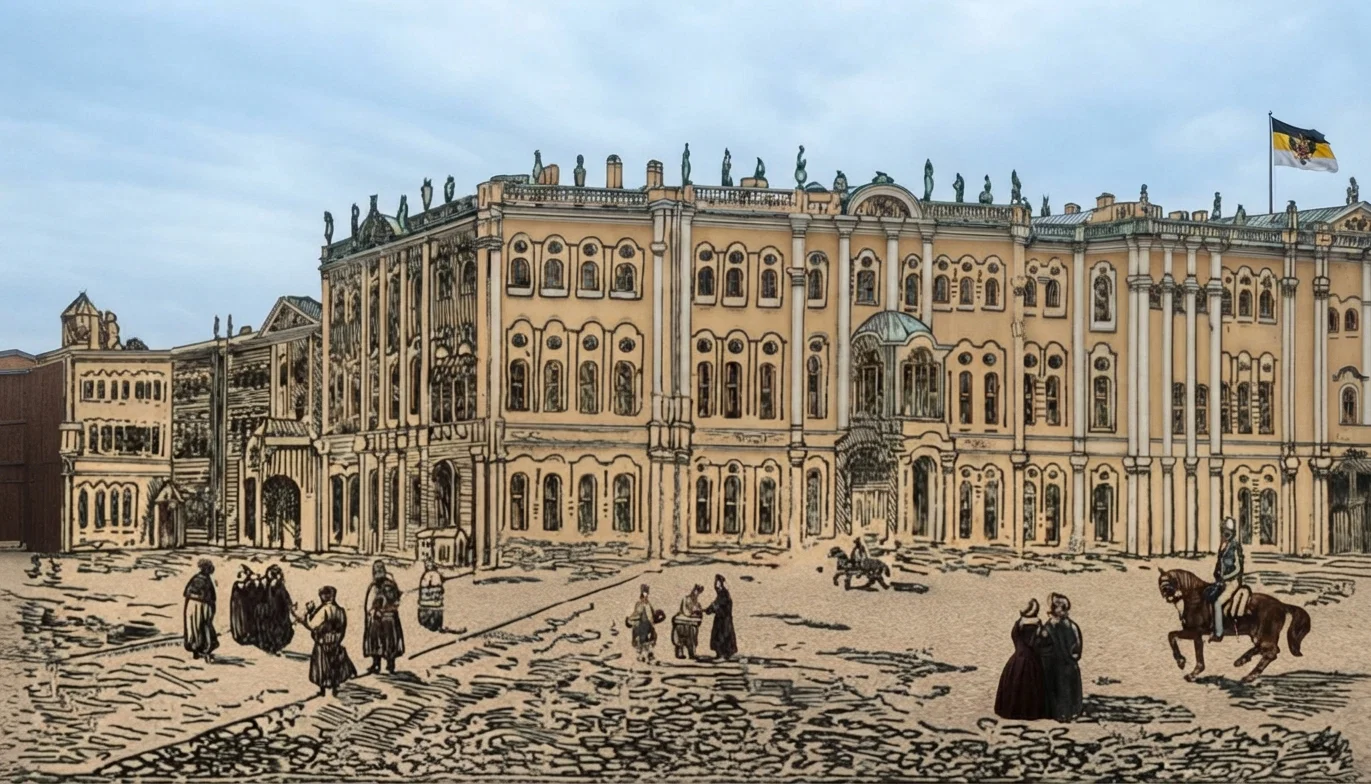
WINTER PALACE, RESIDENCE OF THE ROYAL FAMILY, ST. PETERSBURG.
It is also a fact worthy of note that the Russians were but recently emancipated from a sort of slavery, and the masses are just emerging from their former ignorance and inefficiency. It is hard to start great masses in the direction of improvement, but when once under way they advance with accelerating speed.
It is also a significant fact that the people are in a primitive state, and hence possess more physical vigor than the other nations of Europe. While these nations, having reached or already passed the summit of physical power, are becoming effeminate, and are on the down grade, the Russian is still in primitive vigor, and just beginning to ascend the mountain. While the other nations have reached their greatest power, Russia has but fairly begun to develop her resources, but even as she is to-day, the other powers have tacitly accorded her the first place.
Since the coronation of the present czar there seems to be a decided change in the direction of greater freedom. His grandfather had inaugurated quite liberal reforms, but when Alexander III. came to the throne, all was reversed in favor of the churchmen. When Nikolas II. ascended the throne, an all-absorbing question was whether he would follow the policy of his father or grandfather; and now it seems quite evident that he has adopted the more liberal policy of the latter. One of his latest proclamations is to the effect that non-orthodox students shall not as heretofore be compelled to attend religious service on national holidays; and another ukase specifies that in all public schools where there is a sufficient number of other confessions, the opening prayers shall be according to their liturgy. In civil matters also there is a decided tendency toward greater freedom. The Russian press expresses surprise at the great change that has of late taken place, but can not account for it. Unseen hands are evidently at work.
While Russia is attracting the attention of the political world, it is a field of special interest to the Christian. The student of prophecy both in the Old and New Testaments has long foreseen that Russia would play an important part in the closing scenes of this world’s history; to him the sudden coming up of Russia is an important sign of the times, and the rapidity with which the nation is developing indicates that affairs are now under pressure and will soon reach their culmination in the final solution of the Eastern Question. Under the generalship of the destroyer, the nations are being prepared for the closing struggle. The way seems quite fully prepared, and the nations are under such tension that there must soon be a break; and Russia now stands squarely on her feet ready to act a vigorous and leading part.
The Siberian railway is being pushed with great energy; when finished, this will greatly increase Russia’s power in the East, where she already has a dangerous influence. When it is considered that the drying up of the Euphrates to prepare the way of the kings of the East is one of the last events in this world’s history; and when we remember Russia’s relation to the Eastern Question, this haste in opening the way to the East and the sudden increase of Russia’s influence there, indicate that the momentous event is not far off. The Russian journals can not account for the sudden change that is coming over the nation; but in the light of the Word it is plain and full of meaning. While Russia is waking up politically and industrially there is also a religious awakening; while the enemy is preparing the nation for its important part in his work, the Lord is doing a great work for his people. Thus, to both the politician and Christian, Russia is of special interest just now, and is likely to be of still greater interest in the near future.
H. P. H. In the Caucasus, Russia, Oct. 15, 1897.