ON a recent visit to Switzerland I had the privilege of whiling away several delightful hours in a trip on the blue waters of Lake Leman, and, at the end of the journey, to find myself in the picturesque city of Geneva.
No one that may have the opportunity of visiting the historic city of Geneva can fail to be struck by its beauty of situation, its charming surroundings. And its association with the name of Calvin and the Reformation will ever endear it to the hearts of all lovers of religious liberty. We were also afforded the privilege of entering the great cathedral and of seeing the very pulpit from which Calvin dealt those mighty blows of the Reformation that resounded until their echo was heard in the very halls of the Vatican. And, while standing there, I thought of the great need that exists at the present time of a Heaven-born Reformation. For, after all, the days of Calvin and Luther can hardly be paragoned by those that shall immediately precede the coming of Christ in the clouds of heaven. And if it took mighty and drastic measures to break the spell of Rome, and to emerge from the mire of Catholic superstition, what will be the sublime requirements necessary to pass through the stormy scenes of the last days, and to meet with serenity the blazing splendor of the last great day? But while we are generally accustomed to speak of the bright and victorious side of the Reformation, yet, at this writing, my province will be to call attention to one of its dark blots.
As the sun was mirroring its last rays in the sparkling waters of Lake Geneva, I stole out to the outskirts of the city to catch a glimpse of an object that, for me, had a peculiar interest. It was only a ragged, unhewn rock, but upon its rough surface had been engraved several very significant words. It marks the spot where Michel Servetus was burned at the stake (at the instigation of Calvin). Michel Servetus was a Spanish physician of great genius, learning, eloquence, pertinacity, and courage, who wrote quite extensively on religious subjects in the sixteenth century. He differed so widely in his views from the other reformers, that he became a leader of a movement of his own. While at Vienna, he was apprehended and tried for heresy by the Inquisition; the charge being based upon extracts taken from his last published work. But while the Inquisition was gathering evidence against him, he managed to escape to Geneva, where he lay concealed four weeks, waiting an opportunity to proceed into Italy. But, just as he was boarding a boat to depart, he was discovered by Calvin himself, who notified the authorities, and he was immediately arrested. Calvin's own secretary took the part of the accuser at the trial, and Calvin himself is supposed to have framed the articles of the charge. He was here again tried for heresy based upon his writings. Calvin was present at the trial, and explained to the court in what consisted the heretical teachings of Servetus.
As the outcome of this trial Servetus was convicted of heresy and blasphemy, and was sentenced to be burned at the stake the following day. Calvin and some of the other ministers of Geneva pleaded for a milder death, but the court would not yield. Accordingly, on the day following, chained to a stake, and seated upon a block he perished in the flames that were in truth the flames of persecution.
Upon this very spot where he was burned has been erected the monument that I have mentioned above. While many attempts have been made to justify the action of Calvin in the case of Servetus, it still remains a dark blot upon his history. Consequently about a year ago the people of Geneva erected this memorial, not as a means of exculpating the martyrdom of Servetus, but as an expiation of the crime, as the following words, inscribed upon the monument, will show:
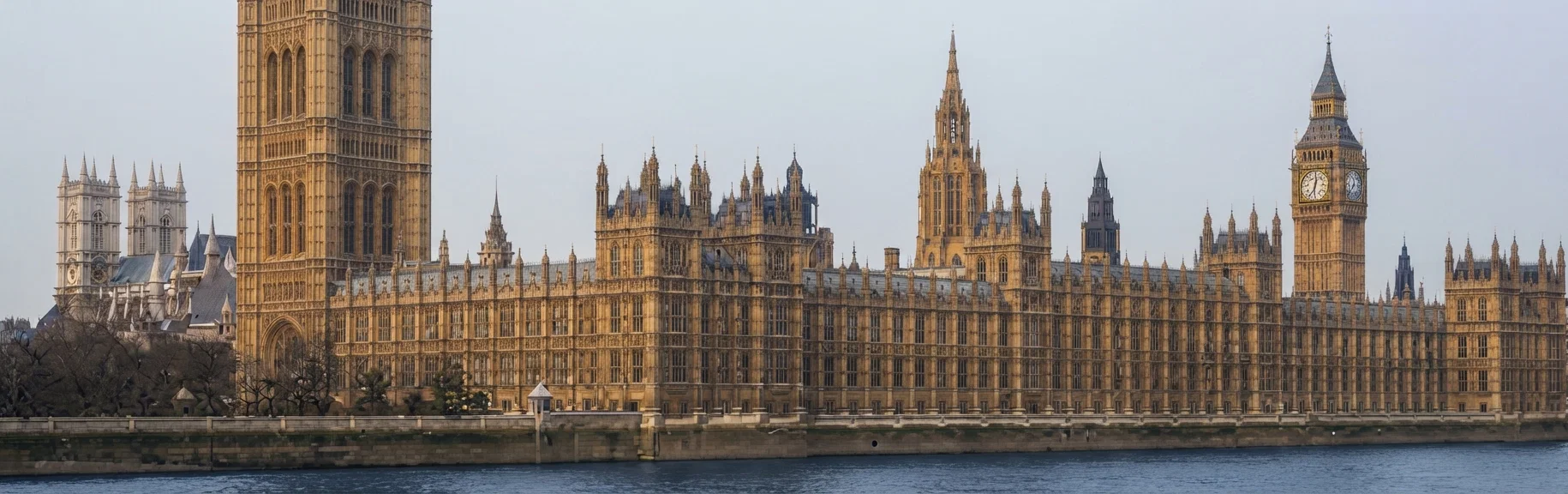
The British Parliament Buildings.
While we are the respectful and grateful children of Calvin, our great reformer, yet we condemn an error which was the one of his age; and, being firmly attached to the liberty of conscience according to the true principles of the Reformation and of the Gospel, have erected this expiatory monument.
While monuments do not wash away guilt, yet in this memorial the Protestants of Geneva have been willing to recognize the action of Calvin toward Servetus as a mistake, and to expiate it by a public acknowledgment engraven in stone. But where are the monuments of expiation erected by the Church of Rome to atone for the blood of the millions of martyrs that have suffered the most cruel deaths under their hand? We look for them in vain. For the Church of Rome rather glories in her bloody work, and those counted as heretics in the past are still branded by this infamous title. Rome does not attempt to atone or expiate her crimes, but is true to the Bible prediction which says: 'I gave her space to repent of her fornication; and she repented not.'