CHINA'S RELIGION

5%

Pacific Press Publishing Company · Mountain View, California · Jan 4, 1905

FromSigns of the Times, Vol. 31, No. 1.

Read the full edition

CHINA'S RELIGION.

BY A. C. SELMON, M. D.
The principle that man can save himself by his own works, lies at the foundation of every heathen religion. Satan's purpose is accomplished when he succeeds in leading a man to look within himself for saving power. The pitiable condition of the Chinese at the present time is but the fruit that must come from such a form of religion, and it shows how utterly hopeless are those who are trying to attain to a better life and yet have no knowledge of the true Saviour.
The national religion of China, if it may be said that there is such, is ancestral worship. Every inhabitant of the Flowery kingdom, from the emperor to the humblest coolie, whether rich or poor, old or young, worships his ancestors. Ancestral worship has been grafted into, and is an essential part of, the three religions of China.
Of the three great sects—Confucianism, Buddhism, and Taoism,—Buddhism was the last to enter the field. It was introduced into China about the middle of the first Christian century. The ruler of China at that time was the emperor Ming. He had a dream in which he was instructed to send men to the west, and they would learn of the law. An embassy was accordingly despatched, but instead of going west and meeting Paul or some of the apostles, and thus learning of the Christ, they turned southward and entered Buddha's country. This account, whether true or not, at least is full of interest, when one thinks of the conditions that might exist now, had China received the knowledge of the One who is not only "The Light of Asia," but "The Light of the World."
From the first, the spread of the doctrine was very rapid, because of the patronage of the emperors. At times there was some persecution. But in spite of this, the adherents of Buddha have increased so rapidly that at the present time this sect ranks next to Confucianism.
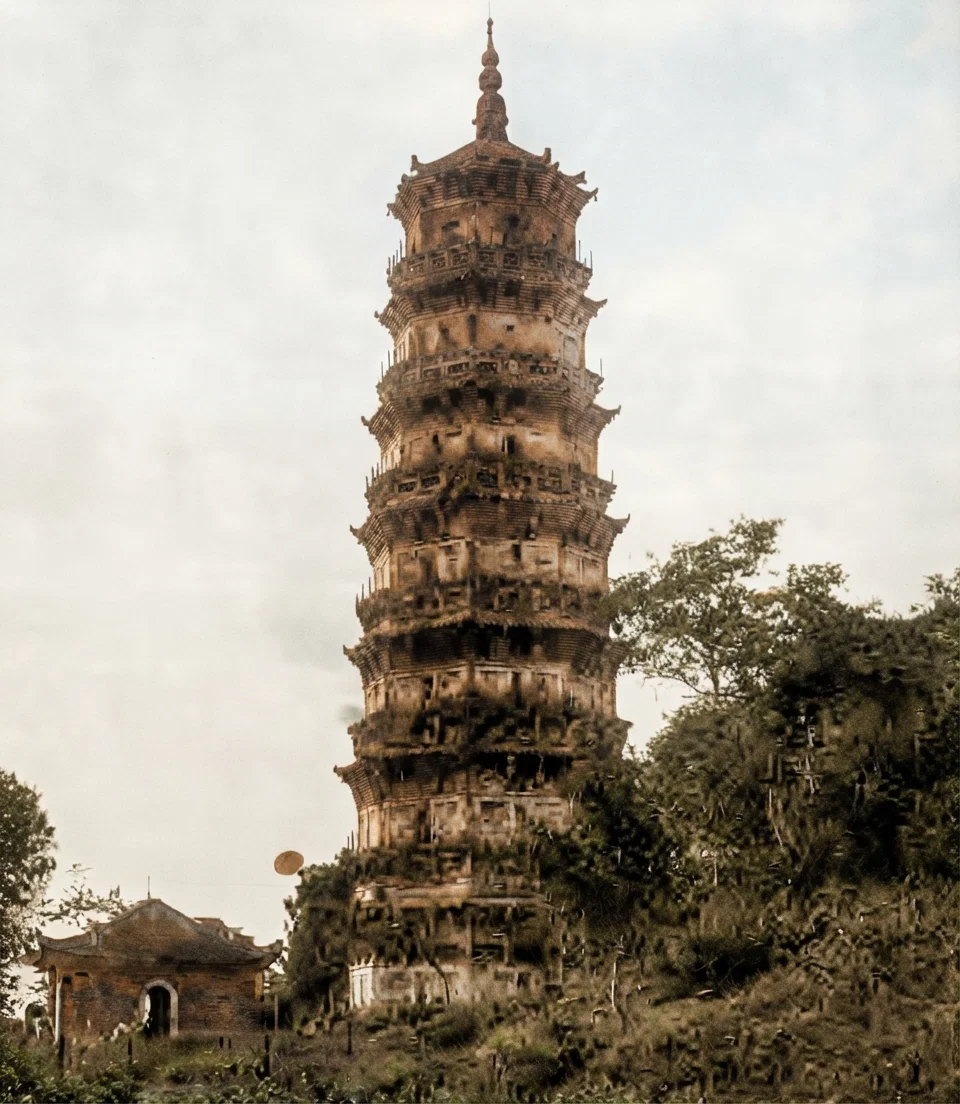
Chinese Pagoda or Temple of Worship.
Since Buddhism has borrowed from the Confucian doctrine "its reverence for ancestors and for state, and from Taoism its demi-gods and its geomantic superstitions, men of every creed rejoice in its banyan-like shade."
In the Sacred Edict, one of the Chinese classics, both Buddhism and Taoism are denounced as heretical, Confucianism being considered orthodox. The Buddhist priests are called a set of swindlers. The writer further states that it is the wildest extravagance to chant prayers in the barbarous lingo of Buddha's country.
The Buddhist temple worship is carried on in Sanskrit, and resembles the use of Latin in the Catholic Church, since it is simply a meaningless jargon to the people. In the temple service the priests repeat over and over again I-mi-to-fuh (Amida Buddha). There is thought to be great merit attached to repeating this and similar expressions over and over again hundreds of times in the course of the day. These same expressions, if uttered sufficiently often, are supposed to cure diseases.
The doctrine of the transmigration of souls underlies all the Buddhist teaching. The wheel of transmigration is ceaselessly turning in Hades, with its six order of beings, viz., insects, fishes, birds, animals, poor men, and mandarins. The credits gained in this life by carrying out the precepts of Buddha, or the demerits received by disobeying them, determines which of these six the soul of the person will inhabit after death. The highest state of perfection they can hope to attain to on this earth is a condition in which the body needs no care, and the mind is devoid of all thought or care for the common concerns of life.By sitting for hours in a state of contemplation, they may in time become immortals. Their idea is to refine and stimulate the spiritual part of their nature by abstraction from the things which concern this present life.
The Buddhist heaven which the ordinary worshiper hopes to reach is called the Western Paradise. They have other heavens higher than this, where the liberated soul reaches a state bordering on absolute nothingness.
The Buddhist hells pictured so graphically in the temples are enough to frighten the bravest. The victims, usually women, are shown suffering in the hell of the chopping knife, the caldron of boiling oil, the lake of blood, the bridge of snakes, and other terrible scenes of a like nature.
Buddhist temples are found in every city and community of any size. Many of them have immense compounds of twenty or thirty acres, numerous temples and other buildings. The priests wear no queue, and keep the head shaved clean. On top of the head is a spot where the hair has been destroyed by burning. Their statement is that in case they start to do some wrong, this spot will begin to pain; thus it acts as a sort of monitor. They wear long gowns with large, loose sleeves, and, like the Catholic Church, they are celibates. Their support comes from the land which they till, and from the money extorted from the people.
The pagodas of China are also a Buddhist contribution. When a rich Buddhist dies, his wealth is used to build a pagoda, the size of the structure depending upon the amount of resources left. This serves as a monument to keep his memory fresh.
The Buddhist teaching is largely responsible for the sorcery which is so common in China. Almost every village will number among its residents one or more old women who are sorcerers.
Recently I was called to see a case of lock-jaw. The woman's jaws were firmly set, and the native doctor had already been treating her by thrusting red-hot needles into the flesh of the jaws. A few days after, seeing the woman, I learned that she had also employed a sorcerer; and the treatment we used having helped her some, the credit was given to the sorcerer.
It is very common for the Chinese, when sick, to employ sorcery. Believing, as they do, that the disease has been caused by demons, they have great faith in this satanic practise. As one mingles with the Chinese from day to day, it seems that there is hardly an act in the every-day life of the common people that is not influenced in some way by their heathen practises and superstitious beliefs. It is these practises which form a veritable Gibraltar to the entrance of the truth. As you think of these conditions, can you feel that you have no responsibility in giving the Gospel message to those who are groping in these midnight practises? "Pray ye therefore the Lord of the harvest, that He will send forth laborers into His harvest."
Shang Cheng Hsien, Henan, China.