A ROYAL PRIESTHOOD

8%

Pacific Press Publishing Company · Oakland, California · Oct 3, 1900

FromSigns of the Times, Vol. 26, No. 40.

Read the full edition

A ROYAL PRIESTHOOD.

BEGINNING with Adam, the head of each family was its priest. And the plan was continued till the flood, and in the family of Noah after the flood.
THE order and the plan were ordained of God, a part of the great symbolic system of sacrifices and offerings for sin, pointing down the ages to the Redeemer to come. Afterward, when one family became a nation, and God led them out of bondage, the order of the priesthood was transferred to one tribe, the priests for the whole people.
IN the glory of his first estate, with the unclouded and majestic intellect of a man made in the image of God, Adam's keenest joy and most absorbing theme were contemplation of his Creator and His wondrous works. God was the All-in-all. This was religion in its first elements. It was an integral part of man's nature. And sin did not efface this principle of worship, but corrupted it, and perverted it, and distorted the system of sacrifices for sin, and changed their signification. It was worship still, but of what a nature!
ALWAYS sin and evil systems have been patterned after the true and the good. This is Satan's plan to deceive. And invariably, also, they are overdone, departing from the simplicity and completeness of the original, and becoming ponderous and burdensome. And so the services of the worship of all nations had and have their forms and ceremonies and sacrifices, and in most instances a vast army of priests and attendants. Here, using as instruments those set apart to conserve the highest interests of mankind, it would seem that sin has wrought out its most skilful product, the refined essence of evil. "Like priest, like people," is a phrase of vast import, when thoughtfully considered.
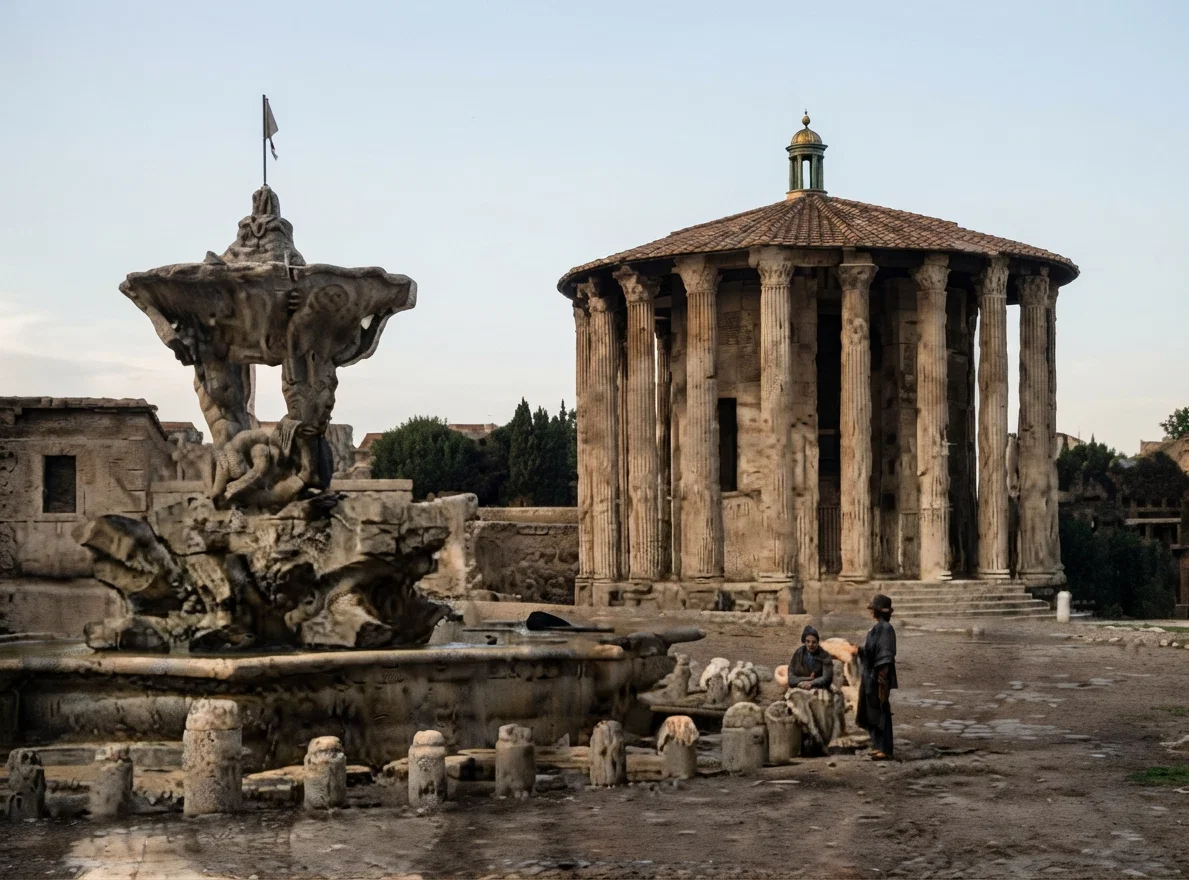
Temple or shrine of Vesta, close by the Forum, Rome, with fountain of Egeria (probably). According to tradition, the original shrine was built by the Emperor Numa (715-673 B.C.). It was four times destroyed before being rebuilt the last time by Severus. Vesta was the Roman goddess of the hearth,—the Greek Hestia,—and identified in various ways with Venus, with the Phoenician Astarte and the Egyptian Athor,—"queen of heaven,"—and the Babylonian Rhea,—woman deified,—the "mother of knowledge." To guard the sacred fire (symbolizing the life of the Roman people), and keep it continually burning, and to have charge of the shrine and its services, four virgins—afterward six—were chosen by the emperor. These priestesses were called vestal virgins, and their term of service was thirty years each—ten years of learning, ten service, ten teaching. The fires of the shrine were finally extinguished, the revenues—which were enormous—confiscated, and the service (almost dead) brought to an end by Gratian, emperor from A.D. 359-383.
BUT there came a time when the offering of the blood of bulls and goats ceased as possessing any efficacy. Type met antitype; an offering for sin was made once for all, and Jesus, the High Priest forever after a better and eternal order, entered into the heavens, there to appear before the throne for us. Through the centuries and the ages, in the darkness of sin and chaos, a light had been shining, and faithful ones all along had looked up, and had seen the light, and followed it. God was choosing a people for Himself, and numbering them as members, servants, children, of an everlasting kingdom, spiritual now, spiritual forever, but due in the end of the world of sin, in a gloriously real, physical sense, also.
THE center of all was Christ, the crucified and the glorified. And He is still the center, and is to be forever. And He is our Brother. He was not ashamed to call us His brethren,—the human race. Into His kingdom He calls us to come, with an appealing cry that echoes over all time, and, by the grace of God, the fellowship of flesh and blood is made infinitely closer and more sacred in each sinner who accepts that grace, even the invisible but enduring spiritual brotherhood of the sons of God.
HE is the Head of the better priesthood; and who are His associates?—His brethren of the everlasting kingdom. Wonderful, overwhelming thought! But it is even so. "But ye are a chosen generation, a royal priesthood, an holy nation, a peculiar people." 1 Peter 2:9. The whole "nation," the whole "chosen generation," is a royal priesthood, called and chosen for holy service in the work of God,—"holy brethren, partakers of the heavenly calling." Heb. 3:1. They are not called out of the world, but, while remaining in it, are not to be of the world.
BUT what is the office work of each member of this royal priesthood?—"That ye should show forth the praises [virtues] of Him who hath called you out of darkness into His marvelous light." Sacred and glorious service! Therein the faithful on earth are co-laborers with their High Priest in heaven and with the "multitude of captives" led on high for service in the heavenly sanctuary. Matt. 27:52, 53; Eph. 4:8; Rev. 5. Not to the "ministry" alone is committed the great work of God on earth. While the church militant is organized after divine instruction for the facilitation of various lines, yet the exalted privilege of the spiritual priesthood, with its solemn responsibilities, restsupon each member, for this is what membership, fellowship, brotherhood, in the eternal kingdom means.
IT is not a matter of passing moment. In the midst of worldly attractions and ambitions, in the presence of worldly and man-made systems and humanly-devised priesthoods, the God of heaven has a kingdom of right royal priests, whose faithful service here will finally be transmuted, translated, into the eternal service of the temple above. For in some form, subserving some eternal purpose, the great temple on Mount Zion in the earth made new will endure in endless ages. And, indeed, God's people, wherever they may be, however then the service may be arranged, will be one vast spiritual temple, in and through and by means of which will be unfolded and revealed to the universe the measureless depths of the plan of salvation. "Him that overcometh will I make a pillar in the temple of my God, and he shall go no more out." Rev. 3:12.
"AND he shall go no more out." Amen. And it may be so even now. Blessed promise! Let it be reality. "But know that the Lord hath set apart him that is godly for Himself." Ps. 4:3. This is the requirement, truly, for setting apart for this holy service. With man it is not possible, but with God all things are possible. And yet without man's will it is impossible. The willing is yours, sinner, professor, saint. The power for transformation is the Lord Almighty's, and it is not far from each one of us. It is to be had for the sincere asking. Ask, and receive.