CHURCH UNIONISM AND TRADE UNIONISM COMING TOGETHER.
IT has been well known to those conversant with the religious movements in this country that for many years there has been an organization called the National Reform Association, the object of whose existence is the embodiment of “Christian laws, institutions, and usages on an undeniable legal basis in the fundamental law of the land,” or a union of Church and State with all its resultant pains and penalties. One of the chief demands which this association has made has been the enactment of civil laws for enforcement of Sabbath observance.
This association was at first laughed at and ridiculed by the Protestant and secular press, then opposed, then tolerated in its teaching, listened to and accepted, till every denomination of note has committed itself to religious legislation over the Sunday question. Sabbath unions of various sorts have sprung up, federations have been formed with other national organizations and with political parties, and the Sunday-sabbath, wholly a church institution, has been pressed upon the Legislature of every State which did not possess a Sunday law, and upon the national Congress.
One of the principal directors in this work for years is Rev. Wilbur F. Crafts, whose headquarters is at the national Capital, where he is constantly working with and working government officials in the interest of the Church-and-State régime.
While we believe the movement is, in its very fundamentals, evil and only evil, and its results bound to be baneful to both Church and State, we freely concede that the men engaged in it are sincere men, working for what they believe to be the general good. Many of them are tremendously in earnest, and the virus of their teachings has permeated and poisoned our churches, our institutions of learning, and their threats of vote-controlling power has had effect upon our legislators.
The same spirit of combination manifest in the trust and the labor union, to crush out competition and opposition, to freeze out smaller dealers, and set aside the individual, is manifest in the church in the effort to federate on politico-religious questions, not so much as a matter of conviction of truth as of policy.
Latterly the National Reform Association, with all its allied forces, has been pressing upon labor unions and associations the importance of uniting with them, not for a day of rest, but for a religious day. One illustration among many is the following recently uttered by a clergyman in Des Moines, Iowa, on the problem confronting labor, to a large congregation:—
If it [trades unionism] is ever to furnish the panacea for our labor ills, it must broaden and deepen its life-currents on the moral ideas that affect the welfare of the laboring man. It must join the churches everywhere in the protection of Sunday as a day of rest and recreation. It means more to the laboring man to have all unnecessary work done away with on the Lord’s day than to any one else. Here is a place for effectively using the splendid machinery of organized labor.
And labor is awakening to the situation, and has taken action in many cases locally, so far as their own organizations are concerned.
The church, too, is bringing into her policy (it is rarely longer a matter of principle and conviction) the principles of the trust and trades union. Note the following as illustrative of this, taken from a recent news item from Lincoln, Neb.:—
The pastors of the larger Lincoln churches have signed an ironclad agreement intended to drive out the small church, and bring greater revenues to the larger, longer-established house of worship. The agreement is aimed at the exclusion of several projected new parishes.
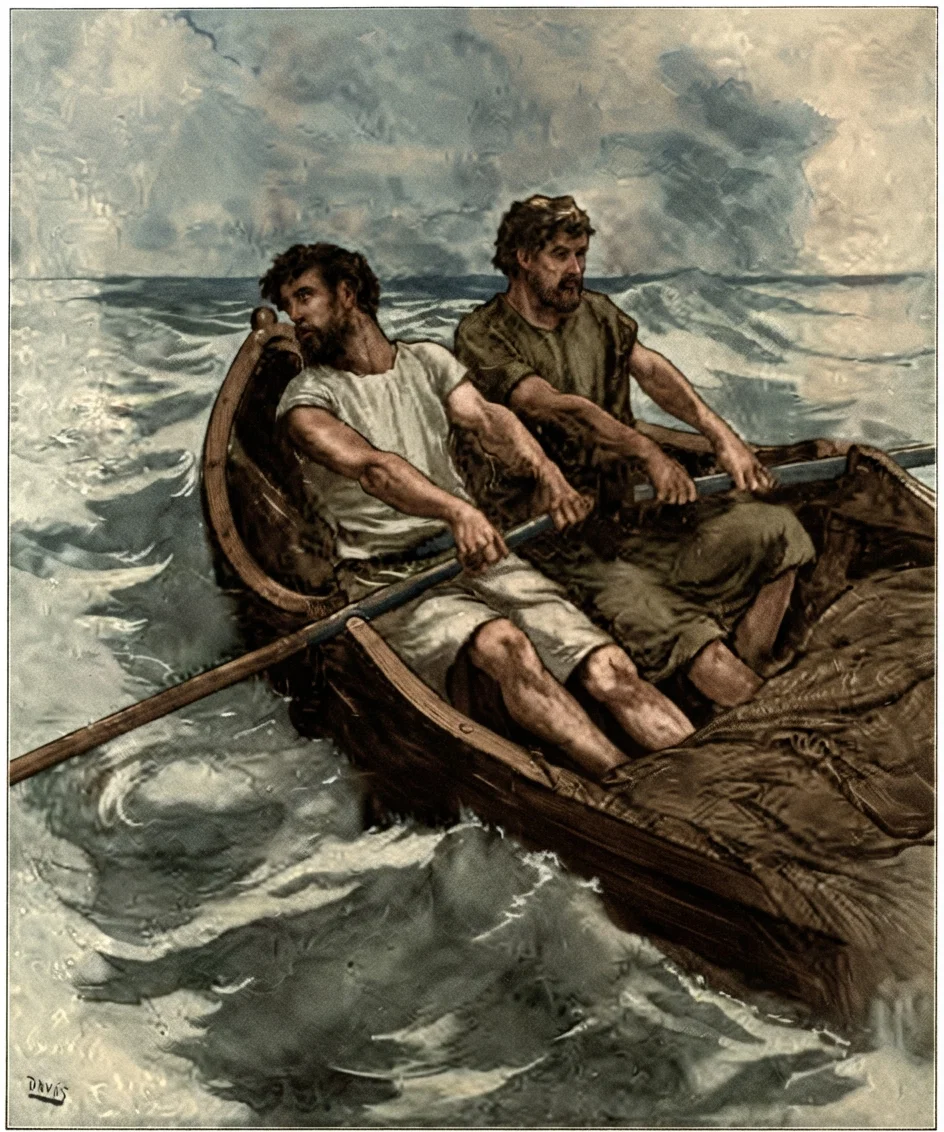
PETER and ANDREW, Fishermen. Matt. 4 : 18.
The Lincoln ministers take the stand that the field is already crowded. One of the ministers admitted frankly that the organization has all the features and aims of the big trusts incorporated under the New Jersey law. “Too many ministers are working for small salaries,” he declared. “Congregations are too small; the salaries of the best ministers are too small. A remedy is the abolition of the small churches and congregations.”
The Monthly People, of New York City, asks if this is a trust or a union, and says:—
All these are thrilling questions. Not the curious, merely, the serious, also, are anxiously looking for an answer.
While the church is pursuing labor-union methods, the unions are imbibing the autocratic, imperialistic spirit of religious bigotry and persecution. The following from the Independent (friendly to labor), of October 1, will illustrate this:—
Human nature is harder to change than social forms are. A born bigot does not become a liberal because he forswears the creed of his fathers, and sets up as an apostle of the latest philosophical quackery. The man or woman who grovels in superstition does not become a fearless rationalist by swapping “isms.” The heresy-hunter does not become less strenuous when he exchanges Presbyterianism or Old-Two-Seed-in-the-Spirit Baptismalism for Trade Unionism.
No one can watch the recent development of trade unionism, with all its unquestioned value and importance, and not be impressed by the rapidity with which it is tending to become a dogmatic religion, surcharged with bigotry, fanaticism, and superstition. The unions have erected Sunday into a sabbath of the faithful. The union itself has become a church, to which on every seventh day the faithful repair. The unbeliever is no longer merely a “scab,” he is a sinner, living under wrath. The individual member who goes out from among the industrially redeemed is a lost being, who can not be permitted to live inconspicuously among his fellows, but must be followed with anathemas, and all the pains and penalties of the excommunicated. The danger to trade unionism from this tendency is serious and deplorable.
To make plainer its allegations the Independent refers to the resolutions passed by the Central Labor Union of the District of Columbia in condemnation of President Roosevelt because of his action relative to the case of W. A. Miller in the book-binding department of the Government Printing Office. Mr. Miller, the union declares, has “violated every moral, and, in two instances, criminal law,” he has been “tried and found guilty of flagrant non-unionism,” and the President, by his action, has committed himself to “the policy of the open [communion] shop.” And his order in reinstating Miller must be considered “unfriendly.”
And all this because Mr. Miller is in favor of the “open shop,” and of so reorganizing the government office as to accomplish much more work for the government at less expense.
Not only this, but the unions arrogate to themselves the authority of sponsors of citizenship. They further say:—
The principle of trade unionism is intended to raise the standard of living among the working classes, to instil into their hearts the blessing of free governments, to educate them so that they might uphold the law and its representatives, to make them good citizens in time of peace and zealous patriots in time of war.
Upon this the Independent remarks:—
If all this is humorous, it is also serious. The trade unions embrace possibly two and a half million members. If they are all to become dogmatic religionists, the days of persecution “for the faith” are not over. It looks as if a great deal of educating and broadening of the human spirit would have yet to be done before all the American people shall be brought to a full realization of what is meant by instilling into the heart a vital sense of the blessings of free government.
In a prophecy of the last days, the central field of which is laid in these United States, we have a certain religious, civil-secular element combining, through vote and influence, to enforce the authority of what the prophecy calls “the image of the beast” under pain of death; and this power, when thus established, prescribes a mark or badge for all within its authority upon the right hand or the forehead, under the severest boycott, even to the prohibition of buying and selling. That this mark is religious in intent and purpose is evident from its being the mark or badge of the system of worship called “the image of the beast,” and that it pertains to commercialism is also evident by its penalty of boycott. See Revelation 13.
It does not need a prophetic gift to clearly see that the attitude of the labor federations and unions confederated with the churches will result in a legal “civil-sabbath” Sunday law enforced upon all, and which must be acknowledged by all, in formal acquiescence at least, as the test of government authority and loyalty on the part of the subject. Failure to do this results in the boycott in which the very necessities of life are denied the transgressor.
The outcome of all combinations to effect religious purposes has always been disastrous to both Church18and State. The union of the religious and the secular to accomplish politically what can not be wrought morally has always embruted the hearts of those who have engaged in such a movement, resulted in the persecution of the truest of men, and the utter ruin of the church and government which permits it. This has been true of the past. The present will prove no exception to the rule.
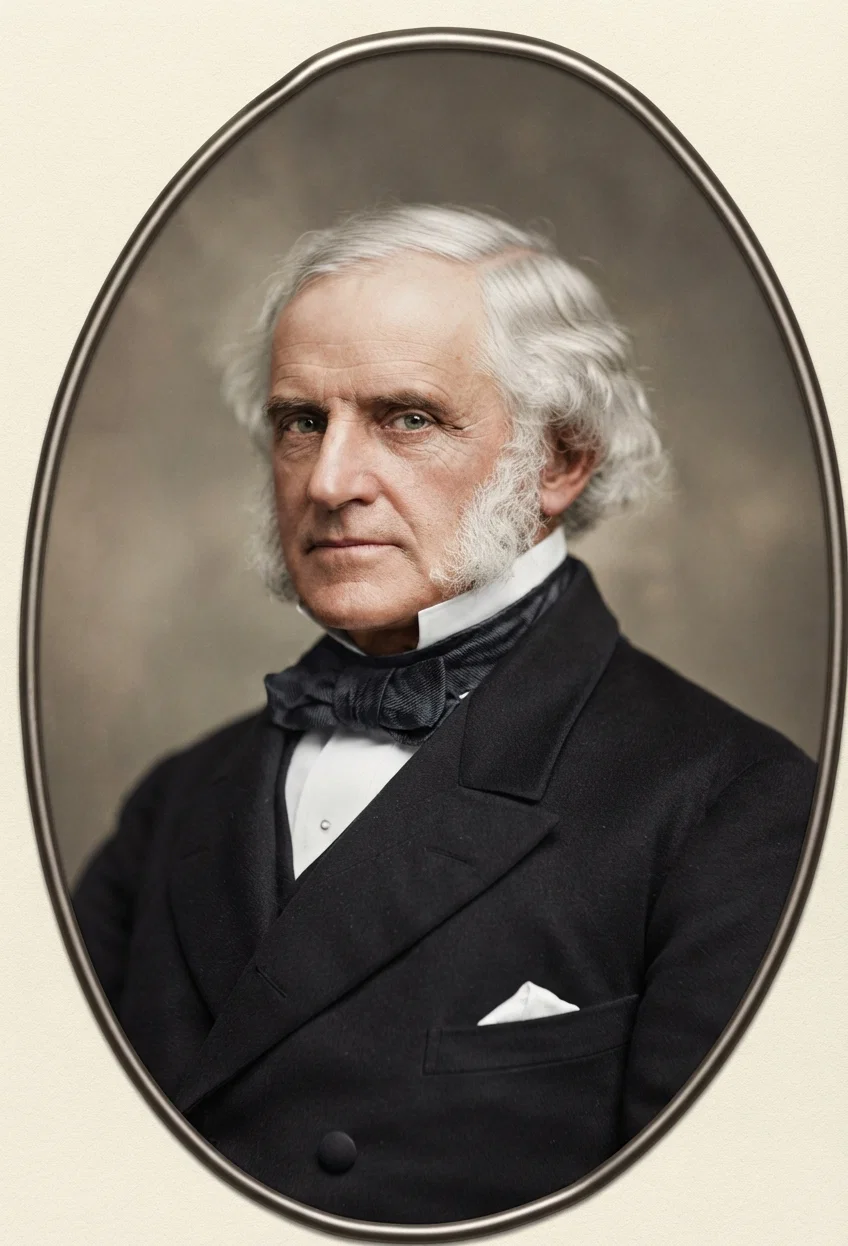
George Peabody.
Upon all the climax of oppression in these last days—whether that oppression come from capital or labor, capital and labor, capital, labor, and religion, or Church and State, in any form—will burst the overwhelming glory of the King of kings and Lord of lords. He comes to relieve the oppressed, to set the captive free, and to begin that reign of righteousness which shall know no tyranny of class, no injustice in rule, no disregard of the poor. Then the “King shall reign in righteousness, and princes shall rule in judgment. And a man [the Man, Christ Jesus] shall be as a hiding-place from the wind, and a covert from the tempest, as streams of water in a dry place, as the shadow of a great rock in a weary land.” All the evils are past, the survival of the fittest is manifest, and forever endures the reign of righteousness over a righteous people.
To that kingdom God in His goodness invites all. To the attainment of the character necessary to obtain that kingdom Christ has pledged His infinite power to every soul who will seek it. He has made that life possible to all; all may possess it in Him and by His own righteous way.