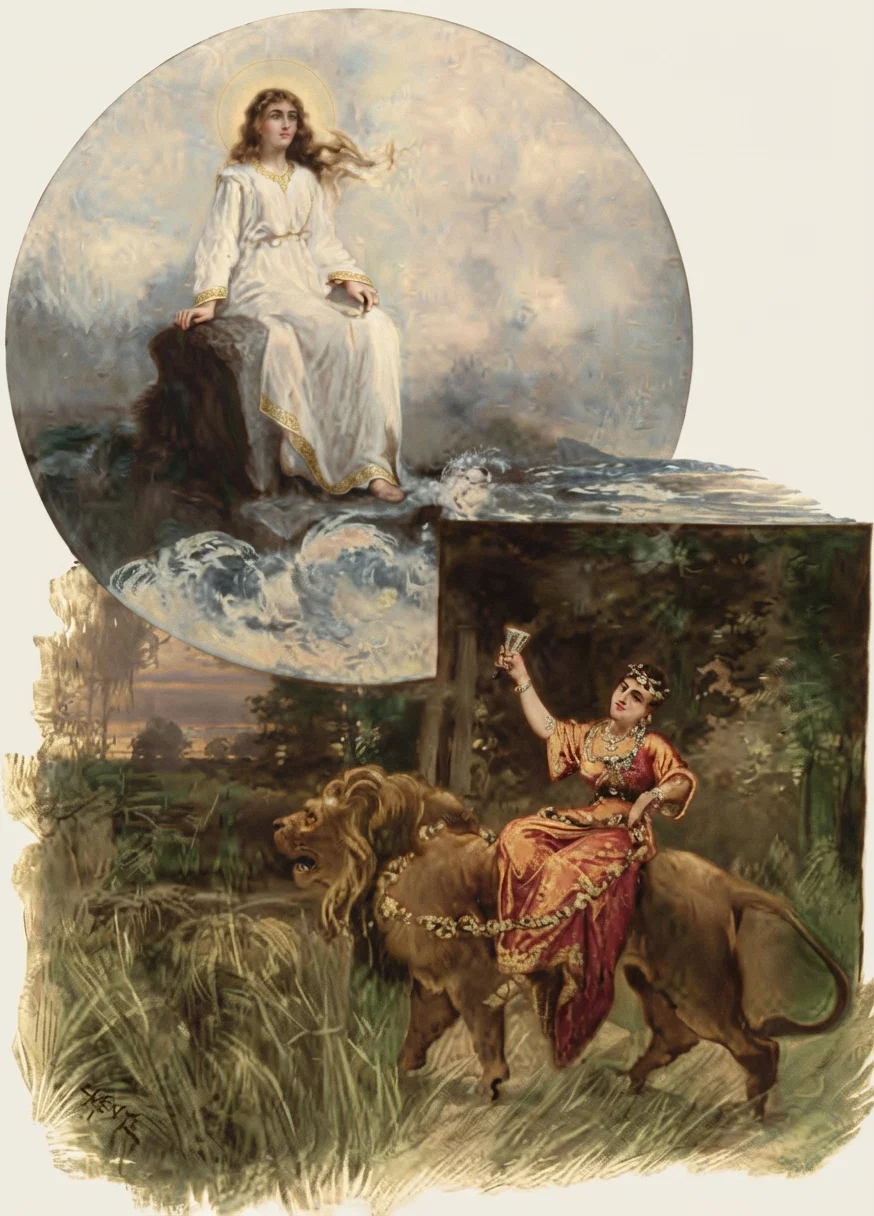
THE question has been answered in the negative many times, and generally by those who are doing all in their power to pave the very way for that condition which they declared could not be. “This nation will never persecute for conscience’ sake,” has been the declaration of the nation’s admirers over and over during the last two decades; but during that very time there has been a procession of events that has made persecution not only probable but sure and certain.
“What,” says an admirer of this country, “America, the ‘land of the free and the home of the brave,’ America that has stood so long as the asylum of the oppressed, already a persecuting power!”—Yes, a persecuting power, and one, too, that has already endorsed and confirmed a system that will make persecutions more frequent and more cruel as the days go by.
A Persecuting System.
First, as to the system that is to foster these conditions of oppression. No nation can maintain a union of church and state, and at the same time assure to each and all of its inhabitants an equality of religious liberty. This fact is so plain that it hardly needs to be stated. It is axiomatic. The established religion is bound to be the religion of preference in the eyes of the law. The adherents of that religion are bound to be the persons of preference so far as the practise of their religion is concerned. Even in England, where obtains the mildest form of church-and-state union, dissenters, or non-conformists, are taxed for the support of a religion in which they do not believe; and those who do believe in the religion so favored by the government receive the financial benefits arising from that preference. The law as it stands to-day makes this involuntary support of a religious system mandatory upon all, and provides for the confiscation of the property of those who will not yield to the injustice.
“But in these United States there is a separation of church and state.” So we have been taught to believe, and such was the case so far as the national government was concerned, until the year 1892. Such was intended always to be the case by those who framed our Constitution and established our governmental forms; but it is not the case to-day. There has been no legislation saying in so many words that the government has joined itself to the church or that the church has become the spouse of the government; but the union has been accomplished nevertheless.
Religious Legislation—Supreme Court Decision.
No nation can maintain a separation between the church and the state whose law-makers legislate upon religious questions and take it upon themselves to interpret the commands of God. When they do that and the highest judicial body in the land declares that they have a right so to do, the union between the church and the state is accomplished; for, no matter how open might be the declaration of a union by the law of the land, there are no other acts they could perform to make the fact of the union more certain or more evident. In every union of church and state, the state legislates upon religious questions and the church signifies to the state what legislation she desires, and gets it.
This is what has been done in these United States of America. Congress passed a law appropriating $5,000,000 to the Chicago World’s Fair on condition that the gates should be closed on “the Lord’s day, commonly called Sunday.” It went even further than that, and made the fourth commandment of the Decalogue the basis for that legislation, thus putting the matter wholly on religious grounds and using the machinery of the Congress of the United States, to interpret the meaning of that commandment for the people of the United States. The Supreme Court upheld that action of Congress as constitutional, basing its decision upon the “religious” history of the people and precedents of colonial days, and declaring that “this is a Christian nation.” That set the seal upon the union of church and state in the United States.
The Fruits of Such Sentiment.
That being the fact, we have but to consider the general results of a union of church and state to know for a certainty whether this nation will become a persecuting power or not; but the sad part of it is that this is not the only evidence we have at hand to prove the certainty of the proposition that this nation will become a persecuting power.
In every union of church and state the dominant religion—the national religion—has been intolerant of every other form of religious faith and practise. The persecution of the early Christians by Nero and other pagan emperors was the result of a union of a religious system with the state, in which the state took to itself the power to regulate the religious practises of its subjects. So the Roman laws declared that no new religion or new god should be introduced on pain of death or banishment. The early followers of Christ came under that proscription and thousands of them were slain because of teaching or practising the religion of Christ.
When Rome became papal in form, religion and the state were still united; but now it was an apostate form of Christianity that was wedded to the state. Its adherents were given every advantage; but those who chose to follow Christ in the simplicity and truth of His Gospel were hunted and hounded from one end of the civilized world to the other, and suffered every form of physical torture that the ingenuity of cruelty could invent.
The head-huntings of England and Scotland were conducted in the name of the “established” church, and the noblest souls of that day paid with their lives for the privilege of worshiping God in the manner that conformed to their belief of truth and right.
So it was in the early history of the colonies, and the Baptists and the Quakers worshiped God at the peril of their lives, or with the prospect of exile or duress, because the civil magistrate had been given power over the practise of religion, and their mode of worship had not been sanctioned by the law of the land.
So it is to-day in every nation where the Catholic religion is the law of the land, and so it is in Russia where the Greek church is enthroned in the person of the czar and the teaching of evangelical Christianity is a crime in the eyes of the law. There he who prefers the teachings of Christ to the dogmas of the state religion is disallowed the privilege of teaching his faith on pain of exile to Siberia, and he who changes his own belief is regarded as a culprit.
Wicked State Laws.
When our nation was established, its founders designed to guard against the repetition of the colonial persecutions in the nation at large, and so in the fundamental law of the land they placed a prohibition that was designed forever to forestall religious persecution in this country. The states did not follow the example of the nation, but retained their religious laws, and so there has been in most of these states a sort of quiescent union of religion and the state, used in these later days as were the racks and thumbscrews of the inquisition to make hard and painful the condition of those who would follow the leading of conscience in their religious practise.
That is how it was that one R. M. King could be arrested in the state of Tennessee for an alleged “desecration” of Sunday by doing ordinary work at home upon that day after he had followed the example of our Saviour in resting “the Sabbath day according to the commandment.” That case was carried to the Supreme Court of the state, and his punishment was upheld as being legitimate and in harmony with the Constitution of Tennessee. That5decision was upheld by the judge of the United States District Court for that district, and that gave national sanction to the persecution of Christians for conscience' sake in this country. That was in 1891.
Two years later thirteen orderly Christian men, observers of the seventh-day Sabbath, were indicted in Henry County, Tenn., for doing ordinary work at their homes or in their fields on Sunday. Hattie Mansfield, who had kept “the Sabbath according to the commandment,” was informed against by her own brother for the crime of doing some sewing at her home on Sunday, in Queen Anne County, Maryland. In the same county Chas. O. Ford was arrested and convicted of doing Sunday labor, on complaint of his own brothers. A minister and a school-teacher, in Gainesville, Georgia, who had arranged some desks in a schoolroom on Sunday, preparatory to opening a school on Monday, were convicted of a violation of the Sunday law. These men had kept Sabbath on the seventh day of the week.
These prosecutions, or persecutions, were made possible by the religious legislation which had been enacted in those states, and which is being used almost wholly against those who observe the seventh day of the week as the Sabbath.
In 1896 the United States Supreme Court
confirmed the constitutionality of the Georgia Sunday law, notwithstanding the fact that if those who religiously observed another day of the week than Sunday and were imprisoned for Sunday work should refuse to work on the Sabbath, they could be shot by the prison officials for “attempted insurrection.” Another item that shows the trend and aim of these convictions, was furnished not long ago by the prosecuting attorney of Queen Anne County, Maryland. Two individuals were convicted of Sunday labor in that county, not as individuals, the attorney admitted, but as representatives of a certain religious sect. Thus the denomination as a body was condemned by the Maryland Sunday law.
These are but a small fragment of what the nation has already done in the matter of religious persecution; but they are enough to show that there is in existence in these United States the full fledged apparatus for the doing of this kind of work in this the most enlightened age of the world. It also shows the disposition on the part of a large portion of these people to use that apparatus to the extent of its power.
A Growing Tendency—A “Christian” Lobby.
While this is a fact, it is also a fact that there is in this country at the present time a strong and growing disposition and determination on the part of the clergy and many influential organizations to improve this persecuting apparatus and make it a more perfect inquisitorial machine than it is to-day. The great religious societies have their departments for bringing about religious legislation that will “preserve Sunday from desecration.” That means legislation that will lay the heavy hand of the law upon those who religiously observe the seventh-day Sabbath, and who exercise their God-given right to labor on the rest of the week as the Creator of the universe did, as Jesus Christ Himself did in the years of His sojourn here as a man among men. In order that this may be brought about more effectually and more speedily, a “Christian lobby” is maintained at the seat of the national government, where strong influence is brought to bear upon congressmen to induce them to enact the desired religious legislation.
This “Christian lobby” (which is in itself an admission of a union of church and state) does not confine its work to congressmen, but works with their constituents at home, inducing them to urge upon the said congressmen the necessity for such legislation as the manipulators of the aforesaid lobby desire. These congressmen are given to understand that if they do not yield to these demands, the solid vote of the “Christians” in their constituency will be arrayed against them in the next election. So in this unchristian manner there is being brought about in this country a condition of things utterly inconsistent with the spirit of the Gospel of Christ. The Gospel of love and faith is to be superseded by the decrees of force, and again in this our country he who chooses to worship God according to the dictates of conscience must do so under the pains and penalties of the law.
It is folly to say that when these laws have been obtained, they will not be enforced in the persecution of Bible Christians, when we find that laws that had been believed to be utterly obsolete have been resurrected for the very purpose of restricting men's liberty of worship. There would not be the almost universal demand for them that there now is if they were to remain dead letters upon the statute books. They are being demanded for a purpose, and the use that has been made of those once believed to be dead is a plain enough indication of the use that will be made of those whose enactment is now demanded. Will America become a persecuting power?—It is a persecuting power now, and will become more and more so as the months and years go by.
[Read in connection with the above the series of articles entitled, “Church and State.”]