HEBER, THE FIRST-BORN

2%

Pacific Press Publishing Company · Mountain View, California · Dec 7, 1904

FromSigns of the Times, Vol. 30, No. 48.

Read the full edition

HEBER, THE FIRST-BORN

A Story of Israel's Deliverance

By HART HALL

CHAPTER VIII.

It seemed an age to Pharaoh before the lad finally returned accompanied by Moses and Aaron.
Haggard with anxiety and fear, the haughtiness all gone from his countenance, he met them with a hoarse cry: "I have sinned this time; the Lord is righteous, and I and my people are wicked. Entreat the Lord (for it is enough) that there be no more mighty thunderings and hail; and I will let you go, and ye shall stay no longer."
It was fear that wrung the confession from his lips, and the prophets knew that the struggle was not ended; but they would give him the opportunity, nevertheless, so that he might be without excuse.
"As soon as I am gone out of the city," said Moses, "I will spread abroad my hands unto the Lord; and the thunder shall cease, neither shall there be any more hail; that thou mayest know how that the earth is the Lord's. But as for thee and thy servants, I know that ye will not yet fear the Lord God."
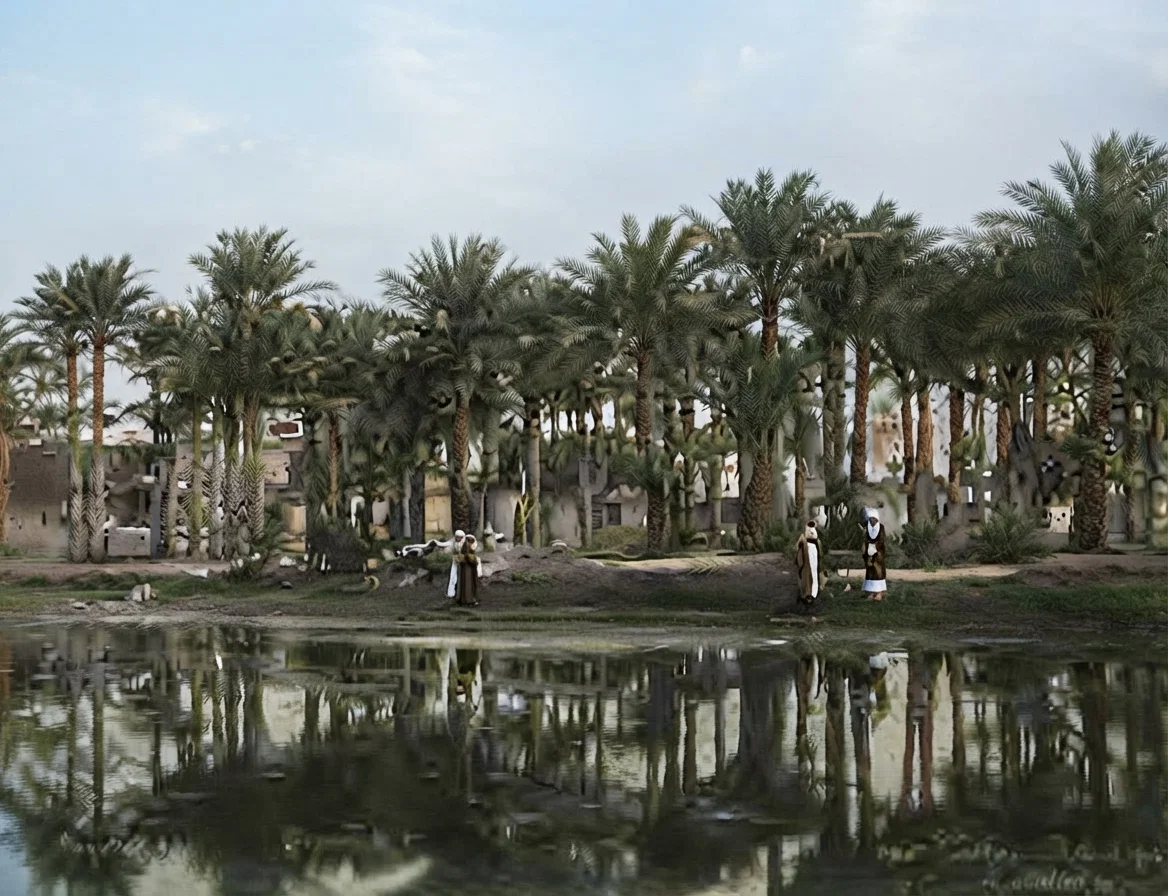
Palms in Egypt by the Nile.
Out again into the storm the two ambassadors went, unheeding its terrible raging, and anxiously the king and the people waited. Soon the wind abated and the hail and rain ceased falling; and before long the sun broke through a rift in the clouds, throwing a beautiful rainbow on the dark western sky. A bow of promise it could and would have been had Pharaoh accepted the mercy of God. But as the clouds cleared away and the serenity of Egypt's climate succeeded the elemental war, so his fears disappeared and his promises vanished into thin air. All the hardness and stubbornness of his nature again asserted itself.
Ample time was given him for deciding, but finally, as no decree was forthcoming bidding the release of the enslaved people, the brother prophets appeared again and warned the monarch that if he still clung to his obstinacy a terrible plague of locusts would be sent to devour every green thing that remained in Egypt.
But the king showed no signs of relenting. Exasperated beyond measure at his stubbornness, princes and courtiers, forgetting their rank, fiercely exclaimed, "How long shall this man be a snare unto us? let the men go, that they may serve the Lord their God; knowest thou not that Egypt is destroyed?"
The priests retorted in favor of Pharaoh, and open hostilities were imminent in the court, but the disturbance was quelled by a word from the king. "The words of the princes are good," said he. "The men shall go and do sacrifice to their God. But their wives and their little ones shall remain in the land. Call the men again." When they returned the king inquired, "Go, serve the Lord your God; but who are they that shall go?" "We will go with our young and with our old," said Moses, "with our sons and with our daughters, with our flocks and with our herds will we go; for we must hold a feast unto the Lord."
The monarch realized in desperation the futility of argument; and his anger, long suppressed, burst out uncontrolled, and furiously he railed: "Let the Lord be so with you, as I will let you go, and your little ones; look to it; for evil is before you. Not so; go now ye that are men, and serve the Lord; for that ye did desire."
He motioned to the soldiers and they sprang forward with spears set menacingly. The prophets looked at them calmly and unflinchingly, but did not move. The soldiers feared these men far more than the king, but they must keep up appearances; and, swinging their spears, they spoke in an undertone begging the men to go. So they departed.
The next day a fierce wind blew steadily from the east, continuing all the following night, and with the gale on the second day came the locusts in clouds, darkening the sky and spreading all over the land, devouring every particle of verdure and leaving desolation in their wake. They entered the houses like flies, and swarmed about until the Egyptians were nearly frantic.
The proud nature of the king rebelled against humbling himself again to these Hebrews, but there was no other way, and the extent of the calamity bade him hasten. Sending for them, he exclaimed, "Now therefore forgive, I pray thee, my sin only this once, and entreat the Lord your God, that He may take away from me this death only." The prophets were obedient to his wish, and while entreating the Lord a mighty west wind arose that swept the plague into the Red Sea.
But no order was received to vacate the land. In the perversity of his heart, Pharaoh held out against all importunities of his people, declaring that the Hebrews must remain in servitude. But while the words were being spoken a darkness like an outspread pall of death settled down over the land. It was a darkness that was close and oppressive; breathing was difficult, and absolutely nothing could be seen, tho held before the eyes. Movement was impossible except by careful groping. Everything was at a standstill, and the people sat in mute horror at this new judgment. The laborers in the fields attempting to find their way to their homes wandered about in the darkness until exhausted. In the houses "none rose from his place."
Yet even this occasion was mercifully given that they might have time for deep reflection; and to the whole nation it was made manifest how completely impotent were their gods, and how useless and ineffectual were any appeals to them. Even their greatest gods, Isis and Osiris, who controlled the lights and the elements, were now smitten by the great Power that had undertaken the cause of the Hebrews.
Three days the deep gloom prevailed, and when at last it lifted, the king sent for Moses and Aaron. He was haggard and worn from his long vigil through the darkness, and exhausted with the struggle. "Go ye, serve the Lord;" he commanded, "only let your flocks and your herds be stayed; let your little ones also go with you."
Previously he would have retained their wives and children as surety for the men. Now if they will leave their cattle he would concede to their demands, for it was from their abundant herds that he must replenish his own depleted land.
"Thou must give us also sacrifices and burnt offerings, that we may sacrifice unto the Lord our God," said Moses. "Our cattle also shall go with us; there shall not an hoof be left behind; for thereof must we take to serve the Lord our God."
The wrath of the king knew no bounds. He would have slain the two Hebrews himself had not God been their protector. "Get thee from me," he shouted. "Take heed to thyself, . . . for in that day thou seest my face thou shalt die." "Thou hast spoken well," said Moses. "I will see thy face again no more."
He himself, a man of peace and the meekest on earth, was weary of the conflict, and he knew it was about ended. His people had been instructed and drilled for the departure. Leaders had been appointed, and all plans laid, and they waited but for the signal.

CHAPTER IX.

The faith and courage of Israel, long depressed by their afflictions, had risen as they had witnessed their miraculous protection from the plagues. They had been instructed to ask valuables of the Egyptians, and the people of Egypt were so anxious for the Hebrews to depart before the falling of another plague, that they gave them what they asked. But it was a just and legitimate remuneration for their many years' labor as bondmen.
Tho under sentence of death, Moses was bidden to appear again before Pharaoh. The last great judgment would not be sent without a specific warning of its terrible results. Fearing the outstretched arm and the holy countenance, Pharaoh cowered as he listened to the scathing denunciation that announced the cutting down of the flower of Egypt's forces.
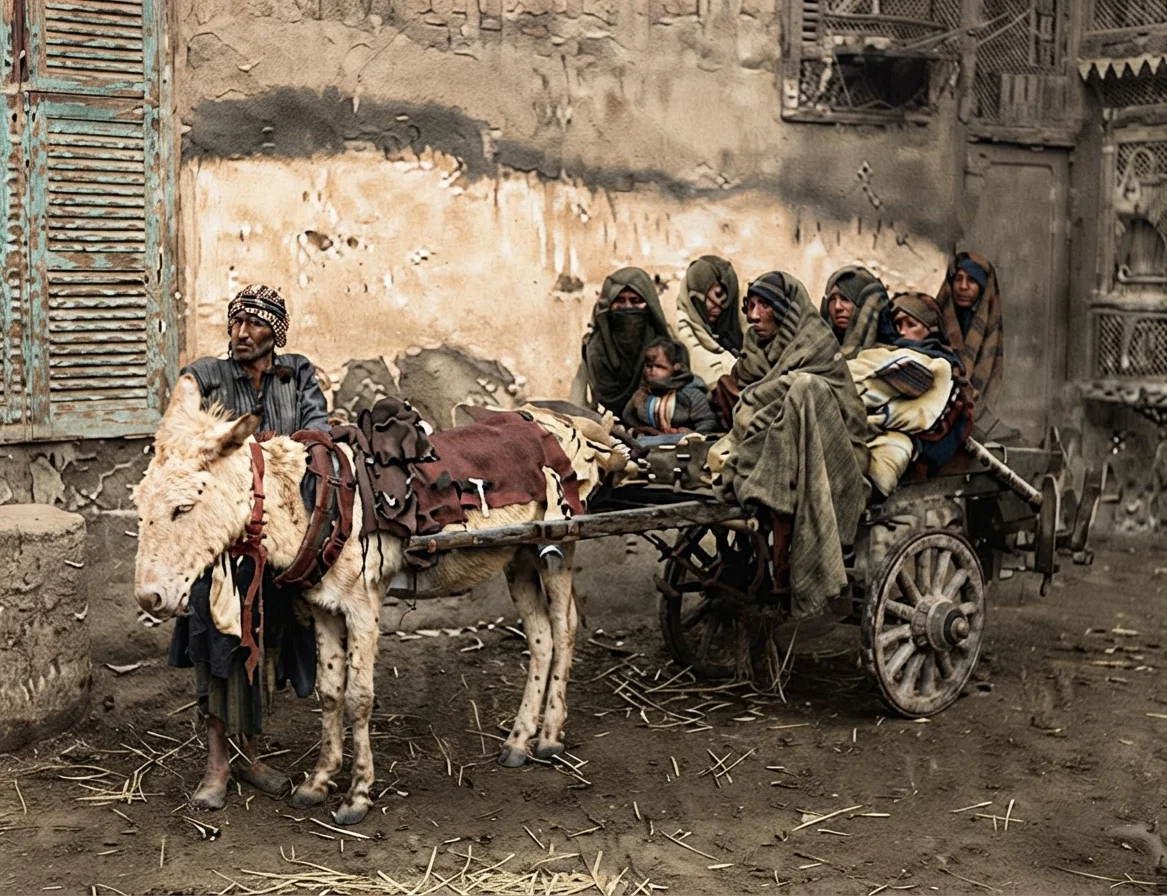
Arabs in Egypt.
Arabs in Egypt.
Said the prophet: "Thus saith the Lord, About midnight will I go out into the midst of Egypt; and all the first-born in the land of Egypt shall die, from the first-born of Pharaoh that sitteth upon his throne, even unto the first-born of the maid-servant that is behind the mill; and all the first-born of beasts. And there shall be a great cry throughout all the land of Egypt, such as there was none like it, nor shall be like it any more. But against any of the children of Israel shall not a dog move his tongue,against man or beast; that ye may know how that the Lord doth put a difference between the Egyptians and Israel. And all these thy servants shall come down unto Me, and bow down themselves unto Me, saying, Get thee out, and all the people that follow thee; and after that I will go out."
The monarch made no sign. His own life was not in danger, and he cared naught for the lives of others. Covetousness was his bane, gain his god; and his wicked heart, stultified with stubbornness, saw in this calamity no excuse for yielding. He had embittered his people and his courtiers against him, but he would still be king and ruler of the land.
In righteous indignation the prophet left the palace. The work of emancipation, as far as he was concerned, was done.

CHAPTER X.

Darkness was gathering on the eve of the Passover night. In Goshen the families of Israel were gathered together; the paschal lamb was slain, the flesh roasted, unleavened bread and bitter herbs prepared. On the doorposts the blood had been sprinkled, and in awe the people watched and prayed.
In the houses of many there were absent members, and, tho the prophets had assured them that God would bring again the absent ones, they bowed in prayer for their restoration.
These loved ones were locked in the stone-walled corridors of Egypt's dungeon. Nervously and with burdened, anxious hearts they paced to and fro in their cells, realizing the awfulness of their situation, for they had been informed of the dreadful visitation that would be meted out that night.
They had not been called to their duties that day nor permitted outside the prison walls. Carefully they had watched for an opportunity to escape, but as if in anticipation of this, Pharaoh had given strict orders that the keepers should exercise extra precaution, and that the number of guards should be doubled.
Heber's fair, manly face was a puzzle to his comrades all that day. It depicted anxiety and excitement, but still there was a hopeful look in his eyes, that the others could not share. His strong athletic frame was nervous with pent-up energy. It was plain as the hours grew late that he was expectant of something they knew not what. "Heber," said one finally, "tell us what is in thine eyes; if thou knowest ought more than we, tell us." "I think thou shouldst know, now," was the reply in a low, tense voice. "There is help for us." "How?" was the exclamation from all.
"The first day when the prophet warned the king of the death of the first-born, I heard it at the court. I sought Anathpherah alone, and said, 'Keeper, believest thou the prophets, or why didst thou keep them in thy house at the time of the hail?' 'By the king's beard,' said he, 'if thou art not mindful thou wilt do me harm. Yea, lad, I believe the prophets, and I believe their God; He is my God for forty years since; Moses taught me so before he fled from Egypt; but this is to thee, mind, not to Pharaoh, nor any other.' 'But hear me,' I spake, 'thou hast heard the warning, thou knowest not that I am one of the first-born, as are also some of my comrades here; must we perish with the king's people?'"
"The keeper looked this way and that, and then said, 'Thou must not speak, but I have sworn to the prophets to aid thy escape.' So now wait, my brothers, and be ready," said Heber.
After a short period of darkness a silvery moon rose, shedding its mellow, peaceful rays over the land. Through a small grated opening high up on the wall the light stole in upon them. It seemed a long time in their anxious waiting since the last keeper's footstep had echoed through the corridors.
But suddenly they heard stealthy footsteps and saw a faint glimmer of a taper. Their door was carefully unbarred and swung back, and they saw Anathpherah holding up a warning hand for silence. Beckoning them to follow, he led them down the passage; at one of the large cells he stopped and unbarring the door, disclosed a group of a score or more gaunt Assyrian captives, taken in battle.
They sprang up surprised and blinking at the light of the taper. To them was held the warning hand. "Canst thou fight?" whispered the keeper in their tongue. They nodded eagerly and hopefully. "If thou canst fight thou canst be free. Come."
They followed with cat-like agility and carefulness. The keeper opened another door, revealing the prison arsenal, where shining spears and battle axes hung in array. Quickly each man was armed, and, leaving the room, they stood before the large stone door opening to freedom.
The keeper spoke low to the Assyrians; then to the Hebrews he said, "Heber is the strongest and quickest, he shall lead. I am not afraid, but I am old. He knows the way. Wilt thou, lad?" In response Heber swung his spear in exultant assent. With a sharp look about at them all, the keeper stepped to the great door and swung it wide.
(Concluded next week.)