EVOLUTION AND GEOLOGY

3%

Pacific Press Publishing Company · Mountain View, California · Jan 18, 1905

FromSigns of the Times, Vol. 31, No. 3.

Read the full edition

EVOLUTION AND GEOLOGY

By Geo. McCready Price

VII. THE EVIDENCE OF ARCHEOLOGY.

Part 1.

IT is in perfect accord with true scientific reasoning that we have been proceeding thus far. We have been reasoning from the known to the unknown, from the more perfectly understood to the less perfectly understood. We have tested the evolution theory by comparison with standards of truth concerning the value of which every Christian is perfectly settled. We have seen that the theory of man having been made through a long series of developing germs, molusks, quadrupeds and savages, up to his present state, is not only contrary to the express statements of the Bible regarding creation, but makes of the Creator a tyrant and a fiend, and is thus contrary to the whole tone and spirit of Christianity from Genesis to Revelation; and that, furthermore, its general acceptance is preparing the way, as nothing else could ever have done, for a religio-military despotism to take the place of democratic government.
The arguments in favor of Evolution are confessedly very obscure and intricate; and now having tested the general trend of the doctrine by other and far more certain standards of truth, we have found it wanting, sadly, wretchedly wanting.

How Men Came to Believe in Evolution.

But this much being settled, and the theory having been found to be a terrible delusion, we may next seek to find out just where and how the slip has been made; just how the scientific mind has been tricked and its reason fooled into believing it. For we can not think that men like Darwin, Huxley, and Mivart were guilty of palming off upon the world what they themselves knew to be only a delusion.
Our first means of testing the theory under examination must be in the field of ancient history and archeology. For if man has sprung from the lower forms of life up through the savage to the civilized condition, we shall be able to find something confirming it in the conditions revealed at the dawn of history. It is really most natural thus to work backward upon the supposed history of development; for there are certainly some leading facts about man's early history that are a thousand times more certain than most of the supposed generalizations of Darwinism or Geology.

What Does History Say?

What, then, are the conditions revealed as the curtain rises on the first scenes of recorded history? Briefly, I may say that we have well civilized tribes scattered over all the continents, in Peru, Mexico, the central plain of North America, Western Europe, Egypt, Babylonia, Assyria, and the East, each possessing a civilization seldom equaled, save in very modern times, and in some respects, not excelled by any, and of such a character, and so undeniably related to one another as to prove that their civilizations must have had a common source in some civilized state before they were scattered abroad. It is also very strongly suggested in many ways that this primal home of civilized man before his dispersion is somehow lost in the geological changes which have taken place. In addition we shall find that the history of languages confirms the record of Babel; while all nations have not only traditions of the Flood, but of an Edenic beginning; and at this first glimpse we get of human society, they give us in their social customs, and embalmed in the dry husks of their dead formalism and idolatry, glimpses of lofty ideals and forms of prayer to one supreme God, the Creator—all traces of a more intellectual, a more truly human state in the dim forgotten past, the afterglow of a once brighter day.
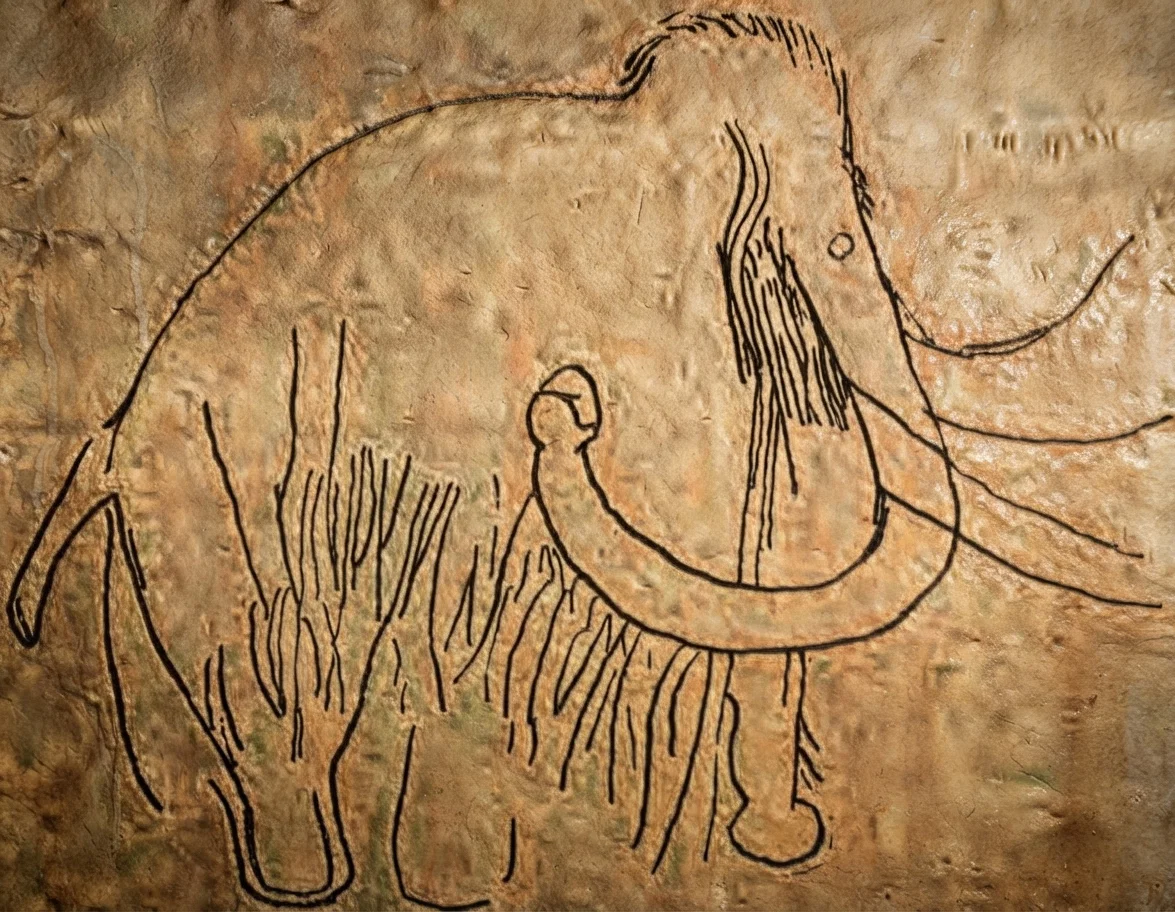
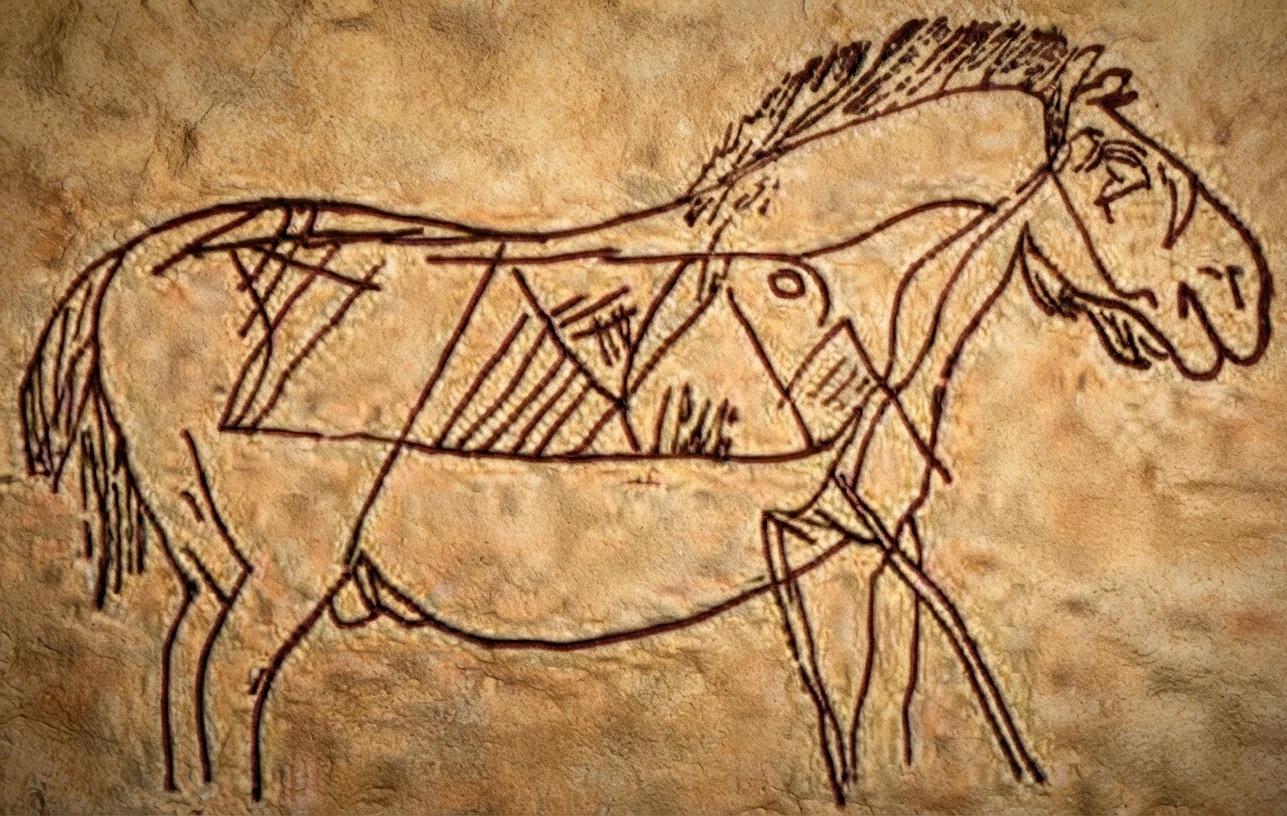
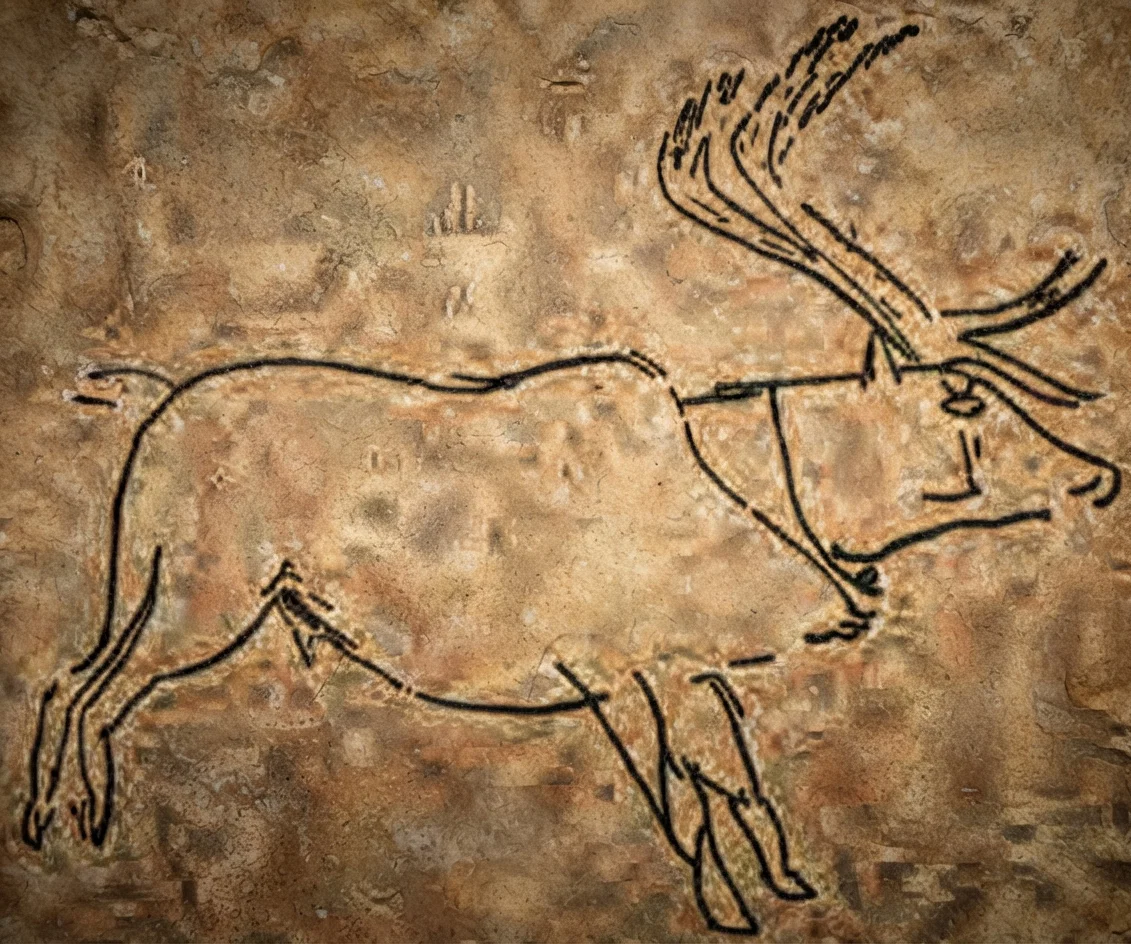
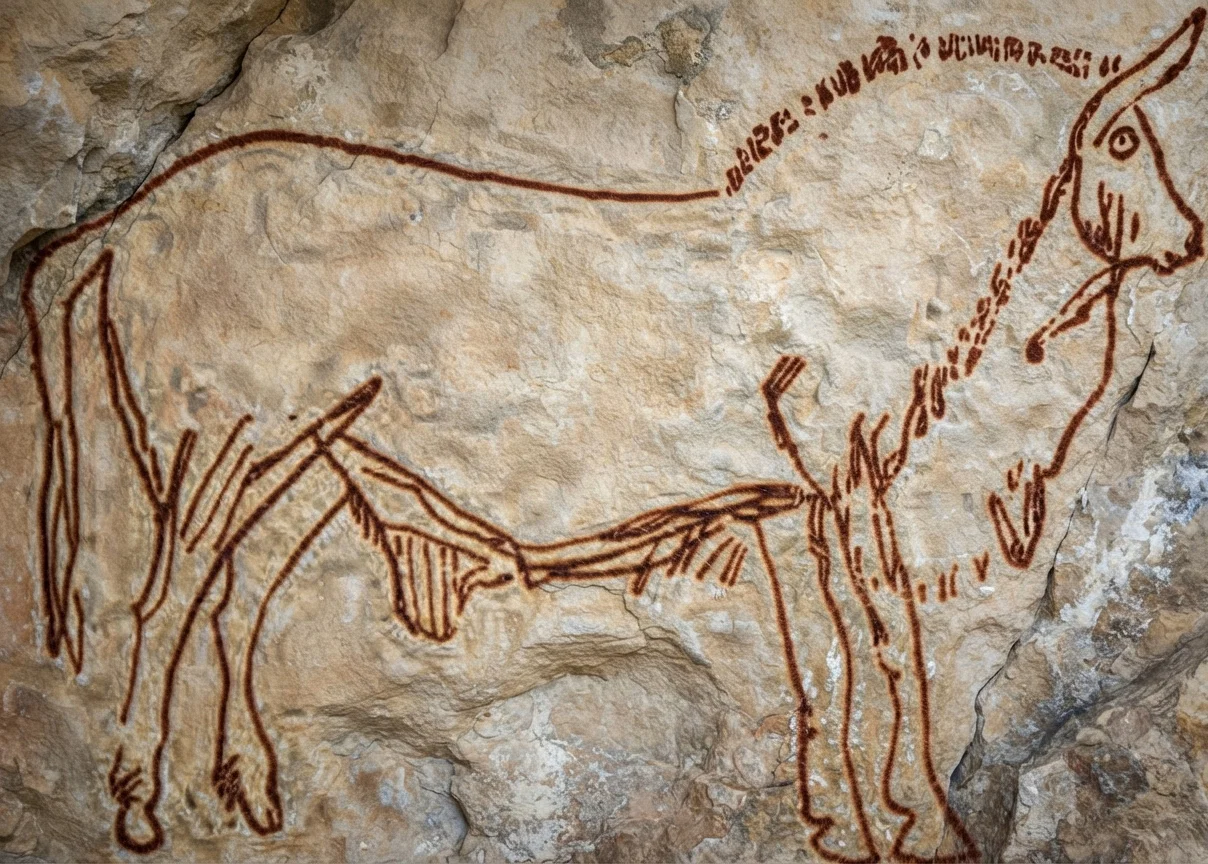
Figure of a mammoth chiseled on the walls of caves in southern France. This great elephant must have been contemporaneous with the man who drew his picture, and also with the other animals shown herewith, whose likenesses adorn the walls of the same caves—the horse, the gnu, and the reindeer. The saddle on the horse shows that he was used for the same purpose then as now.

The Connection between the Races of the Two Hemispheres.

We may first note, then, that about fifteen or twenty centuries before the Christian Era, there were peoples possessed of a high degree of civilization spread over practically all the northern hemisphere, and over some tropical countries. The monuments of Peru, Mexico, and Yucatan, which are the astonishment of every traveler, testify to this fact for the localities which they represent. Every one is familiar with those stupendous remains in Peru and Yucatan, and I can not enter into a detailed description of them here. Suffice it to say that there are very many points about these peoples which connect them closely with Ancient Egypt and the far East.
  1. The Central American architecture resembles in many ways that of Egypt.
  2. The Peruvians, Aztecs, and other American tribes embalmed their dead, as did the Egyptians and some others of the ancient oriental nations.
  3. The hieroglyphic writings of the Mayas, so abundant on the walls of their ruins in Central America, are closely related to those of Egypt, and these are "the only two phonetic systems of the alphabet in the world"—Ignatius Donnelly, "Atlantis," page 232.
  4. "It is a very remarkable fact," says Alfred Maury, "that we find in America traditions of the Deluge coming infinitely nearer to that of the Bible and the Chaldean religion than among any people of the Old World."—"Atlantis," page 98.
  5. The skeletons of the Peruvians, Mound Builders, etc., show a remarkable degree of what scientists call "platicnemism," or flattening of the tibia or leg bones, a striking peculiarity found also in many of the skeletons of Western Europe, some of which, as we shall afterwards see, are clearly antediluvian, and others very early post-diluvian.
  6. The races in America give us very numerous representations of the elephant (or the mammoth), which show a close resemblance to the drawings of the elephant on the cave walls of southern France, which certainly carry us back near to the time of the Deluge, or beyond.
Taken together, the above facts clearly prove (a) that the ancient American races are closely connected with the most ancient civilizations in the Old World, (b) that they were in a civilized state themselves before they separated from the latter, and (c) that this dispersion must have occurred long centuries before the Christian Era, probably (d) very soon after the Flood,—the latter being a well-defined event for which we shall find abundant scientific proof.

Is It Development or Deterioration?
If we go to the Old World, we have first the Dolmens or Cromlechs scattered over almost all Europe, North Africa, and parts of Asia. Some will have it that it was a rude state of life to which these people had attained. Certainly they had a hard lot, and possessed few of the comforts and luxuries of life. But I can not believe that the tribes who thus took somuch pains to construct elaborate and substantial tombs for their dead, involving with their rude implements a degree of skill and patient labor which we can scarcely imagine,—I say I can not believe that these people were of the type which we call savages. It is true they had no electric lights or morning papers, no telegraphs or telephones, not even brandy or cigars, all of which are, in the fancy of some superficial thinkers, the criteria of civilization. But we must own that they possessed what we call pluck to an unexampled degree.
Works left by the very earliest races on all the continents testify that these people possessed a strength of mind and body unequaled at the present time. It required an indomitable courage to attempt, and a patient perseverance to carry out, works before which any modern race of men, I care not who, would quail utterly and never think of attempting, if limited, like these their ancestors, to the rude implements which they could individually manufacture from the rocks and ores. Compared with the men who built the sphinx and the pyramids in Egypt, Birs Nimrod at Babylon, the temples and Teocallis in Cambodia and Java, and the almost identical, tho larger, ones in Mexico and Central America, Stonehenge in England, or even the mound of Cahokia in Illinois, we moderns are sadly degenerate in physical and moral courage.
We must also own that these ancient observers of nature, thus scattered almost contemporaneously over all the continents, who understood all the leading principles of astronomy, including the rotundity of the earth, twenty centuries or so before the Christian Era, and who in their wonderful works display a mastery of all the leading principles of civil and mechanical engineering, were not without mental training, albeit they had no sumptuously bound books, and no morning papers delivered at their door. With no facilities to help them, they accomplished wonders; hence they possessed abilities. We accomplish less, with every facility; have we evolved from them by development, or have we degenerated?

Egypt and the Development Theory.

But let us look at ancient Egypt a little nearer. There is no evidence that her civilization was developed in that country itself, and abundant evidence to show that it must have been received full grown from some other locality—doubtless through Babylon from the antediluvian world. As a writer in Blackwood's Magazine expressed it a few years ago: Till lately it was believed that the use of papyrus for writing was introduced about the time of Alfred the Great. Then Lepsius found the hieroglyphic sign of the papyrus-roll on the monuments of the twelfth dynasty. Afterward he found the same sign on monuments of the fourth dynasty, which is getting back pretty close to Menes, the proto-monarch; and indeed little doubt is entertained that the art of writing on papyrus was understood as early as the days of Menes himself. The fruits of investigation in this, as in many other subjects, are truly
most marvelous. Instead of exhibiting the rise and progress of any branches of knowledge, they tend to prove that nothing had any rise or progress, but that everything is referable to the very earliest dates. The experience of the Egyptologist must teach him to reverse the observation of Topsy, and to "spect that nothing growed," but that as soon as men were planted on the banks of the Nile, they were already the cleverest men that ever lived, endowed with more knowledge and more power than their successors for centuries could attain to. Their system of writing, also, is found to have been complete from the first.
But what are we to think when the antiquary, grubbing in dust and silt of five thousand years ago to discover some traces of infant effort—some rude specimens of the ages of Magog and Mizraim, in which we may admire the germ that has since developed into a wonderful art—breaks his shins against an article so perfect that it equals, if it does not excel the supreme stretch of modern ability? How shall we support the theory [of development] if it came to our knowledge that, before Noah was cold in his grave, his descendants were adepts in construction and in the fine arts, and that their achievements were for magnitude such as, if we possess the requisite skill, we never attempt to emulate?
As we have not yet discovered any trace of the rude, savage Egypt, but have seen her in her very earliest manifestations already skilful, erudite, and strong, it is impossible to determine the order of her inventions. Light may be thrown upon her rise and progress, but our deepest researches have hitherto shown her to us as only the mother of a most accomplished race. How they came by their knowledge is matter for speculation; that they possessed it is matter of fact. We never find them without the ability to organize labor, or shrinking from the very boldest efforts in digging canals and irrigating, in quarrying rock, in building and in sculpture.

Or, in the words of Ernest Renan:

Egypt at the beginning appears mature, old, and entirely without mythical and heroic ages, as if the country had never known youth. Its civilization has no infancy, and its art no archaic period. The civilization of the Old Monarchy did not begin with infancy. It was already mature.