THE words "thank you" and "please" are not found in the languages of India. The newcomer wonders at this, but acquaintance with the people and their religious beliefs readily explain the omission. Among the natives the oriental idea prevails, that every man gets his deserts, good or bad, as the case may be. As they express it, "Every man's fate is written in his forehead, and according to that he receives." He is not indebted to any for acts of kindness, for all he receives is his just due. This is the teaching of Indians to-day; it has been the teaching of their fathers and forefathers for ages. "When they knew God, they glorified Him not as God, neither were thankful." Their ancestors became unthankful, and so much so that even the expression "thank you" became obsolete. The following from Pandita Ramabai, a converted Hindu, shows the fatalism of the Hindus:—
In former years, when I was an orthodox Hindu, I never knew the pleasure of expressing gratitude by giving thanks to those who did me some kindness. The Hindu religion never teaches to give thanks; for its chief doctrine is that man gets only what his karma, or action, buys for him. If he is blessed with a good wife, it must be supposed that he had given a lovely little maiden in marriage to some learned Brahman in his previous existence; if he is rich, it is because he gave money to the Brahmans in his former life; if any one is kind to him—if some one gives him money, food, clothing, comfort, or help in any shape—it must be taken for granted that the friend who does him kindness is his debtor, owed him money, food, clothing, kind words, comfort, etc., etc., in some one or other of the series of lives which the giver and the receiver lived before they were born in this present time.
According to this belief, no one is obliged to give thanks to any one, not even to God. In all the prayers addressed to millions of gods and goddesses, not a word of thanksgiving is to be found in any of the Sanskrit religious books. The people in India are in many cases better than their religion; and tho they do not really have any idea of thanking their benefactors, they show their gratitude by some word or action which gives expression to their feelings. The old orthodox Hindu, wishing to express gratitude for some great kindness done to him, says in a very affectionate manner, "O this person must have been my debtor in the former life; that is why he has done or is doing this kindness to me. I bless him; may the god have mercy upon him; may this poor, poor debtor of mine be happy in this and in the next life!"
The gods are not supposed to give anything to men unless men do something to obtain their favor. The Hindus are a generous people naturally. They like to share their blessings with others; but their religion has so marred this good nature that they do everything in a mercenary way. If they give anything to any one, it must be given to the Brahmans, and to the devotees of some gods and goddesses, that they may obtain some great blessing in many lives in future. What a great contrast the Hindu religion presents to the teaching of Christianity. "In everything give thanks." To give thanks to God and to the friends who have done us some kindness makes a Christian very happy. The Hindu is a stranger to this pleasant feeling, and so he loses one of the greatest pleasures of this life.
A System of Man-Worship.
The Hindus worship men, beasts, and creeping things. The confession of their faith is found in Rom. 1: 23: "And changed the glory of the uncorruptible God into an image made like to corruptible man, and to birds, and four-footed beasts, and creeping things."
Of the four general divisions of caste, the highest is the Brahman. They are twice born, and are therefore above all others, and are very highly regarded by other castes, and even worshiped. They are lords of creation, and the universe is their property. Manu, the reputed author of the most renowned law-book of the ancient Hindus, says:—
Since he was the first born, and since he holds the Vedas, the Brahman is, by right, the Lord of all creation. . . . Thus whatever exists in the universe is all the property of the Brahman; for the Brahman is entitled to all by his superiority and eminence of birth. A sudra [a man of low caste], whether bought or not, the Brahman may compel to practise servitude; for he was created by the Self-existant merely for the service of the Brahman. . . . A Brahman may take possession of the goods of a sudra with perfect peace of mind; for since nothing at all belongs to him as his own, he is one whose property may be taken away by his master.
The following syllogism, says Dr. Wilson, has gained universal currency in India: "The whole world is under the power of the gods; the gods are under the power of the mantra; the mantras are under the power of the Brahman; the Brahman is therefore our god."
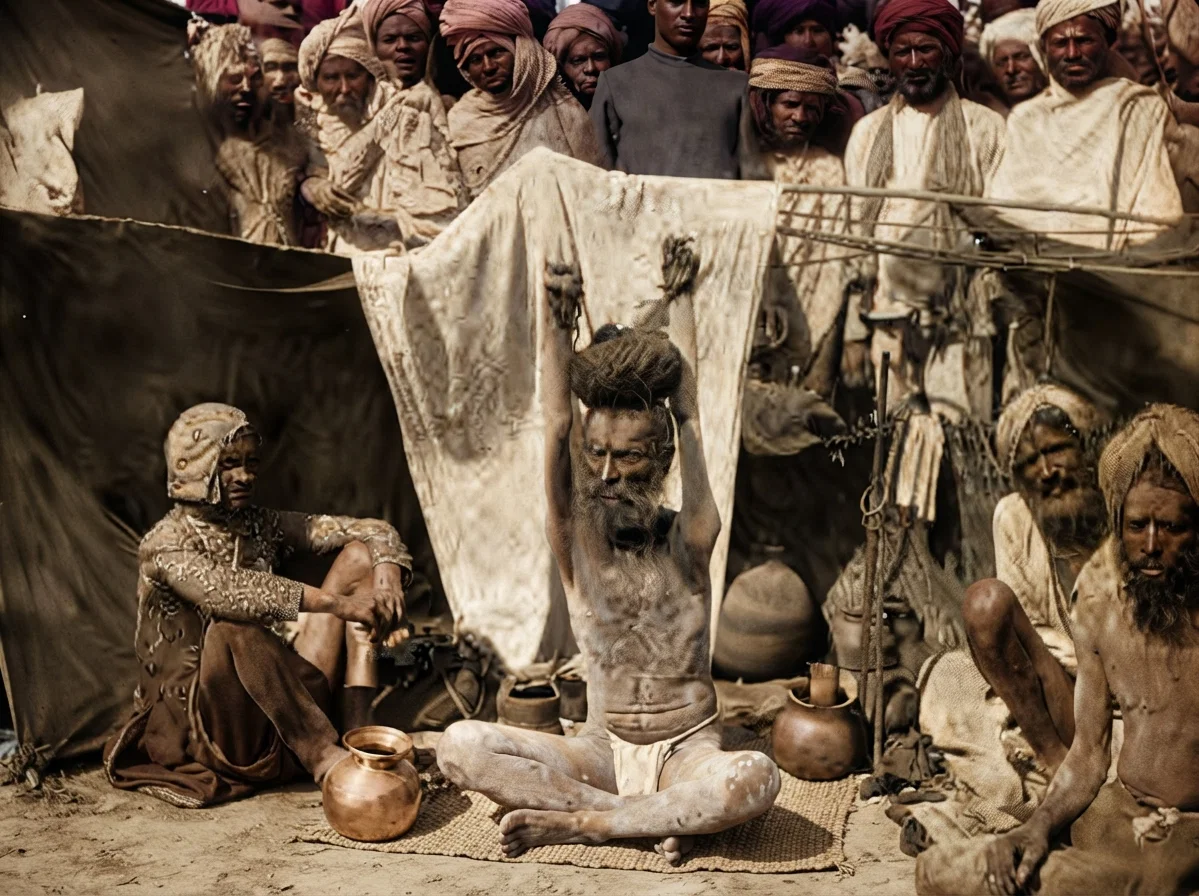
Hindu Fakir, or Fanatic, Who Has Held His Arms Above His Head until They Have Withered and Grown into that Position.
Worship of Four-footed Beasts and Creeping Things.
To the Hindus the cow is a sacred animal. He who takes the life of a cow offends the Hindu. "He that killeth an ox is as if he slew a man." Altho they mistreat the ox, and make him pull heavy burdens under pain and torture, they do not think it right to kill except for sacrifice. The following from the hymns of the Rig-Veda is one expression among many showing their devotion to the cow. "To me the cows seem Bhaga [god of good fortune]; they seem Indra [god of the blue sky thunder]; they seem a portion of the first-poured Soma [the moon-god]; these present cows, they, O ye men, are Indra. I long for Indra with my heart and spirit."
The serpent with its deadly venom is worshiped; and instead of destroying this minister of death, the Hindu pays homage to it, and allows it in some instances to live in his house. So little has been done to destroy these animals that they are prevalent outside of the cities, and thousands of people are killed as the result. Twenty thousand were killed by snake bites last year.
A Religion of Self-Righteousness.
Hinduism is a doctrine of justification by works. There is no faith in it. Its devotee seeks salvation through self-righteous deeds. He resorts to penance to free himself from sin, and to the most terrible torture of body to make himself good. The accompanying picture shows a fakir who has held his hands up since infancy. The Hindus call him a holy man, and go great distances to see him. He has become so good and his mind so holy that he has forgotten his bodily existence. He will not have his nails trimmed or hair combed. The hair is matted upon his head, full of grease and filth. The more hideous his appearance through neglect of the body, the better. It shows that his thoughts are above the world.
A few months ago the writer visited a native festival, and the cruel sights of self-inflicted torture were abhorrent. One man was lying in the sun, beating himself upon the chest. He had been doing this for days. Another was lying on a bed of sharp spikes. How he could endure such torture is a marvel. The people going by threw him money for his righteous deeds.
What a deliverance God has for these people,—a salvation for body and soul without pain or penance. "Come unto Me, all ye that labor and are heavy laden, and I will give you rest." Some are coming, and, thanks be to God, they are finding rest. The Orient wants a thousand consecrated voices to say, Come; and then many more weary, heavy-laden souls will respond, and be emancipated from the sins of self-righteousness. J. L. SHAW.
Calcutta, India.