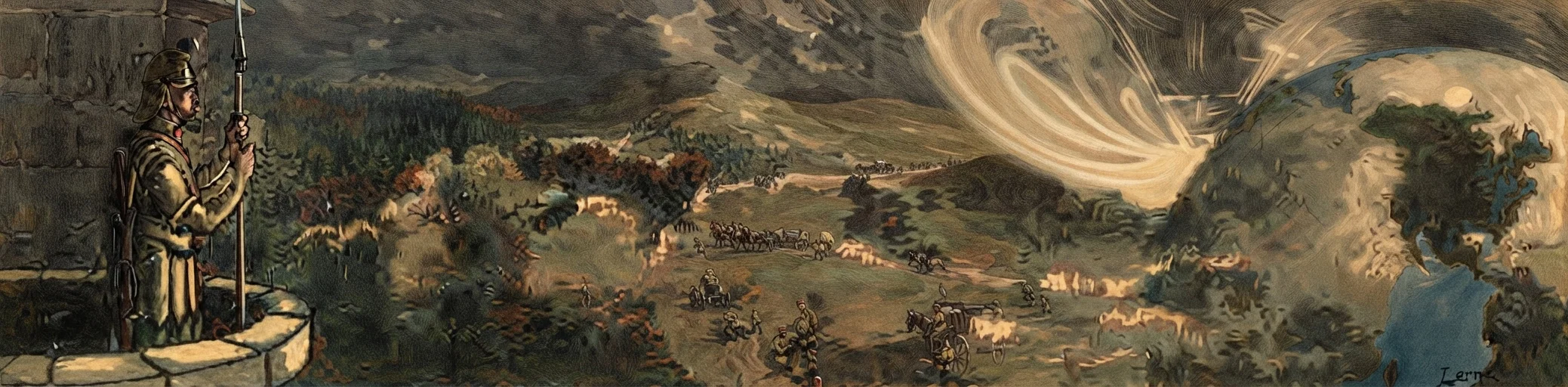
A TRADER of Mukden, Manchuria, is credited with the following statement concerning the Russian retreat from that place:
Officers came in from the front, went to the restaurants and drank themselves stupid. Officers and men senseless with vodka were piled in the waiting trains. Chinese servants threw their drunken masters in carts like so much wood and started them north. We finally reached Tie Pass, but still there was no rest. Tie Pass had been a great place before—music, lots to drink, many traders, many women. Now it was all upside down. The retreating soldiers looted all the shops and sold the stuff to their comrades. Champagne at a ruble a bottle, brandy, gin, rum, everything as cheap as water.
Another statement of the Russian Government's general disregard of the welfare of her soldiers, as given in the Philadelphia Ledger, is as follows:
The Russians left their wounded to die and their well men to suffer, because the hospital and medical services were insufferably equipped and handled, and because the hospital and other looters had stolen or sequestered the supplies.
With this let us compare a paragraph from the Christian Statesman, referring to the Japanese:
The Japanese military ministration has been a model of efficiency and economy. One of their leaders said at the outbreak of the war: "We propose largely to eliminate disease as a factor in this contest." And they have done so. A very small fraction of the Japanese soldiers have died of preventive diseases, while the percentage of the wounded who have failed to recover has been wonderfully small. This has been due, as competent observers declare, not only to scientific methods of treatment, but to the integrity with which the service has been administered.
Here we have a marked contrast between the humanity manifested by a country in which a heathen religion prevails and the moral degeneracy of a nominal Christian church-and-state government. From this, as Emperor William of Germany says, "we must not draw the conclusion that Buddha is stronger than our Lord Christ." The Russian Government and the Russian army and navy do not in any true sense represent Christianity. That government is an illustration of a government largely influenced by a church called Christian, yet whose worship is as idolatrous as that of Buddhism.
The ancient government of Papal Rome and that of Russia are two gigantic monuments of the folly and wickedness, the terribly degenerating influence, of any attempt to make any kind of religion a controlling element in secular government. These two governments demonstrate to what extent even the Christian religion—the best the world ever has known—may be prostituted by endeavoring to make it a dictator or arbiter in the affairs of civil government.
Yet with these extreme examples before us, there is a large and growing class of churchmen in our own country persistently pushing to the front the alleged need of a national Christianity. This is called "national reform." Did it reform Rome? Has it reformed Russia?—No; nor will it any more reform the United States. No religion in the world, that is or ever has been, is so poorly calculated to yoke up with a worldly government as the Christian religion. It can not do so without first departing so far from the Standard of faith as to be unchristian, and then it must inevitably corrupt whatever it touches. A majority of the great government corruptors of this country are professors of the Christian religion, and the proposed national religion would class them all as such. Could there be a greater travesty on Christianity?
Shall we not learn by the experience of others? Christ has left it on record that He is not of the world, His followers are not of the world (John 17:16), and His kingdom is not of this world (chapter 18:36). Pilate found no fault with this last statement; for he understood, as any one else might understand, that Jesus did not purpose to interfere in any way with the civil government. And His apostles all maintained that idea throughout their lives. When Christ does interfere with the governments of earth, it will be to break them in pieces, and in person to set up His own glorious kingdom, which will fill the whole earth. See Ps. 2:7-12; Dan. 2:31-45; 2 Tim. 2:4.