ABRAHAM, the father of those that believe, did not at once come to full growth in his stalwart faith. He believed God, but through years which followed his faith was weak and lame. By miraculous power, questioned of Abraham, God gave him a son in his old age. When the child became a comely youth, the pride of the father's heart, the supreme test of faith came to the father in the command to offer that son as a sacrifice. Abraham met the test without question; the hand raised to slay was restrained to strengthen and soothe, and a sacrifice was furnished in place of the son which he loved. There God revealed Himself in a new light to Abraham; under a new name—Jehovah-jireh, "Jehovah will provide."
How GOD has thus demonstrated His love through all the ages in all the common blessings of life, in common light and common air, in common water and common bread! God manifests His goodness in preserving the lives of His children. So needed are these common blessings, so unappreciative are we of them all, till deprived of them or of the power to use them!
BUT more than all these common blessings is the great uncommon, unique gift in which all these blessings are bound up, Heaven's best Gift, the sacrifice, the life of the Son of God's love. And these common blessings are ours to-day, because this world is redeemed—under the bond of the blood of Jesus Christ. In the light of the cross—the climax of the sacrifice—all the common and uncommon blessings of life are blood-bought, whether we believe it or not. All that we use and consume to perpetuate our lives is a gift from His hand.
FOR forty years in the wilderness God fed His people with "the corn of heaven." Morning by morning it fell; and He did it that His children then and at all times might know "that man doth not live by bread only, but by everything that proceedeth out of the mouth of Jehovah doth man live." Deut. 8:3. The fall of man's "daily bread" from heaven was to be, for all ages, the assurance that God is the great Provider; that, doing His will, we might trust the future with Him.
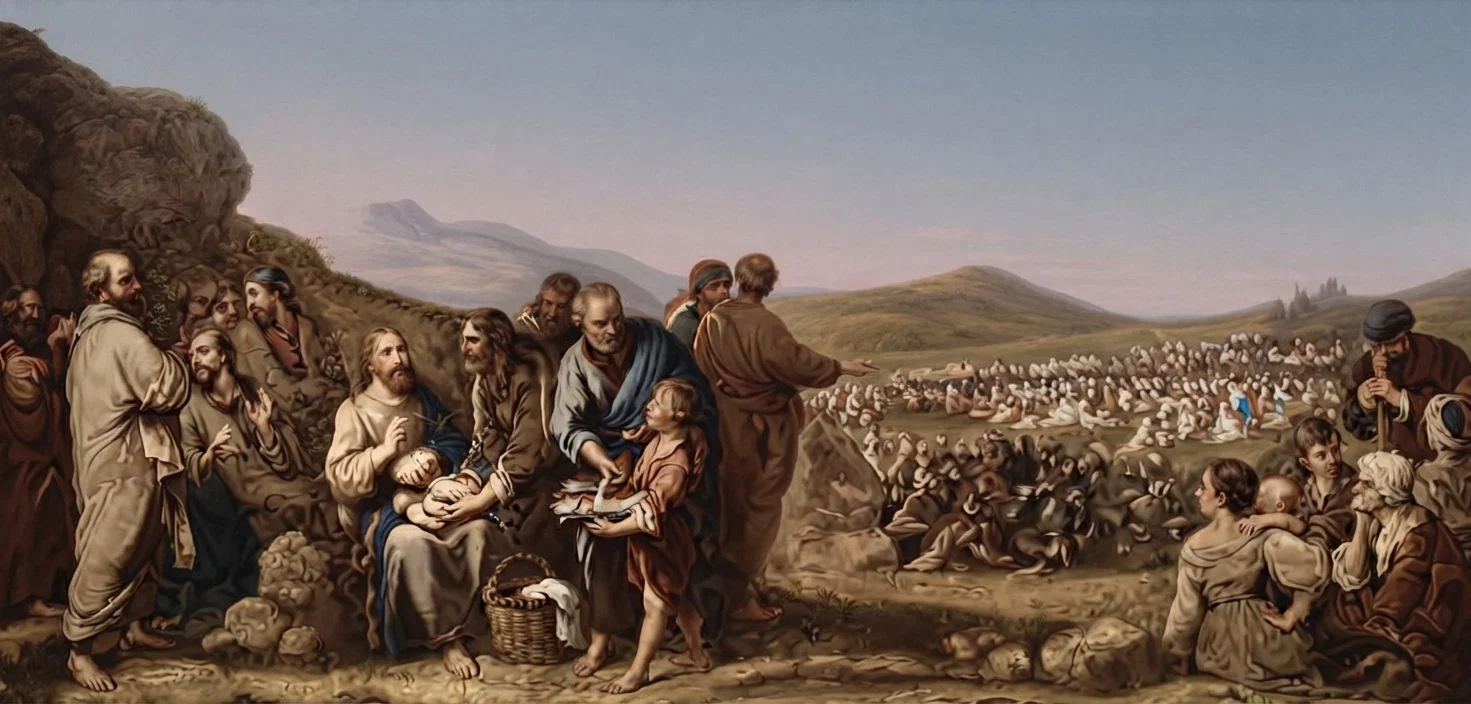
"HE DIVIDED THE LOAVES AND FISHES AMONG HIS DISCIPLES."
WHEN Jesus came to this world, He was God manifest in the flesh, and hence Jehovah-jireh. He came to provide them the bread of life. But the gross hearts could not appreciate the spiritual life, and the Master must so work that even the gross materialist could see that Jesus could supply the deeper needs of the spiritual side of man, as well as the physical need. And therefore He fed them.
YEA, as of old, He fed them in the wilderness. Read the account in Mark 6:35-44. See, also, in Matthew 14, Luke 9, and John 6. The weary Master had called His disciples apart from the crowds and cities and busy haunts of men to rest awhile. But it was useless. The people, knowing of the wonder-working power which went with Jesus, followed Him on foot a great multitude. Jesus looked upon them as sheep without a shepherd, scattered upon the dark mountains, and His heart was touched. They were in need, and there the heavenly manna fell from His lips during the day in words of life.
AS THE day declines, the disciples grow anxious. There was a great multitude of people, far from any supply house, with no provision for their needs. The disciples go to the Teacher, and ask Him to send the multitude away, that they may go into the villages round about, and get food. But Jesus calmly replies: "They have no need to go away; give ye them to eat." The reply seemed so preposterous to them, and they answered: "Shall we go and buy two hundred shillings' worth of bread, and give them to eat, that every one may take a little?" That sum of money, about thirty-three dollars, probably constituted the cash assets in the Christian treasury. But all that expended in bread would give each one but a meager morsel. What could the Master mean?
AND then He asked, "How many loaves have ye?" They investigate, and reply, "Five, and two little fishes; but what are these among so many?" His only response was, "Bring them hither to Me." His next command was that the people should be made to sit down upon the green grass, disposed in4rows, by hundreds and by fifties, and it was done. And then He took the little quantity of food that a dozen men could have eaten, and looked up to heaven and blessed it, and broke the loaves. Strange indeed it must have seemed to the people that any one should even attempt to feed a multitude of perhaps ten thousand with such a miserable dole. Surely, He must be insane or divine.
HE divided the loaves and fishes among His disciples. As they passed from one to another the food multiplied in their hand, and, as the people partook of the blessed bread, it was again multiplied, till all had eaten, and all were filled, and there was left twelve basketfuls, besides pieces of the fishes. The fulness of the Godhead was in the food blessed of Him. The people knew the deed for what it was, a mighty miracle of God; and they said, “This is of a truth the prophet that cometh into the world.”
JESUS CHRIST is still the great Provider; and Jehovah-jireh is His name. We may go on our way of unbelief, refuse to obey His commands, and may eat our unblessed food alone. It will do us little good and others none. Or we can trust God, obey His commands, give our all into His hands, co-operate with Him in its distribution among the needy, and have the satisfaction of seeing them blessed and filled, and we ourselves left with more than when we began. “The liberal soul shall be made fat; and he that watereth shall be watered also himself.” “And he that supplieth seed to the sower and bread for food, shall supply and multiply your seed for sowing, and increase the fruits of your righteousness.” Truly, we can say with an apostle: “And my God shall supply every need of yours according to His riches in glory in Christ Jesus.”