THE ISLAND OF JAMAICA

6%

Pacific Press Publishing Company · Oakland, Cal. · Jan 6, 1904

FromSigns of the Times, Vol. 30, No. 1.

Read the full edition

THE ISLAND OF JAMAICA.

SELDOM does a weary seasick voyager meet with a more beautiful sight than that which greets his eyes on approaching the evergreen isle of Jamaica. Its surface is literally covered with mountains, gorges, and valleys. Peak rises above peak, until, in the Blue Mountains, an elevation of 7,360 feet is attained. These hills, altho composed largely of limestone rock, are covered with verdure to their very summits. Sea-shells and coral are found in many places, even on the mountain tops, indicating that the land was once covered with water.
When Christopher Columbus and his small band of bold adventurers discovered this spot, May 3, 1494, they found it occupied by Indians, living in peace and plenty; but not much longer were they permitted to enjoy their quiet manner of life; for no sooner did Columbus return to Spain and report his wonderful find, than many decided to try their fortunes in the new Dorado.
Upon the arrival of the Spaniards, the Indians arose in arms to repel the invaders. But the natives were cunningly deluded by fair promises; the wily foe won over their unsuspecting natures. However, the Spaniards were no sooner able to execute their bloody designs, than they began a terrible slaughter of the simple-minded people. In a few years no less than 60,000 had been put to death. Erelong the very name of Indian was rooted out, and none left to bear witness to the existence of that once flourishing race. Previous to this, Jamaica had been the most densely inhabited of all the Antilles.
While engaged in this war of extermination, the Spaniards made several temporary settlements in Western Jamaica. At length they decided on Saint Jago de la Vega (now Spanish Town), and there founded a fine city. The savannas (fields) which to-day are so barren and useless, were then the richest and most highly cultivated portions of the island, yielding all manner of necessaries. Here, with nature lavishing upon them her almost boundless store, they could say with the rich man of old: "Soul, thou hast much goods laid up for many years; take thine ease, eat, drink, and be merry." But, like him, they were not left long in the enjoyment of their ill-gotten and blood-stained treasure.
The usurper became the usurped. From the time Sir Anthony Shirley (1596) made his attack upon Jamaica, and plundered and burned Saint Jago, until its final occupation by the English, May 11, 1655, many and sanguinary were the struggles that took place. Among the silent witnesses of those troublous times are the cannon now serving as "bumpers," on the street-corners in different parts of the island.
The English were not slow in occupying their newly-acquired possession. Like the Spaniards they employed slaves in the cultivation of the soil. In 1734, the Maroons (as the slaves left by the Spaniards were called), who had taken refuge in the mountains, and whose numbers had been swelled by the accession of runaway slaves formerly owned by the English, until they were several thousands strong, began to give trouble, whether justly or not, we can not say. Led by the notorious Nanny, the renowned Maroon leader, they made their headquarters on one of the naturally fortified ridges, and the regular troops were unable to cope with them. It is said that bloodhounds were imported from the United States, and let loose upon them, before they were brought into subjection. Altho they suffered defeat then, many of them are to-day gaining a glorious victory in the progress Christianity is making in their midst.
Some of the horrors of the old slave days are being revealed to this generation. In the museum at Kingston hangs an iron cage that enclosed the skeleton of a person who had evidently been placed in it alive, and had suffered death by torture and starvation. It was made with hinges, to fit any sized body, and the sharp iron spikes in the bottom were for the victims to stand upon. It was discovered near Kingston a few years ago, after a heavy rain-storm had washed out the road where it lay buried. Other instruments of torture have been found.
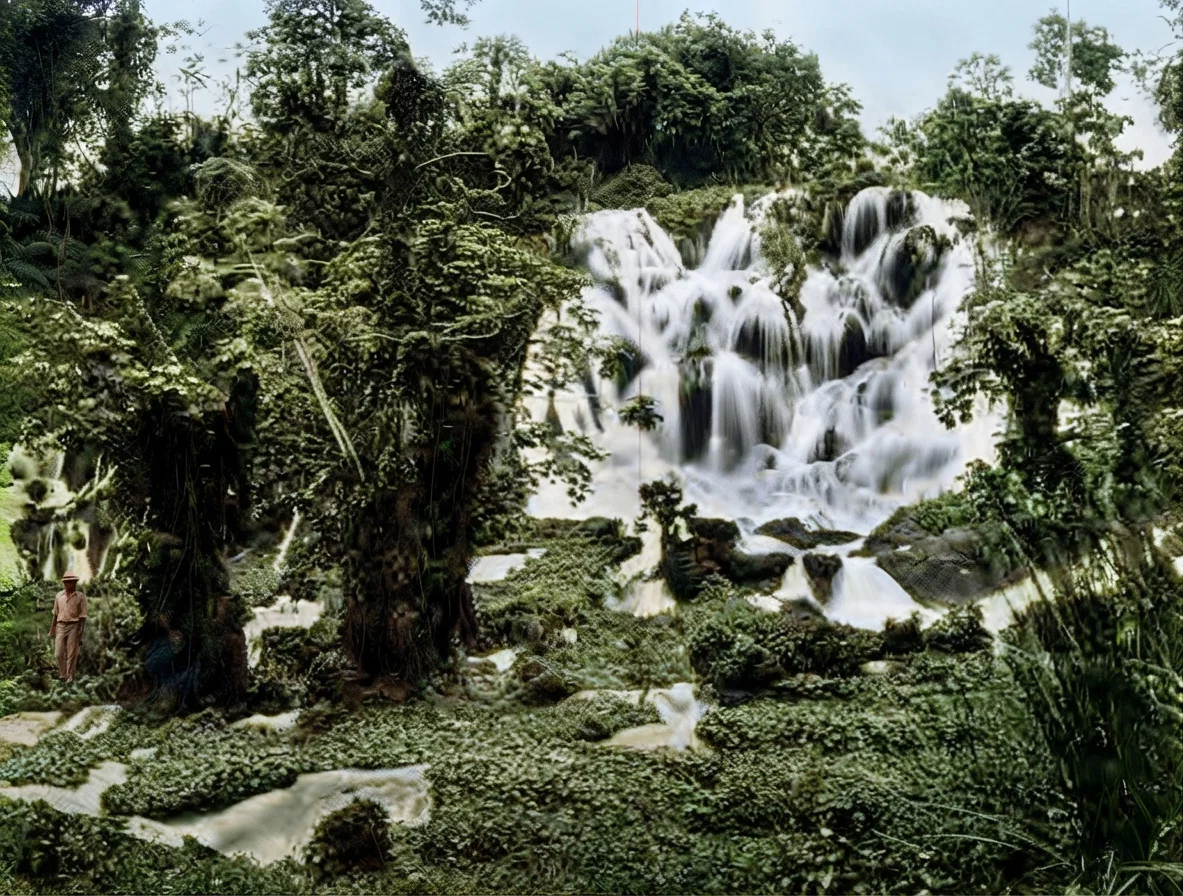
A Typical Jamaican Waterfall.
August 1, 1834, slavery was abolished, and four years later absolute freedom was conferred upon the whole population. Altho more than sixty years have gone by, yet the effects of slavery are still seen in the low morals of that people. But through the blessings and influence of the Gospel many are learning a better way, and walking in it. Missionaries find here a wide field of usefulness.
January 17, 1692, occurred one of the most violent earthquakes that was ever felt. All the houses on the island were thrown down; mountains were split, and whole plantations were moved out of place. Port Royal suffered the greatest damage; at that time it was a city of several thousand inhabitants. It was reputed to be the richest spot on earth. For many years it had been the rendezvous of pirates who had been very successful in their depredations, and had brought thither their ill-gotten gains. The people of the island are supposed to have welcomed and protected these marauders because of the wealth they brought. In two minutes nine-tenths of the city had gone down, and with it immense treasure, and 3,000 human beings.
"I have seen the wicked in great power, and spreading himself like a green bay tree. Yet he passed away, and, lo, he was not; yea, I sought him, but he could not be found. Mark the perfect man, and behold the upright, for the end of that man is peace. But the transgressors shall be destroyed together; the end of the wicked shall be cut off." Ps. 37: 35-38. At the present time, the tops of the buildings in the doomed city may be seen in the depths of the clear water, ever bringing to mind the sad fate of those wicked men.
The inhabitants that escaped left the place and built Kingston, which is to-day the metropolis and capital, with a population of 50,000. The houses are usually but one story high, on account of the hurricanes and earthquakes. It is said to be the hottest place in the island. Here the mean temperature is about 78°. The thermometer registers lower in the hills and mountains until an average of only 56° is found. As Jamaica is situated between 17° 48' and 18° 32' north latitude, of course winter is unknown. There is one perpetual summer, and the temperature in any given place scarcely varies 20° the year 'round, thus making a very desirable climate.
According to the census of 1891, the population of Jamaica was 639,491. Of this number 14,692 were whites; 121,955 colored; 488,624 black; 10,110 East Indians; 481 Chinese; and the nationality of 3,623 was not stated. The estimated number of inhabitants in 1902 was 750,000.
The government has constructed good roads around the island, and in several places in the interior. A railway 125 miles in length connects Kingston with Montego Bay. It is a wonderful specimen of engineering skill. Three-fourths of the distance this railroad forms almost one continual wind and twist through mountain gorges, or skirts mountain sides, or plunges through them. It is impossible to picture the beauty of the scenery along this route; to be appreciated, it must be seen. Branch lines run to Ewarton and Port Antonio; sothat nearly all parts of this otherwise almost inaccessible island are made accessible.
The extreme length of Jamaica is 144 miles; its greatest width is 49 miles; and its least width (from Kingston to Annotto Bay) is 21 1/2 miles. Its aboriginal name was Xaymasa, a word supposed to imply an overflowing abundance of rivers. This meaning would not be inappropriate, for in many parts of the island springs and rivers are numerous.
Because of its central position among the West Indian islands, and owing to the fact that it lies in the direct route between Europe, the United States, and the Isthmus of Panama, Jamaica offers great advantages for trade, commerce and missionary work.