METEOROLOGICAL RECORDS

7%

Pacific Press Publishing Company · Oakland, California · Jan 15, 1902

FromSigns of the Times, Vol. 28, No. 3.

Read the full edition

METEOROLOGICAL RECORDS.

THE title of this article would frighten a small child; but it must be remembered, as I have said before, that these articles are not written for children, but rather for those who have to do with their education. Meteorology is that department or branch of science which treats of the atmosphere, especially of that which relates to climate and moisture. Meteorological records are records of the changes which take place in the atmosphere. The study of the last article on clouds would be included in this department of science, and the records which are made will involve an observation (and recording) of different kinds of clouds.
The making of records is of value in itself. It leads not only to observation, but stimulates to accurate observation, and accurate observation is the only kind of observation through which God can reveal Himself. This is so for two reasons: God is a God of system and order, and He can not well show Himself to the careless observer, for such an observer is a thoughtless one. And again, the wonders of nature are not revealed most forcibly on the surface. God manifested Himself in the still small voice on a certain occasion, and so in the works of His hands, he who looks carefully and listens most intently will see that which is most beautiful and wonderful, and will hear the finer harmonies of all His doings. The spirit in which we should always come to the study of God's works is well illustrated by the saying of a noted scientist to his assistant. The two were in their laboratory, and were about to perform an important experiment. The assistant was making some light and careless remarks, when he was interrupted by the scientist's command, "Be still, I want to ask God a question." The great inventor Edison says that often in his laboratories, as he sees the marvelous life and power of God shown in his experiments, he is awed into a fear, for he seems to see all but the very presence of the Omniscient One. Such a reverence on the part of all who study the works of God as these men had, will not allow them to make careless and inaccurate statements concerning those works.
Every man, woman, and child should be interested in something that is growing. God manifests Himself in everything whether animate or inanimate, but it is in plant and animal life that perhaps we most readily see and appreciate the wonders of His work. So if no more than two or three square feet of ground can be obtained in which to plant and watch the growth of flowers or vegetables, the ground should be so used.
The atmosphere has the closest and most practical relation to all the conditions of life. In a former article I made a statement that even a slight variation in the average temperature of a country would, in many cases, completely change the productions of that country. Now, as the atmosphere bears such close relation to life, its study becomes an imperative necessity to all students of the works of God. Many a farmer would be more successful in his farming, did he make a closer observation of the conditions of soil and moisture in their relation to growth. Practical farmers are at times inclined to scoff at the teachings of scientists, and often they have a just occasion; for many of the theories advanced by students of science are of little worth, because they are not practical.
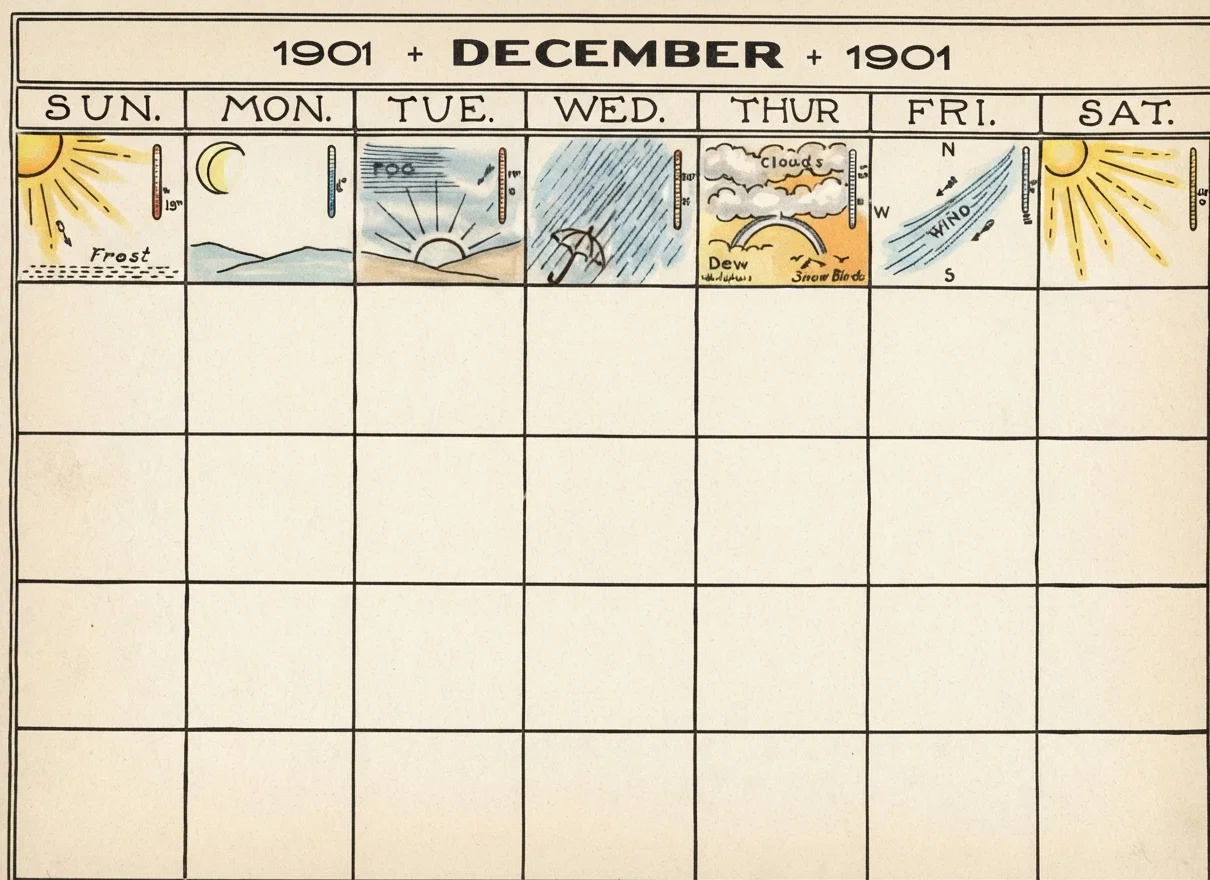
Meteorological records can be very easily prepared. Draw a page into as many squares as there are days in a month, and you have the blank record. One of these pages so marked off may be for the temperature; another for the record of cloudiness; another for dew or frost, or neither; another for the wind and its direction; still others for rainfall, length of day, increase in the day's length, and variations in the rising and setting of the moon.
Now all these records may be well combined in one. Make the spaces large enough so as to admit of all being represented. Then let the children show the weather conditions by drawings in spaces designated to each day. The accompanying illustration will give some hints as to how the conditions of the weather may be represented in a record. This illustration is simply suggestive, and many other ways of showing the weather conditions will occur to the mind of one who is interested in making these records. It does not follow that the records have to be made in drawings as I have here suggested, nor that the conditions of the weather each day have to be gathered into one space; for they can be written in separate records as I have suggested. But the value of having them gathered into one space each day is apparent, for there is graphically and interestingly shown, the conditions of each day. For the child these spaces will have to be much larger than shown in the illustration, and it may be well in some cases to make the record for each week rather than for a month. Let me here again urge the importance of drawing as a feature of education, teaching us, as it does, to see in form and color the beauty which the Lord has made.
Not only that, but it places in our hands a very powerful means of expressing our thoughts. The publications of to-day would be of far less value than they are, had they no illustrations. A picture reveals at once a whole story. This is why I suggest the gathering of these facts concerning each day's weather in this form. The majority of people feel that they have little or no ability in the direction of drawing, and this is true, but this can be developed to a surprising extent. The reason that so many fathers and mothers are wanting in this respect is because, as children, they did not have placed in their hands colored crayons, paints, or pencils. These should be considered a necessity in the education and training of every child. It is rare indeed that a child will hesitate to reproduce anything it sees.
These weather records should be taken at a regular time each day. The record of the thermometer, for instance, will be of little value, if it is not recorded at about a certain time every day. A few moments spent with the children in making these observations, and assisting in illustrating them, will be of profit to parents as well as children, and no parents should be so busy but that they could have a few minutes at least each day to spend with the children in some such way. The development of many children is greatly hindered, because of this lack of time spent with them by parents.
Summaries should be made both weekly and monthly. The value of the record is quite largely in these summaries. The facts to be placed in the summaries can be recorded in writing or by drawing. Such summaries can include the number of dews or frosts, the prevailing wind, the number of cloudy days or clear ones, the number of days on which rain fell, the mean temperature, the length of the longest and shortest days, the increase or decrease of the day's length, and the total variations in time of the rising or setting of the moon.
Children five or six years of age will often comprehend and enjoy these studies with a little help from parents. Many suggestions of value may be obtained from a little pamphlet, entitled "Instructions to Voluntary Observers of the Signal Service," which can be obtained free by sending the request to the chief of the Weather Bureau, Washington, D. C.
Constant reference to the Bible upon all of these subjects will not only stimulate interest, but will greatly strengthen the child's reverence for God in his studies. The heavens declare the glory of God, and the firmament does show His handiwork.
FREDERICK GRIGGS.
South Lancaster, Mass.