THE Bible tells us that “righteousness exalts a nation;” but a false religion has no such tendency. On the contrary, it weakens and degrades. This fact is forcibly illustrated by the influence of Mohammedanism on the adherents of that religion, as brought out by Henry Otis Dwight, LL.D., in a recent work, published by Revell, “Constantinople and Its Problems.”
The mental stagnation of the Muslims is simply marvelous. Dr. Dwight says of the peasant Turks of Asia Minor: “The cart of the Turk of Asia Minor is the highest evolution of brain that he has ever seen; but do not think that he invented it. It has not a particle of iron about it, except the iron tires of its narrow-footed wheels.”
To build it, two long poles are laid side by side. At one end they are fastened together with a wooden peg, and at the other end they are spaced apart by a “wooden stretcher about two feet long. The small end of this triangle thus formed is the tongue, to which the long straight bar, which answers for the yoke, is lashed by thongs of rawhide. The broad end of the triangle is the body of the cart, and is filled with a rough network of rope.” The rest of the structure is equally rude.
When the cart is done, two buffaloes are hitched to it. The solid wooden “wheels and the axles revolve together like car-wheels. As they revolve, they give forth unearthly shrieks and groans. A caravan of these carts, carrying produce to the coast, enlivens the mountain sides with weirdly ringing music, and yet no one seems to have thought of diminishing the din by the use of a little grease.”
The inhabitants of the cities are not greatly in advance of their country cousins. Dr. Dwight says of them:—
One meets there Mohammedans who are dignified and commonly courteous officials and shrewd diplomatists. One admires there many patient and brave soldiers. But the Muslim masses are hewers of wood and drawers of water; they are bearers of burdens; they are donkey drivers; they are the smallest of small traders; they are artisans whose hands compete with their tools in clumsiness.
Closer acquaintance reveals the fact that from the beginning of Turkish history very many of the greatest men of the empire have been of Christian origin—men who took Mohammedan names and the Mohammedan religion as stepping-stones to greatness.
To-day the army depends upon foreign Christians for its organization as well as its arms and ammunition, and to a considerable degree for the instruction of its officers. The treasury would go to pieces if Christian counselors were not at the side of the Minister of Finance.
Rarely does a wealthy Turk venture to keep up an establishment without a Christian to manage. A Mohammedan banking-house is almost unthinkable. The most important publishing houses for Mohammedan literature are owned and operated by Christians, and the most influential Mohammedan newspapers are Christian property. No Muslim machinist succeeds, unless he has a Christian for chief. The architect who builds the mosque is a Christian. Turkish steamers are bought abroad; or if built at great expense in Turkey, the man who makes the plan and the builder who follows it are both Christians. The steamers are rarely trusted to Muslim captains; and when they are, they can be recognized as far as they can be seen by their dilapidation and disorder.
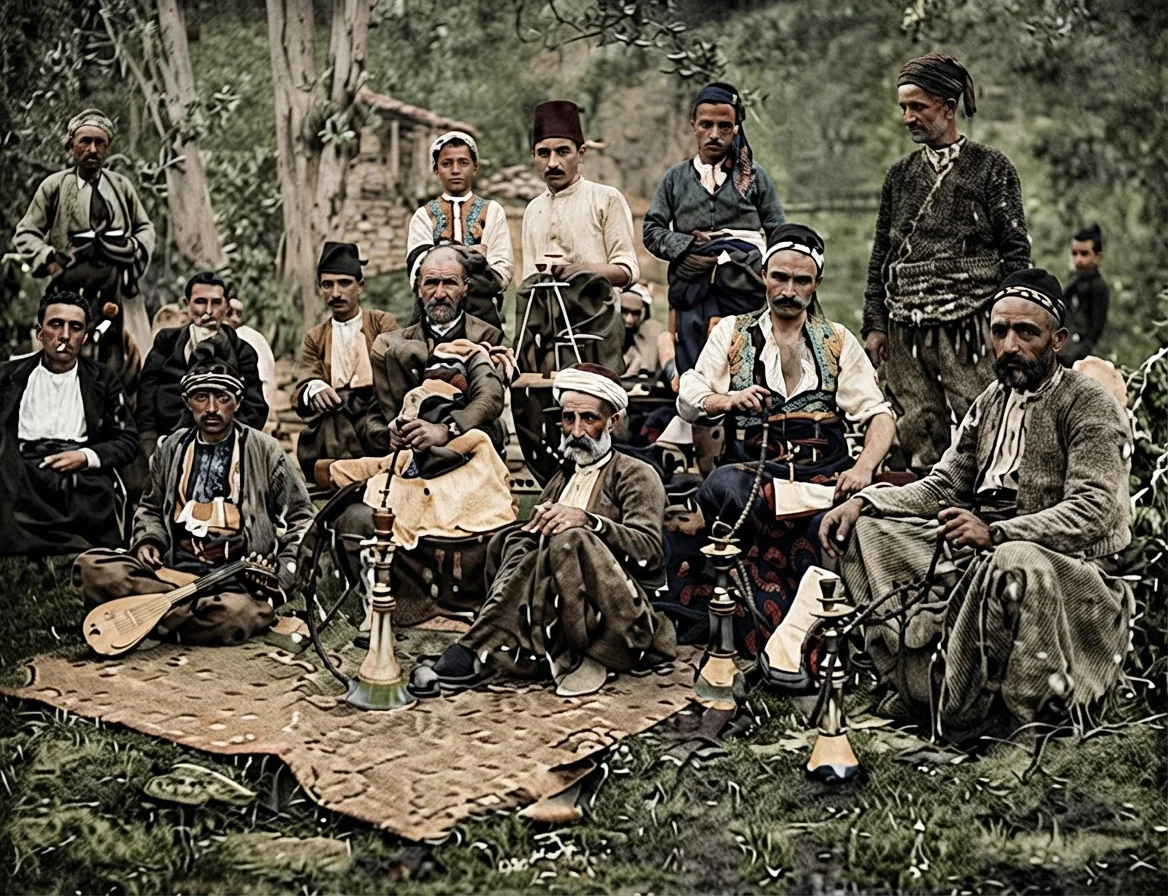
A Group of Turks.
The inefficiency and mental stagnation of the Muslims is attributed by Dr. Dwight to three fundamental principles.
1. “God is too merciful to reject any believer for yielding to the impulses of his nature.” The Koran teaches: “God is minded to make your religion light unto you, for man was created weak.” The Muslims feel that they “are not placed in jeopardy by sin, and need no Saviour.”
2. “The moral law is too severe in its requirements for man to attempt to keep it.” The Koran says that God proposed the keeping of His law to all created things in turn, but all refused to be bound by so strict a law. “But man was foolish enough to promise to keep the law, and so fell under sin.”
3. “Ritual forms and observances constitute the obedience required of a Mohammedan by God.” In performing their acts of worship, the order of words, the genuflections, etc., are far more important than heart devotion. Indeed, failure to observe the exact form of the complex ritual spoils the whole worship, and all must be done over again.
These principles bear fruit in the lives of the “faithful.” So effectual is the barrier they raise against the Gospel, that Dr. Dwight is led to say, “Far-seeing purpose to thwart the essential aim of Divine Love could hardly more effectively have fortified the ground against influences which emanate from the Gospel of salvation and new-creation in Christ.”
This is the way he proposes to meet these conditions:—
The whole secret of gaining the respect and approval of Mohammedans for Christianity is contained in the one phrase,—Show them character. Christian character, known through experience, will actually do what controversy can not, what argument is powerless to accomplish, and what mere exposition of doctrine will go far to prevent. What they need is “a society truly Christian, that is filled with the Holy Spirit revealing Himself through righteousness and love.”
And this is the great need of the whole world. To reveal God is what Christians are in the world for.