AROUND the Sea of Galilee, occurred many of the most noted of Christ's miracles. The people of the northern part of Palestine were more ready to receive the Master; they were less bound by superstition and tradition. Here the great Teacher found a most fruitful soil, and here wonders and signs followed His teaching.
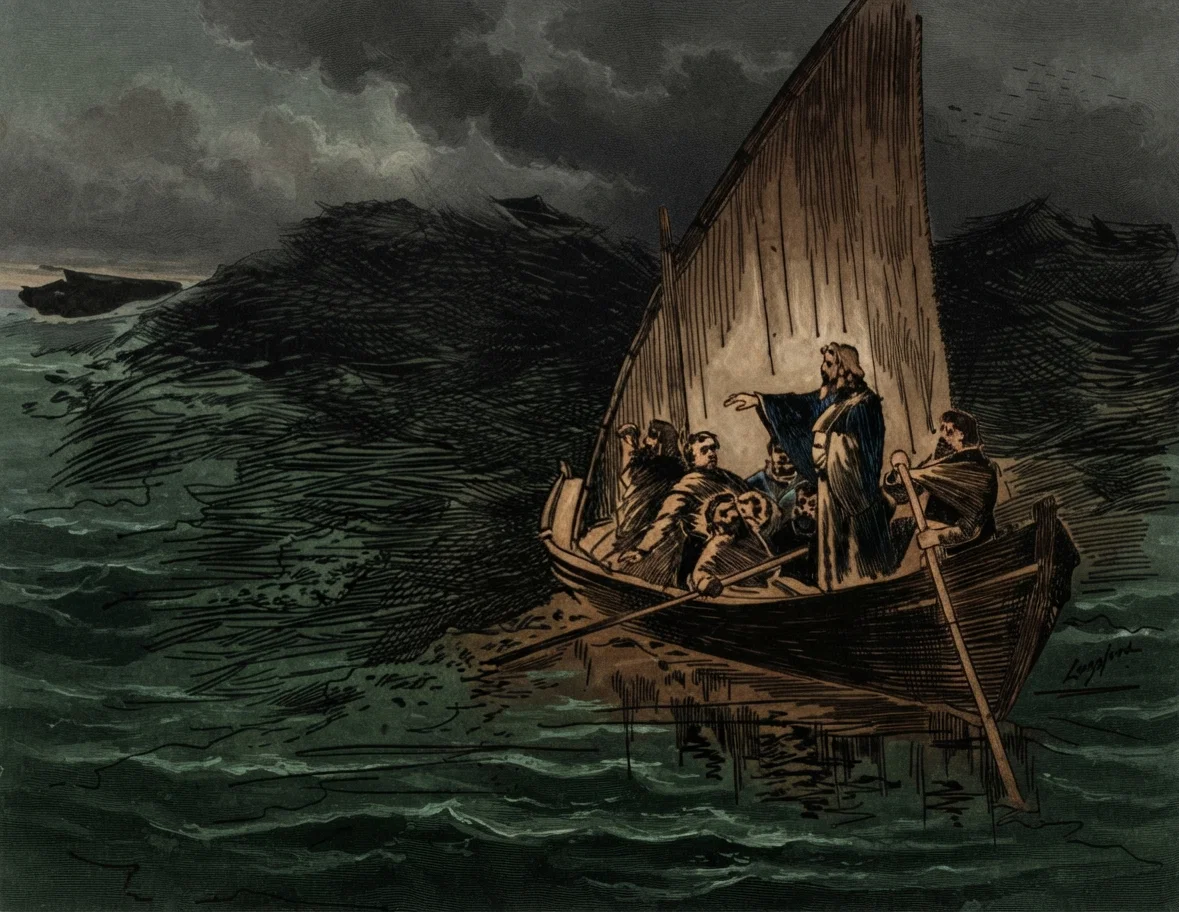
THE scene of our present miracle was "blue Galilee," so beautiful in its calmer days, so restless, turbulent, raging, when the fierce cyclonic winds of the superheated valley swept down upon its slumbering waters. It was after long hours of teaching the multitude, in which was included the parables of Matthew 13, that Jesus, weary with labor, suggested to His disciples to cross the little sea to the other side. (See Mark 4: 35-41, and also Matthew and Luke). Responsive to His wish they launch forth. Other boats accompany them. Jesus lies down in the stern of the boat, and is soon fast asleep.
THEN "the prince of the power of the air" thinks it possible to destroy the Saviour of men, and so destroy the race in destroying its Head. "And there ariseth a great storm of wind and the waves beat into the boat, insomuch that the boat was now filling." Danger was imminent and fearful. Men could not hope to live if the boat were wrecked or filled and sank. Row and bail as they will, they can not prevail against the storm demon. Their beloved Master seems to be oblivious of their peril, yet will they do all in their power before they disturb Him, calmly resting in the wild storm as tho He were sleeping in the arms of Infinite Peace, as He truly was. His life, His work, were God's; surely God could keep all that He had committed to Him. "Thou wilt keep him in perfect peace, whose mind is stayed on Thee; because He trusteth in Thee."
THERE seems to have been three calls from the disciples, utterances, perhaps from different ones, marking the progress of their fear and peril. First comes the almost reproachful cry to the wearied Sleeper, who seems so indifferent in sleeping in such a storm, "Teacher, carest Thou not that we perish?" As if to say, How can you sleep on when we are in such fearful danger.
WITH the hope that He might save them comes the second cry, "Save, Lord, we perish." It was acknowledgment that they had no power to battle with the fierce storm; their hope was in Him. But when He does not spring to their bidding at once, fear seems to have crept over them that all was lost; that the Master is Himself powerless to save, and the despairing cry is raised, "Master, Master, we perish. All is lost now."
AND then "He awoke, and rebuked the wind, and said unto the sea, Peace, be still. And the wind ceased, and there was a great calm. And He said unto them, Why are ye fearful?
have ye not yet faith? And they feared exceedingly, and said one to another, Who then is this, that even the wind and the sea obey Him?"
HERE is the lesson; will we profit thereby? There are storms of life which sweep over the human soul as fierce as any that ever beat down upon "blue Galilee." There are tempests of passion which stir up all the deeps of the human heart, till it seems that the soul must perish in their vortex. There are storms and tempests of hate, and lust, and passion, and lawlessness, and crime, which sweep over the world, over the nation, over the professed church of Christ, till it seems from the outward view that all is lost or overwhelmed, and the soul in anguish cries out as did Elijah, "Lord, . . . I am left alone, and they seek my life."
BUT let him who trusts God rest on His everlasting, strong promises. Our God is the Creator of heaven and earth. All power is His, He "ruleth in the kingdom of men." For a little while in His own wise purpose, He may suffer sin and its consequences, yet are they not forever. Every soul that trusts Him shall find deliverance. "He maketh the storm a calm, so that the waves thereof are still." Through tribulation and persecution and storm and tempest He will lead His people. If the storm be too fierce, call upon His name, and let Him say to the troubled heart, the heaving, surging passions, "Peace, be still." The same mighty power which the Christ of God exercised on Galilee He will use for you. He is "the same yesterday, and today, and forever."