STEPHEN, THE MARTYR

8%

Pacific Press Publishing Company · Oakland, California · Sep 19, 1900

FromSigns of the Times, Vol. 26, No. 38.

Read the full edition

STEPHEN, THE MARTYR.

WHEN the apostles counseled the church at Jerusalem to choose seven deacons, the qualification was that they should be "men of honest report, full of the Holy Ghost and wisdom." The first on the list of those chosen was Stephen, and of him it is especially stated that he was "full of faith and of the Holy Ghost." Again it is noted that he was "full of faith and power," and that he "did great wonders and miracles among the people."
ALTHO he was set apart especially to "serve tables," that is, to see to the proper distribution of food among the people who "had all things common," in order that the apostles might give themselves to the "ministry of the Word," Stephen soon became a power in spiritual work. So mightily did the Lord work through him that erelong he became the special object of bitter opposition on the part of the enemies of the Gospel. The learned ones of various schools undertook by their wisdom to overthrow his arguments, and to counteract his influence among the people.
"THERE arose certain of the synagogue, which is called the synagogue of the Libertines, and Cyrenians, and Alexandrians, and of them of Cilicia and of Asia, disputing with Stephen."
There was a combination of the world's leading wise men (after the flesh) pitted against one of the humble tho learned followers of Christ. It was a notable effort on the part of the enemy of souls, by a display of learning, to draw away disciples and to hinder others from becoming convinced of the truth. But the adversaries of Christ "were not able to resist the wisdom and the Spirit" by which Stephen spake.
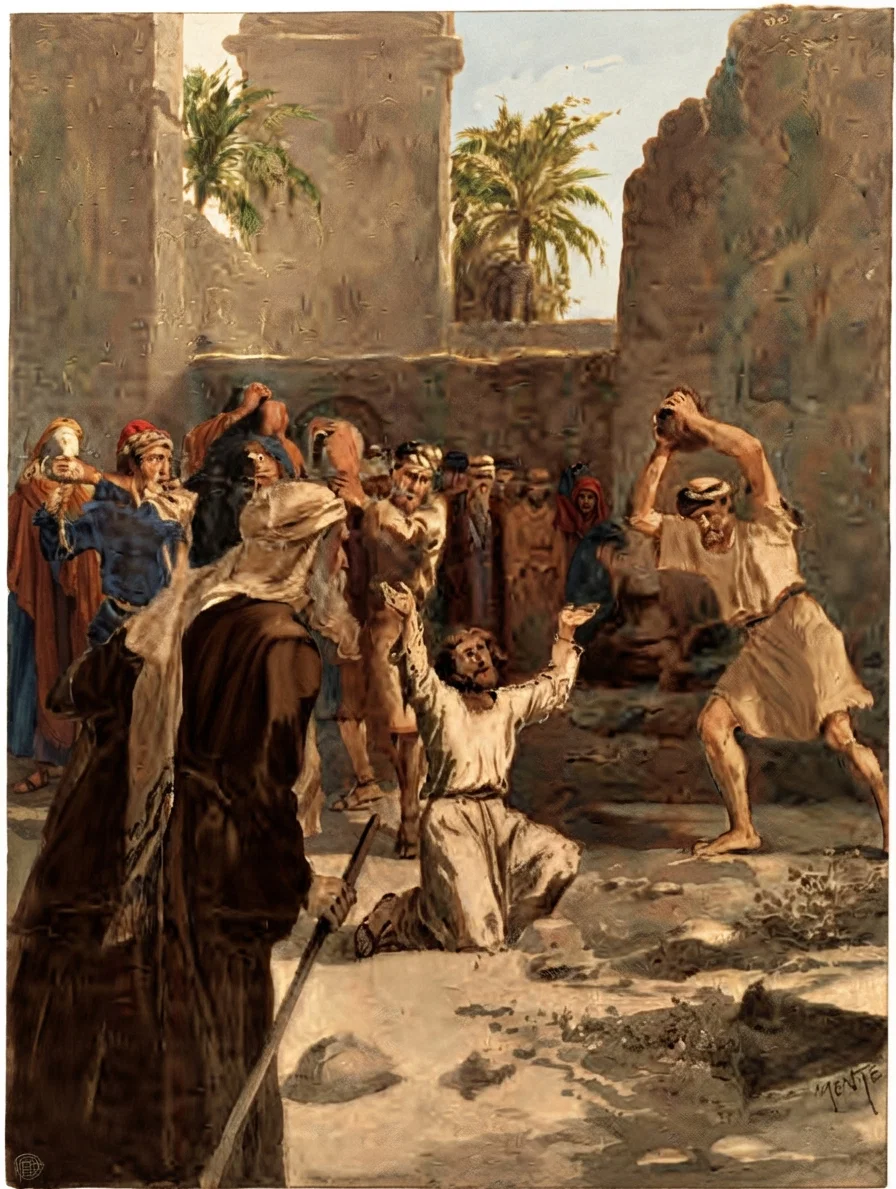
The Stoning of Stephen.
THEN followed the characteristic course of the enemies of truth. They are usually quite good natured as long as they can hold their influence with the masses by force of shrewd argument; but when that fails, there is almost certain to be a loss of temper, and, if possible, a resort to harsher measures. The enemies of truth are always unscrupulous, and are always ready to go as far as they dare in order to carry out their opposition. So in the case before us, the opponents of the Gospel began to persecute Stephen when they could not withstand him by fair means.
THEY began by bringing false charges against him. Then they "suborned men" to substantiate their charges. These hired falsifiers said, "We have heard him speak blasphemous words against Moses, and against God." This was designed to arouse the people, who were superstitiously bound to the traditional law of Moses as taught them by their leaders, and professedly zealous for God. The scheme was successful, "and they stirred up the people, and the elders, and the scribes, and came upon him, and caught him, and brought him to the council."
BEFORE the council Stephen was formally charged with speaking blasphemous words against the temple and the law. And the false witnesses declared that they had heardhim say that "this Jesus of Nazareth shall destroy this place, and shall change the customs which Moses delivered us." In refutation of these charges, before the accused man had been given opportunity to reply, the approval of Heaven rested upon him in a visible manner. "And all that sat in the council, looking steadfastly on him, saw his face as it had been the face of an angel." Had those who professed such zeal for the teaching of Moses really believed Moses, they would have recognized in Stephen's face the same glory that shone in the face of the patriarch as he came down from communion with God on Mount Sinai. But prejudice and jealousy are always blind to evidence, and Satanic hatred refuses to yield either to the Word of God or to manifestations of His power and glory. "If they hear not Moses and the prophets, neither will they be persuaded, tho one rose from the dead."
WHEN the high priest asked Stephen himself if the things charged against him were true, the prisoner entered upon an eloquent defense of the truth—not of his own person. He was earnest in his desire for the salvation of his persecutors. He rehearsed the history of God's dealings with His people from Abraham down to the building of the temple by Solomon, and his auditors were deeply interested in his theme and attracted by his eloquence. But when he said, "The Most High dwelleth not in temples made with hands," he was construed as speaking against the temple. Their disapproval was evidently so manifest that Stephen knew that further appeal was useless. So he boldly charged them with always resisting the Holy Ghost, with persecuting the prophets, and, finally, with betraying and murdering Christ. They had "received the law by the disposition of angels," and had not kept it.
HUMAN nature, backed by a determined unbelief, never can stand being confronted with personal sin. The utmost limit of power to resent it will surely be employed in whatever way is deemed most expedient. The truth had "cut to the heart" the persecutors of Stephen, and, in their rage, they "gnashed on him with their teeth." But the man of God was calm, "being full of the Holy Ghost." Looking up to heaven, he "saw the glory of God, and Jesus standing on the right hand of God," and faithfully bore witness to the fact.
THIS vision gave added strength to the hero of the cross, as he faced his doom; but his testimony and his fearlessness were too much for the enemies of Christ to bear. "They cried out with a loud voice, and stopped their ears, and ran upon him with one accord, and cast him out of the city, and stoned him." But Stephen committed himself to his Saviour, used his last words in prayer for his enemies, and "fell asleep." But the trying of his faith on this terrible occasion, his heroic defense of the Gospel, and his tragic death were not without fruit. One of his bitterest opponents, one who consented unto his death, afterward became the fearless apostle Paul. He faithfully served his Master through a long ministry of great persecution and suffering, and finally yielded up his own life in defense of the faith.
"AND devout men carried Stephen to his burial, and made great lamentation over him." For the full scriptural record of Stephen's call, trial, and death, see Acts 6:1 to 8:2. G.