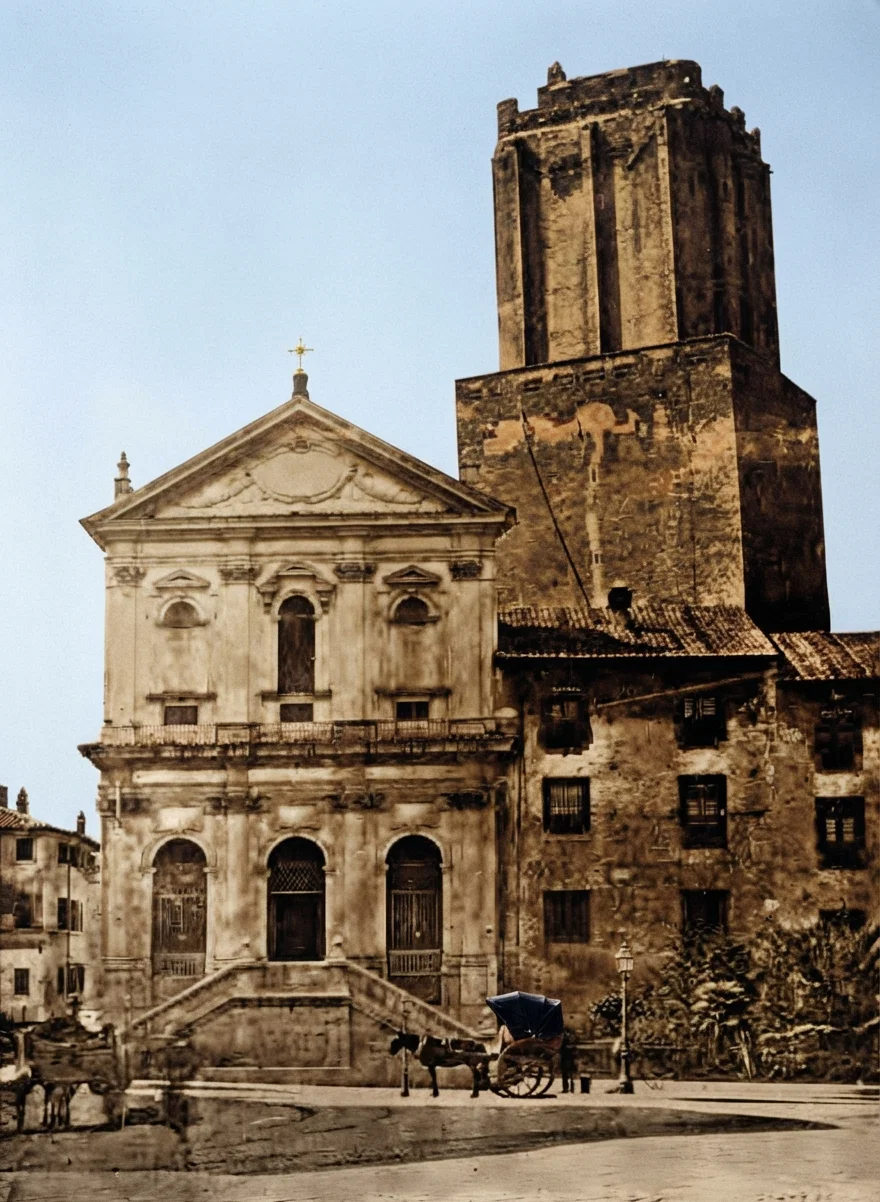
NERO'S TOWER

8%

Pacific Press Publishing Company · Oakland, California · Apr 16, 1902

FromSigns of the Times, Vol. 28, No. 16.

Read the full edition

NERO'S TOWER.

AN important text-book in the school of life is the history of the past. "Whatsoever things were written aforetime were written for our learning." At least some of the things written aforetime were experiences from which we may learn lessons. So it is sometimes important to be put in contact with the past, that we may learn from the experience of those who lived in days of old. The long past may sometimes be brought vividly near through the presentation of ancient structures in picture.
HOWEVER, were there no other purpose than the commemoration of a heartless tyrant and his wicked deeds, the tower still known by the name of Nero, emperor of Rome, would be a topic too academic for the general purpose of this journal. But the name and tower of the first Roman emperor who inaugurated a systematic persecution of Christians, may also be a memorial of a period of Christian faith and fortitude well worthy of frequent contemplation. Indeed, the Sacred Record itself gives testimony to these things; therefore they are worthy of consideration. The Word tells us of those who "had trial of cruel mockings and scourgings, yea, moreover of bonds and imprisonment; they were stoned, they were sawn asunder, were tempted, were slain with the sword; they wandered about in sheepskins and goatskins; being destitute, afflicted, tormented (of whom the world was not worthy); they wandered in deserts, and in mountains, and in dens and caves of the earth." Heb. 11:36-38.
NERO'S TOWER.
NERO'S TOWER.
NERO was born in A.D. 37, his mother, Agrippina, being a niece of the Emperor Claudius. At his birth the diviners, or fortune-tellers, said that some day he would be emperor. So his mother determined that the prediction should be verified. She became a
widow in course of time, and set about winning the affections of the emperor. In this she succeeded so well that he had his wife put to death and married his niece. Then she induced him to adopt her son Nero, and give him preference over his own son, Britannicus. After this she succeeded in having the emperor murdered, and then Nero was proclaimed emperor in A.D. 54, at the age of seventeen.
For five years, under the counsel of Seneca and other wise advisers, he did fairly well; but at last his natural instincts prevailed. He murdered his step-brother, Britannicus, divorced and then murdered his wife, murdered several leading men, among them Seneca and Lucan. Then he murdered his mother, who had so wickedly intrigued to promote him.
SUCH a man was ready for any Satanic act. In A.D. 64 a great fire broke out in the city, and burned for nine days. While the fire raged, Nero indulged in the most hilarious acts, playing on musical instruments, singing songs, and reciting verses on the burning of Troy. He was suspected of having been the instigator of the fire, and so strong did this impression become that he was obliged to devise some scheme to turn public suspicion in some other direction. So he accused the Christians of the crime, and began to persecute them in the most cruel manner. Thus the people of God were made the scapegoat to bear what would have been most outrageous punishments for even guilty parties. This persecution lasted during the remainder of Nero's life, about four years.
THE apostle Paul was one of the victims of Nero's vindictiveness, altho his death was not as atrocious as that of some others. Nero was the Caesar to whose court Paul was taken from Cesarea. The reference to "Caesar's household" in Phil. 4:22, is the household of Nero. It was to one of Nero's soldiers that Paul was continually chained during his two years of imprisonment in Rome. Thus we can account for some of those who were immediatelyconnected with the palace, becoming converted to Christ. During this first term of imprisonment, it seems there was no general persecution by the Romans. So far it had been at the instigation of the Jews.
THE tower represented in our illustration was built after the great fire to which we have alluded, the building in the foreground being a more modern structure. In the rebuilding of the city, the emperor did not neglect to build for himself a magnificent palace, highly ornamented with gold and precious stones. Of course a tower was a necessary accompaniment, and would be constructed in the most substantial and durable form.
IT is a notable fact that under such a corrupt and oppressive government, the church remained pure and experienced unparalleled prosperity. We have no record of any attempt on the part of the ambassadors of Christ to reform the government. It was not until the apostasy set in, and the church became corrupt through pride and ambition, that any union with the State or any part in political affairs was deemed advantageous. The doctrine of the apostles was: "Be ye not unequally yoked together with unbelievers; for what fellowship hath righteousness with unrighteousness? and what communion hath light with darkness? and what concord hath Christ with Belial? or what part hath he that believeth with an infidel?" 2 Cor. 6:14, 15.
AS WE look upon the monuments of those trying times, let us beware of the allurements to luxury and the temptations to carnal indulgence that beset our otherwise most favorable season. Let us remember that "when the south wind blew softly" it was "not long after" that there arose a "tempestuous wind." Acts 27:13, 14. May the tower of Nero be to us rather a memorial of the grace and faith in store for God's people under the most trying circumstances. G.