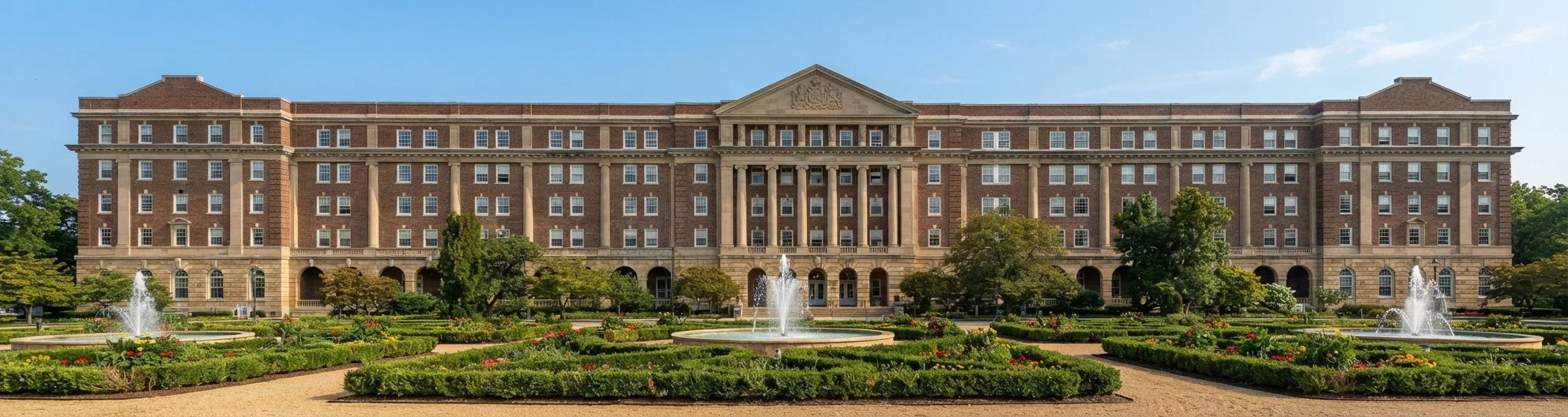
WE reproduce a drawing of the proposed building from the Battle Creek Enquirer. It may and probably will undergo certain modifications, but not such, it is thought, as will affect its general plan.
It is proposed to erect the new building of absolutely fire-proof materials, stone, steel, brick, and cement. The drawing contemplates a building 500 feet long, about 50 feet deep and 5 stories high, one story higher and 200 feet longer than the old building. Upon the top will be a roof garden. The first floor will be given to parlors, chapel, offices, etc. The dining-room and kitchen on the fifth floor, the north end, the surgical ward on the south end.
In the rear of the central portion of the new building will be five other buildings diverging from a central court, or enclosed palm garden, for the purpose of two massage rooms, two bath-rooms, including two plunge baths and a gymnasium. The plan contemplates a building of great security, beauty, and utility, as expressed by Dr. Kellogg, "the noblest temple of health and healing the sun ever shone upon, . . . equipped with every modern method and appliance for the conservation of health and the healing of the sick." So may it be.
Battle Creek, Mich. (started as the Health Reform Institute) has been endeavoring to do a noble, self-sacrificing work, a labor of love for God and humanity. Under God, Dr. Kellogg and his co-workers have built up, without doubt, the largest and best equipped institution of its kind in the world. Its medical work has been based on the highest principles of rational treatment, and carried out through the very best and most approved methods known to medical science, using every known therapeutic remedy. Its missionary work has been increasingly continuous, both in medical treatment and wide-spread teaching. Its aim has not been merely to cure or alleviate, but to instruct the pupil as to how to help nature to heal and how to keep well. It was built for a purpose—to benefit and bless humanity.
Of course its friends knew all this, but the public did not. It almost seemed necessary in the providence of God that a fire should occur, that the public, especially in its own city, might get to know the object, purpose, and animus of the institution.
To arrive at an understanding concerning the institution and its management, a committee of representative business men of Battle Creek was appointed to investigate and report thereon. Following will be found their report, as taken from the Review and Herald of that city, date March 18:—
To this inquiry your committee has devoted chiefly its time and attention, and we find as follows:—
1. No private individuals or parties whatsoever have, under the present organization of the Sanitarium, derived any profits or revenues therefrom above extremely moderate wages for their services.
2. No funds or profits of the institution have been sent outside the State to promote or support similar enterprises abroad.
3. The indebtedness of the institution, amounting to $245,109.25, is not due in whole or in part to any of the trustees, or to Dr. Kellogg, or to other persons connected with its management, but is owing in part to banks, and the remainder is held in small amounts by 146 different persons not in the management. A complete list of the holders of these notes and obligations has been submitted to your committee.
An Accountant's Report.
An expert accountant was employed to make a special examination of the books and records of the Sanitarium, acting in connection with two members of the committee appointed for this purpose. The accountant reported as follows:—
1. The diversion of funds to branch sanitariums. Your committee first obtained a list of these branch institutions. I then called for the ledger accounts with these branches, and selecting several at random, carefully examined them, together with the other members of your committee, finding nothing whatever but legitimate charges for goods sold to them, which were paid for in cash. I verified these charges by comparison with the bill book showing tissue copies of original invoices. There was absolutely no evidence that I could discover, that any funds had been used for the support of any branch outside of the State.
2. Excessive salaries and fees to Dr. Kellogg and others. We made a careful examination of the pay roll, which includes the whole force of employees receiving pay. This roll shows the rates paid to the help in all departments, including those concerned that the patronage of the institution has been extensive, and the receipts proportionately large but its expenditures have also been on a large scale, covering such items as new buildings, furniture, medical and surgical equipment, the pay roll of the help amounting to about $18,000 a month, fuel and lights, water, insurance, interest charges, payment on principal of debts, table and food supplies, and many other items of large amounts.
In Conclusion.
Finally, your committee are constrained to add that the revelations made by our investigations have been a surprise to us. Not only were we personally unaware of the wholly philanthropic nature of the institution under the law, but we were also unaware of the vast amount of charitable work performed by it, and the wonderful sacrifices made by the managers and employees generally. There are over 800 of these employees—physicians, nurses, helpers, etc. Dr. Kellogg donates to the Sanitarium all the services he performs for it, including all surgical and professional fees. He receives no salary or compensation whatever, and has not for years; on the contrary, he contributes annually from his private resources, derived from the sale of his popular medical books, thousands of dollars. The large corps of physicians receive no professional fees, and only weekly wages so small that their services are practically a charity. This is also true of the hundreds of nurses and helpers. They are a band of sincere people, conscientiously devoting themselves to a great work for humanity, and not for personal gain. This we do not need to tell those who have made themselves familiar in the past with the Sanitarium and its work.
It should be remembered, also, that the dispensing of alms to the poor is not the only, nor, indeed, the highest, form of charity. The silent influences, unseen, but powerful and pervasive, of a great benevolent institution like the Sanitarium, are of far greater value. No such colossal work can be carried on in the spirit which actuates and controls the Sanitarium without producing results absolutely incalculable for the good of humanity.13
We have, many of us, misjudged the Sanitarium. The members of your committee have themselves heretofore supposed that at least some persons connected with it were deriving large personal gains from it. As already stated, we are surprised at what we have discovered. The more deeply we have gone into the investigation, the more convincing and overwhelming the proofs have become of the straightforward management, the lofty purposes, and the wide-spread beneficence of the institution, and above all of the personal devotion and wonderful self-sacrifice of the nearly one thousand persons employed in it, from Dr. Kellogg, its renowned chief, whose great ability and superior skill are the foundation upon which it rests, and whose labors, enthusiasm, and devotion are the soul and substance of it, down to the youngest helper.
We rejoice that one of the consequences of the fire which consumed the principal buildings of the Sanitarium has been this occasion for investigation and the enlightenment of our people upon matters not only vitally affecting the interests of our city, but of importance to the world.
Rebuilding.
At a recent meeting of your committee, Dr. Kellogg was present by invitation, and was asked to make some statement for himself and the Sanitarium Board of Managers with reference to the prospects of rebuilding in this city. In reply, the doctor indicated his good will toward our city, and said that if the citizens of Battle Creek will raise $50,000 dollars, this sum to include the $15,000 tax money paid under protest, and which he expects the Supreme Court will order refunded; and if the city will furnish water for Sanitarium use free, or at a cost not to exceed the cost of pumping; and will provide adequate fire protection for the buildings and property, then the Sanitarium management will proceed to erect in this city a new Sanitarium building to cost not less than $275,000, exclusive of furniture, and far surpassing the structures destroyed by fire, in capacity, adaptation to its uses, convenience, architectural design and beauty, and the general attractiveness of its surroundings; and that this new Sanitarium shall remain the center of their system of sanitariums.
Respectfully submitted.
S. O. BUSH, I. L. STONE, GEO. E. HOWES, W. S. POTTER, NELSON ELDRED, Committee.