THE LIGHT OF LIFE

8%

Pacific Press Publishing Company · Oakland, California · Oct 24, 1900

FromSigns of the Times, Vol. 26, No. 43.

Read the full edition

THE LIGHT OF LIFE.

THE light of the glorious Gospel of Christ was just beginning to shine above the world's horizon when Saul of Tarsus made his historic journey to Damascus.
THE Jewish Sanhedrin had thought to quench on Calvary the first outshining of this light. Perhaps they imagined they had succeeded; but at Pentecost it blazed no brighter than ever. The Spirit was poured out in mighty power. Three thousand converted in a day; and soon "the number of the men" that believed "was about five thousand," and among those who were obedient to the faith was "a great company of the priests."
THE preaching of the apostles was attended with such divine power, such signs and miracles were wrought in the name of Christ, and so much had been accomplished in a short time, that the Jewish leaders were startled. Clearly something must be done. The Sanhedrin was aroused to action. Stephen won a martyr-crown, and the "great persecution" that followed his death scattered the believers far and wide. But each outcast was a light-bearer, and the dispersed "went everywhere preaching the word." The light at Jerusalem was not extinguished; for there was still a church there with the apostles at its head; and little lights were beginning to twinkle all over the Jewish world. The persecution was not accomplishing its object. Still more vigorous measures must be taken. Then it was that, authorized by the Sanhedrin, Saul went to Damascus on an errand of cruelty and oppression against the infant church.
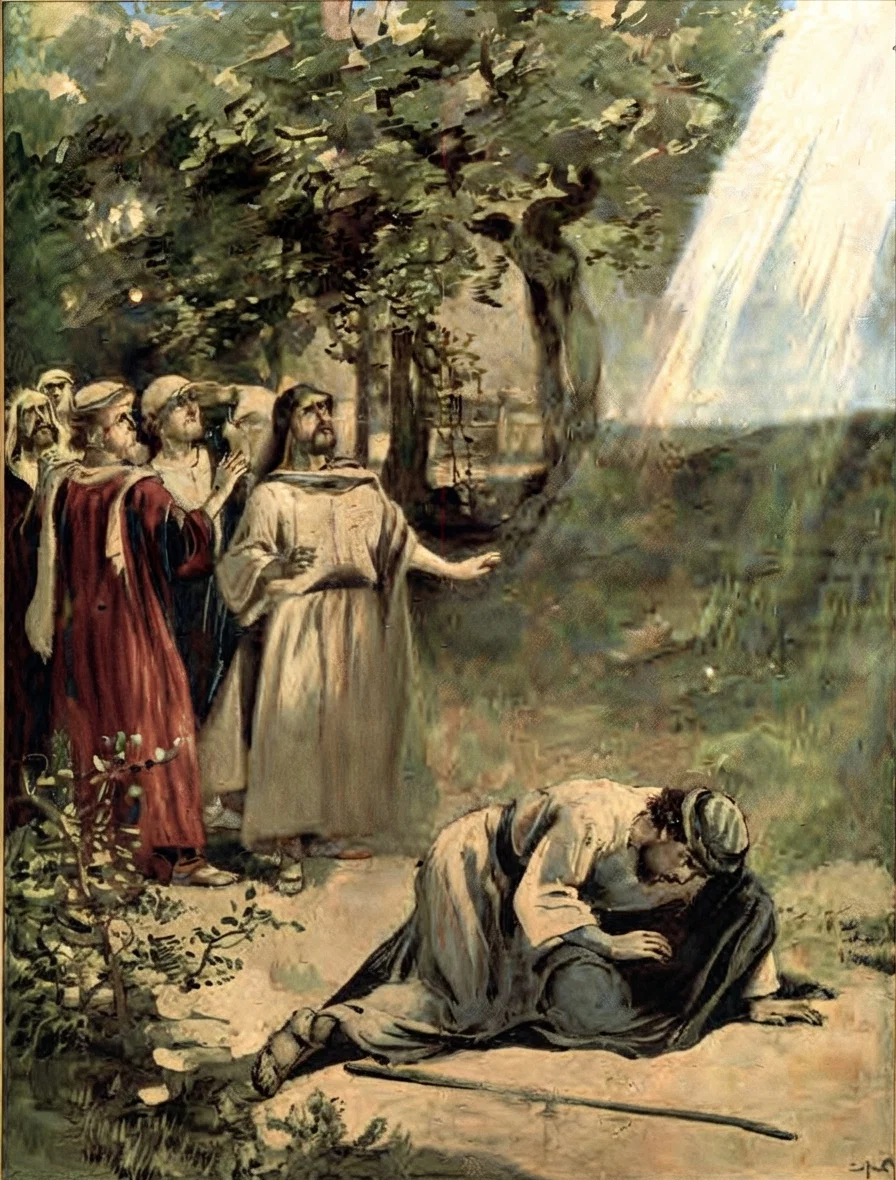
As he journeyed, he came near Damascus; and suddenly there shined round about him a light from heaven; and he fell to the earth, and heard a voice saying unto him, Saul, Saul, why persecutest thou Me?
SAUL and the men that were with him were approaching Damascus. Perhaps as they traveled the hot, dusty road, with the burning midday sun overhead, they could see before them the gleaming white city, "resting, like an island of Paradise, in the green inclosure of its beautiful gardens." "A wilderness of gardens,—gardens with roses among the tangled shrubberies, and with fruit on the branches overhead," it seemed; and everywhere among the trees was the murmur of unseen rivulets that drew their cool waters from the Anti-Libanus. A veritable oasis in the mountain-desert was and still is this ancient and beautiful city.
AS THEY journeyed, suddenly there fell around Saul and his companions a light above the brightness of the Eastern sun shining in its midday splendor; and a voice demanded of the proud Pharisee, "Saul, Saul, why persecutest thou Me?" During three days of darkness and isolation, Paul had time to think of this question. Feared and shunned by the disciples, who knew him as the chief persecutor of this new way; surrounded by zealous adherents of Judaism, who could have no sympathy with the revelation he had received, he was alone with God and his own heart, —alone in self-abasement, and fasting, and humble prayer.
WHY had he persecuted? He answered this question himself when he was no longer Saul the persecutor, but Paul the apostle. Defending himself at Jerusalem, he said: "I am verily a man which am a Jew, . . . brought up in this city at the feet of Gamaliel, and taught according to the perfect manner of the law of the fathers, and was zealous toward God, as ye all are this day." Acts 22:3. Again he declares that he was "of the stock of Israel, of the tribe of Benjamin, an Hebrew of the Hebrews;as touching the law, a Pharisee," and according to "the righteousness which is in the law, blameless." Phil. 3:5, 6.
NONE knew better than this Hebrew of the Hebrews that to Israel pertained "the adoption, and the glory, and the covenants, and the giving of the law, and the service of God, and the promises." Rom. 9:4. The faith of his fathers stood to him for home, country, and the worship of God,—all that was dearest in life. Could he see a movement arising in the very heart of the Hebrew church that threatened to undermine its doctrines and prestige, and not be stirred to the very depths of his fiery, zealous heart? Could he see the ancient landmarks threatened, the glory of Israel obscured, and not be aroused to the most determined action? He says, "I verily thought with myself, that I ought to do many things contrary to the name of Jesus of Nazareth."
BUT the three days of darkness in the house of Judas at Damascus, were three days of new, strange light to Paul. He began to see the relation between the law and the Gospel. The temple service and the ministration of the priests took on a new meaning. For centuries the temple had been the center of the religious life of the Jewish nation. It was the tower in the vineyard, the object to which all eyes turned. Thither year by year the tribes went up, "the tribes of the Lord unto the testimony of Israel, to give thanks unto the name of the Lord." By the daily service within its sacred walls, Jehovah was acknowledged as the covenant God of Israel; while in the homes of the devout, hearts turned to the temple at the hour of morning and evening worship, and prayers and thanksgivings ascended with the smoke of the incense and of the sacrificial offering.
DAY by day the priests, ministering in the temple, received the offerings of the people. Thither came the penitent with offerings for trespasses and sins. The pardoned sinner expressed in freewill-offerings his gratitude and praise for peace with God. Tithes and first-fruits were presented to their King, the Giver of every blessing; while the good hand of God in the bestowal of special blessings was recognized by thank-offerings. And at the close of the year came the solemn day of atonement, when the sanctuary was cleansed from sin, and the people stood free before God.
THUS the sanctuary and its service were interwoven with the very life of the people. It is no wonder that they loved it. But with all its stately beauty, with all its grand and solemn round of ceremonies, with all its dear and hallowed associations, the earthly temple was but a type of "the true tabernacle, which the Lord pitched, and not man." With its service, it was "a shadow of things to come." It was a daily object-lesson, a parable of One who was to appear. The temple service made nothing perfect, or complete. It invited the worshiper to look beyond, even "into heaven itself," where Christ as our priest and advocate has now entered, "to appear in the presence of God for us." To this sanctuary we are to look for pardon and peace; from the divine love and sympathy there flow all our blessings.
PAUL saw that the "hope of the promise made of God unto our fathers; unto which promise our twelve tribes, instantly serving God day and night, hope to come," centered in Jesus of Nazareth, who was indeed the promised Messiah. And he went forth to preach Christ with the same earnest purpose that had characterized his persecutions when he was "exceedingly mad" against the believers. He became a bearer of the light he had tried to extinguish. He helped to fulfill the prophecy: "The people that walked in darkness have seen a great light; they that dwell in the land of the shadow of death, upon them hath the light shined." Isa. 9:2.