Composition of Alcohol

6%

Pacific Press Publishing Company · Oakland, California · Oct 24, 1900

FromSigns of the Times, Vol. 26, No. 43.

Read the full edition

Composition of Alcohol

ALCOHOL; ITS HISTORY, AND ITS EFFECTS UPON SOCIETY.

By W. H. Riley, M.D., Superintendent of Colorado Sanitarium, Boulder, Colo. [All rights reserved.]

Composition of Alcohol.

WHAT is alcohol?—The word is from the Spanish alcohol,—galena, antimony,—derived from the Arabic word al-kohal, powder of antimony, used to paint the eyebrows. This Arabic word was later used to designate rectified spirits, and may have been applied to alcohol because of its use as a solvent of pigments insoluble in water. Alcohol is the product of the fermentation of any vegetable matter which contains sugar. It is composed of three elements, carbon, hydrogen, and oxygen, in the proportions of 2 to 6 to 1, being represented by the chemical formula C₂H₆O. In order to show more clearly how it is formed, we will describe a simple experiment by which it may be produced.
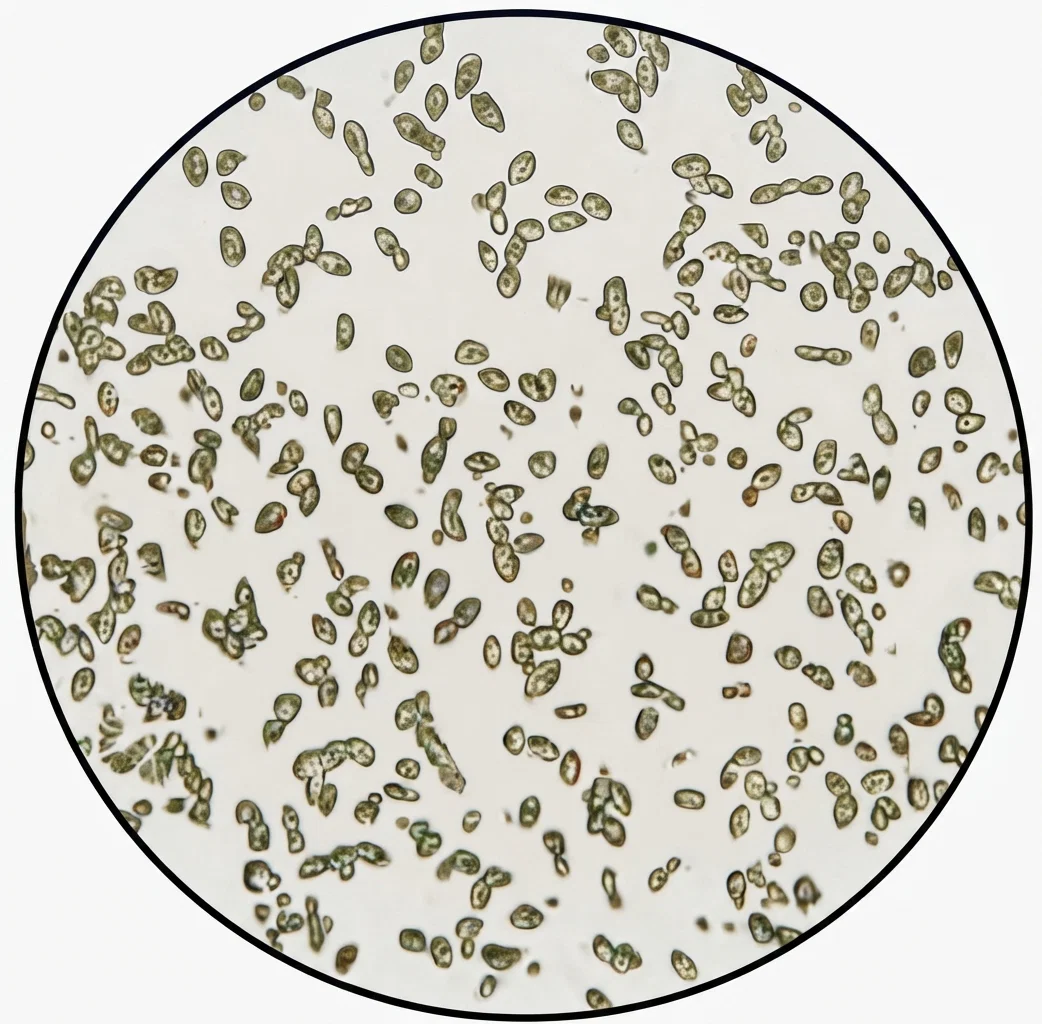
Yeast Cells.
Yeast Cells.
A small quantity of molasses may be dissolved in water, a little yeast added, and the liquid placed in a warm place to ferment. This fermentation is caused by the growth of the yeast plant, which is so small that it can be seen only by the aid of a powerful microscope. When so examined, the plant is found to be composed of globules less than one four-thousandth of an inch in diameter. These cells are filled with gelatinous compounds, consisting principally of exceedingly minute germinal granules. In fermentation below 45° Fahrenheit, these granules increase in number until the cell wall bursts, when they develop further and in turn become parent cells. In a temperature of 75° or 80° F. the development is more rapid, the granules passing through the pores of the cell wall, and forming buds. Here they grow, detach themselves, and become parent cells.
In order to secure fermentation, yeast must be present. It may be added intentionally, or it may be communicated from the air, which always contains its spores. In the process of its growth, the plant decomposes sugar into alcohol and carbonic acid.
As the warm dilution of the molasses ferments, or decomposes, bubbles are seen to rise to the surface. These bubbles are a combination of carbon and oxygen in the proportion of one to two, indicated by the chemical formula CO₂. This gas is much the same as that which is exhaled from the lungs in breathing, and is called carbon dioxide, or carbonic acid. This gas comes from the decomposition of the sugar in the molasses. The plants will not develop in pure sugar, but in the form known as glucose, or grape sugar, from which alcohol is obtained, and which is present in molasses. Sugar is composed of the same elements as alcohol, but combined in a different proportion, as indicated in the formula C₆H₁₂O₆. The growth of the yeast plant causes these elements to shift their positions, forming two new compounds, one of which is the carbonic acid, CO₂, seen in the bubbles, and the other is alcohol, C₂H₆O. The changing of one part of sugar to two parts each of carbonic acid and alcohol is shown in the following chemical equation:—
C₆H₁₂O₆ = 2(C₂H₆O) + 2(CO₂). Sugar Alcohol Carb. Acid.
If now the solution of molasses be tasted, it will be found to have no longer the sweet taste of sugar, but is instead sour. The same change occurs when a jar of canned fruit is not securely sealed, permitting fermenting germs to enter from the air. Not only is the taste then found to be sour, but the odor of alcohol may be noticeable.
At this stage of our experiment, the alcohol is still mixed with the water and remaining portions of the molasses. To remove it, heat is applied and the alcohol passes off as vapor; and when this is collected and cooled, it is condensed into a liquid. This liquid is not pure alcohol, but contains more or less water. Alcohol vaporizes at a temperature much below the boiling point of water, and yet its affinity for water is so great that it is difficult to obtain it in absolute form by distillation alone. The addition of quicklime to absorb the water, and then redistillation, is sometimes practised.

Properties.

Alcohol, when obtained pure—termed absolute alcohol—is a clear, colorless liquid, having the appearance of water, but only four-fifths as heavy, its specific gravity being .79. The odor is agreeable, the taste strong, warm, and penetrating. It boils at a temperature of 173° F., or 40° lower than water. Until recently it was thought that alcohol could not be frozen, but this has been accomplished by reducing the temperature to about 200° below zero. It has a great affinity for water, mixing with it in all proportions. Alcohol is very inflammable, burning with a pale bluish flame without smoke. In burning, it combines with six parts of oxygen from the air, and produces carbon dioxide and water (H₂O), as shown in the equation:—
C₂H₆O + 6O = 2(CO₂) + 3(H₂O).
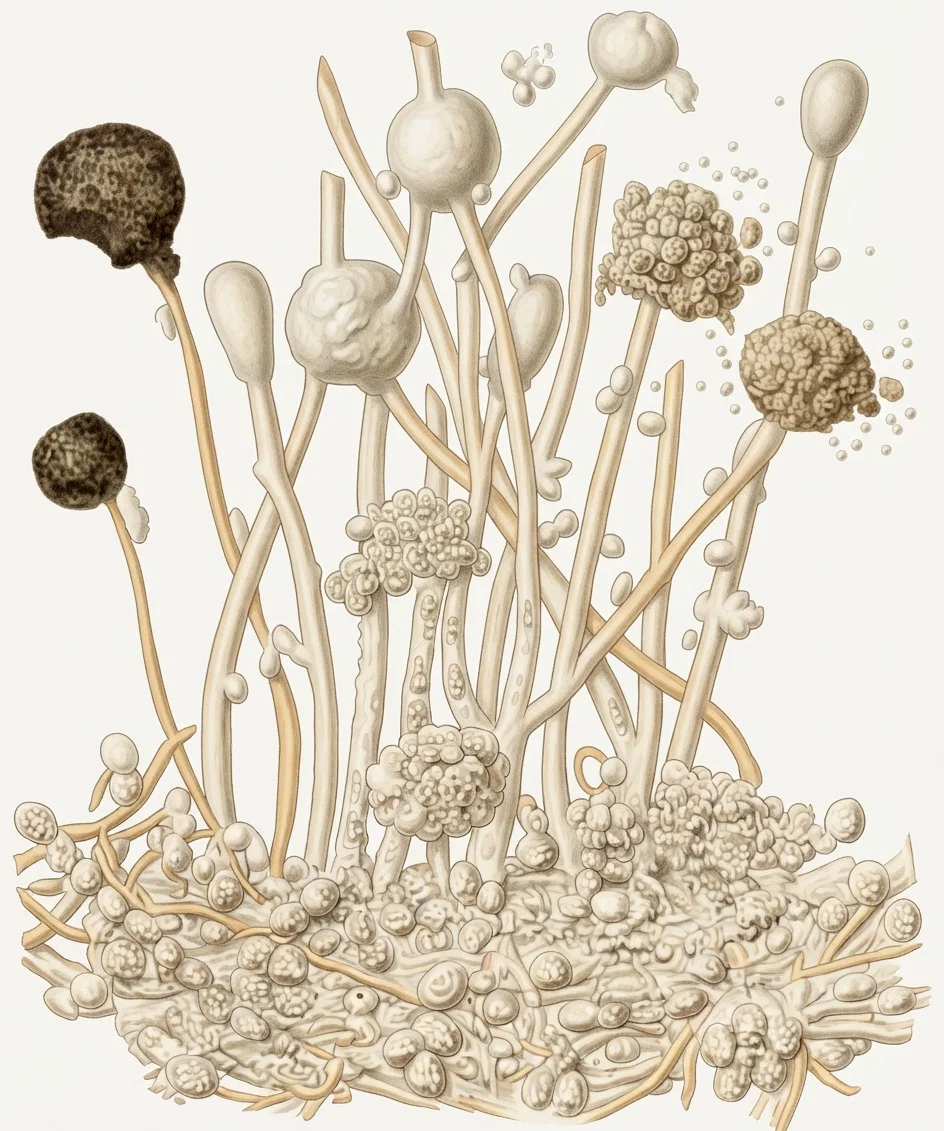
Fungi of Yeast-plant.
It is valuable to the chemist, as it affords much heat with no annoyance from smoke; and also for another valuable property, that of dissolving substances not soluble in water, especially resins, gums, etc. It is a valuable reagent for separating salts, one of which is soluble, the other insoluble in it. Combining it with resins, varnishes are made, and perfumes are made by dissolving essential oils in it. The affinity of alcohol for water makes it valuable for preserving anatomical specimens. It combines with the moisture, and so prevents this from acting upon the animal substance to produce decay.
It is readily seen that alcohol is a valuable substance in many ways, and if confined to these uses would never be other than useful and harmless. It is the misapplication of it, as with many other good things, which makes it a curse.