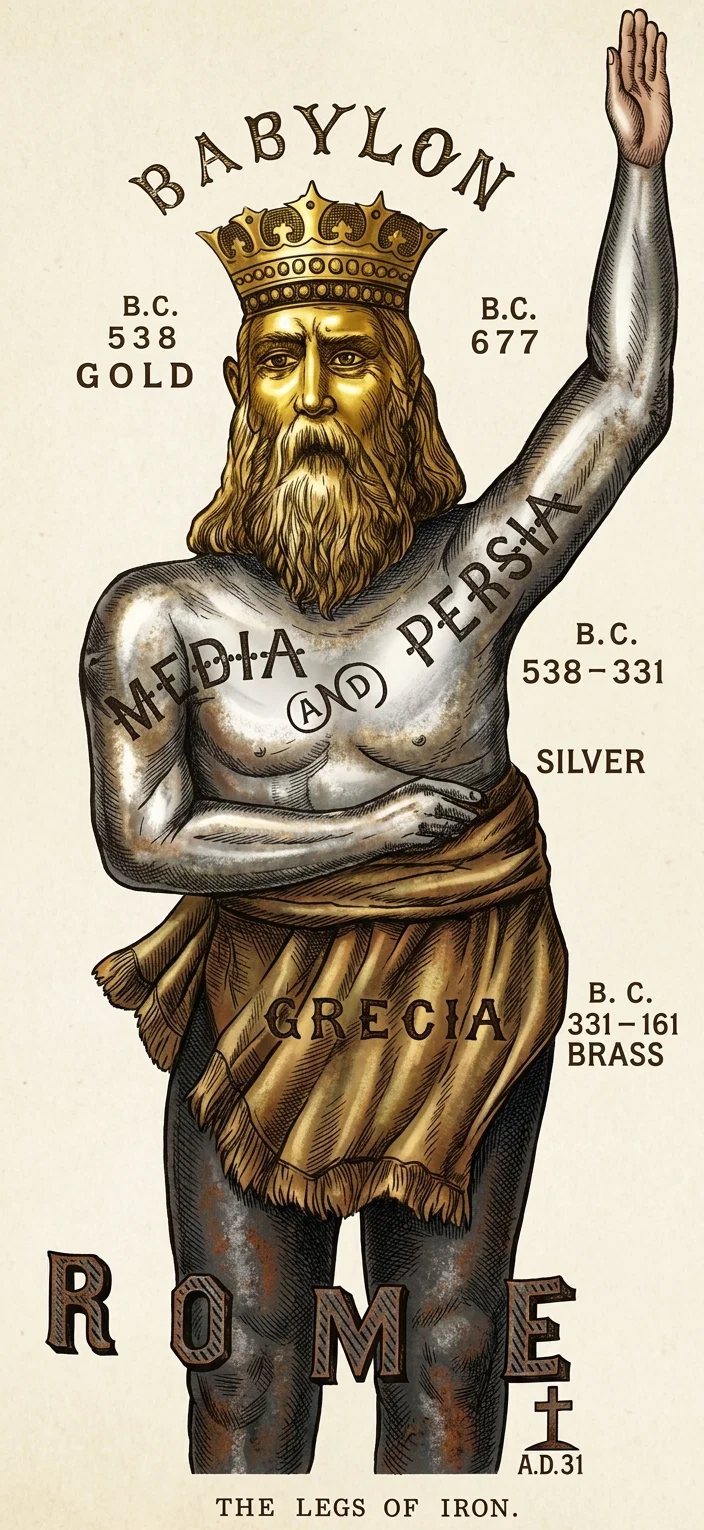
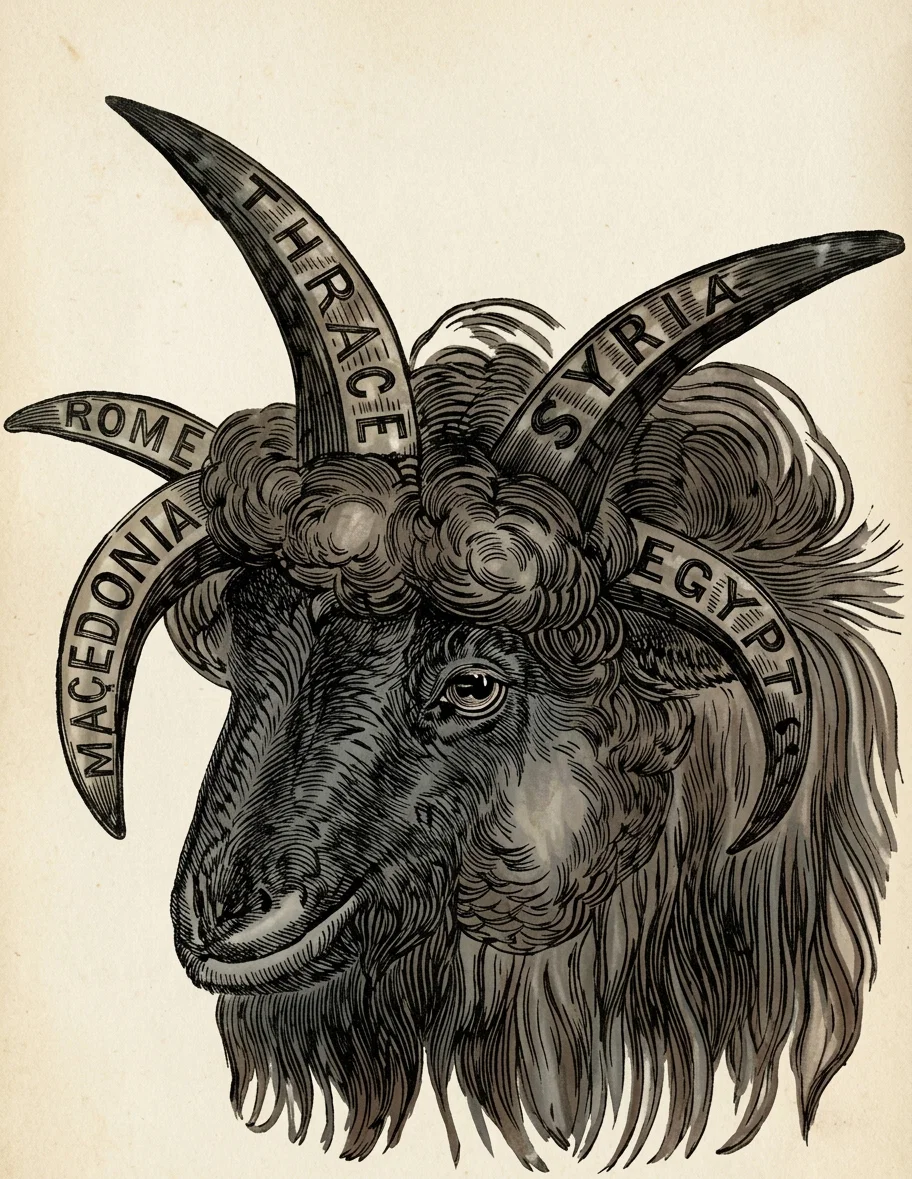
The brass of the great image was followed by the legs of iron; and out of one of the four horns which sprung up when the great horn of the goat was broken, the prophet saw come forth a little horn, which waxed exceeding great. Dan. 2:40; 8:9. What power is designated by these symbols? Answer: The next great power that succeeded the empire of Grecia, as existing in its divided form under Alexander's successors; and that power was Rome.
Passing over, as already proposed, these divisions of the Grecian empire, the narrative of events is interrupted till we reach the year B. C. 161. Previous to this point it does not become necessary in the light of prophecy to notice particularly the power under consideration; for be it remembered that a power is not introduced into prophecy till it becomes in some way connected with the people of God; and here the Romans first assumed this relation. The Jews being grievously oppressed on account of their religion by the heathen, Syrian kings, Judas Maccabæus sent an embassy to the Romans, to solicit their aid, whereby a league was entered into between them of mutual friendship and defense. This was the commencement of the Roman ascendency over the Jews; and here we may place the termination of the third kingdom of brass, after it had borne rule from the battle of Arbela 331, one hundred and seventy years.
We pause to notice an objection which is urged against the position here taken. Papists, to avoid the application of the prophecy concerning the little horn to the Roman power, pagan and papal, have applied it to Antiochus Epiphanes, a king of Syria. And as it is no unusual thing for the Pilates and Herods of the land to make friends against the cause of truth, they have been followed in this application by the mass of those who oppose the Advent faith.
1. But who was this Antiochus Epiphanes? He was only one, the eighth in order, of a series of twenty-six kings that constituted the Syrian horn of the Grecian empire. How then could he, at the same time, be another remarkable horn?
2. If it were proper to apply the little horn to any one of these kings, it would be reasonable to suppose it would be the most illustrious; but Antiochus Epiphanes did not by any means sustain this character. Although he took the name of Epiphanes, that is, The Illustrious, nothing, says Prideaux, on the authority of Polybius, Livy, and Diodorus Siculus, could be more alien to his true character. For on account of his vile and extravagant folly, some thinking him a fool and others a madman, they changed the name of Epiphanes, The Illustrious, into Epimanes, The Madman.
3. Antiochus the Great, the father of Epiphanes, being terribly defeated in a war with the Romans was enabled to procure a peace only by the payment of a prodigious sum of money, and the surrender of a portion of his territory; and as a pledge that he would faithfully adhere to the terms of the treaty, he was obliged to give hostages, among whom was this very Epiphanes, his son, who was carried to Rome. This ascendency the Romans ever after maintained. Which, therefore, was the more notable power, the Romans who exacted tribute, or the Syrian kings who were compelled to pay it?
4. The little horn waxed exceeding great; but this Antiochus did not enlarge his dominion except by some temporary conquests in Egypt; which he immediately relinquished when the Romans took the part of Ptolemy, and commanded him to desist from his designs in that quarter. The rage of his disappointed ambition he vented upon the unoffending Jews.
5. The little horn, in comparison with the powers that preceded it, was exceeding great. Persia is simply called great, though it reigned over "an hundred and seven and twenty provinces." Esth. 1:1. Grecia, being more extensive still, is called very great; but how ludicrous and absurd, in view of the above facts, to apply the next power, which waxed exceeding great, to Antiochus, who abandoned Egypt at the dictation of the Romans!
6. This power was to stand up against the Prince of princes. The Prince of princes is, without controversy, Jesus Christ. Dan. 9:25; Acts 3:15; Rev. 1:5. But Antiochus died 164 years before our Lord was born.