IN bringing a Redeemer out of Nazareth, God has taught the world a lesson whose value is beyond estimate. Why would it not have been better that Christ should have been reared in one of the great, recognized centers of learning and culture? Many suggestions come to the natural heart that this or that course might have been better than the one which Infinite Wisdom chose; but when the eye-salve of heaven has been applied, the wisdom of God's way and the foolishness of our own are plainly evident.
God had a design in bringing the world's Messiah out of the despised Nazareth. He had a design in saving Israel from the Philistines at the hand of a shepherd youth with his sling and pebble; and from the Midianites by Gideon's three hundred, while the heartless hosts went home to comfort and safety. God sees not as men see, and the reason is because men have allowed themselves to be blinded by the deceptions of one who chooses to have men see truth as falsehood, falsehood as fact, and the unreal as the real. They can lift the eyelid from the eyeball, but they can not, without divine aid, lift the curtain hung by the deceiver over the window of the soul.
THE rejectors of Christ asked, "Can there any good thing come out of Nazareth?" God answered the question; but the majority of them never believed the answer. Out of sin-smitten Nazareth came the One who knew no sin; the One who bore the sins of the world, that the world might again one day be free from the burden of transgression. From that least respected city of the Jews, the byword of the nation, the most hopeless, apparently, in moral influence, came He who held the destiny of the whole race in His hands. Is there no lesson in this? Does it mean nothing that one of the most despised cities of the world cradled the Redeemer of the world?—Surely, there is a lesson and a meaning in it all. God meant to teach men hope. He meant to teach men that their hope is not in men, not in the great of earth, not in schools of learning, not in the wisdom of this world, nor in anything that savors of this world; but in Him, and in Him alone.
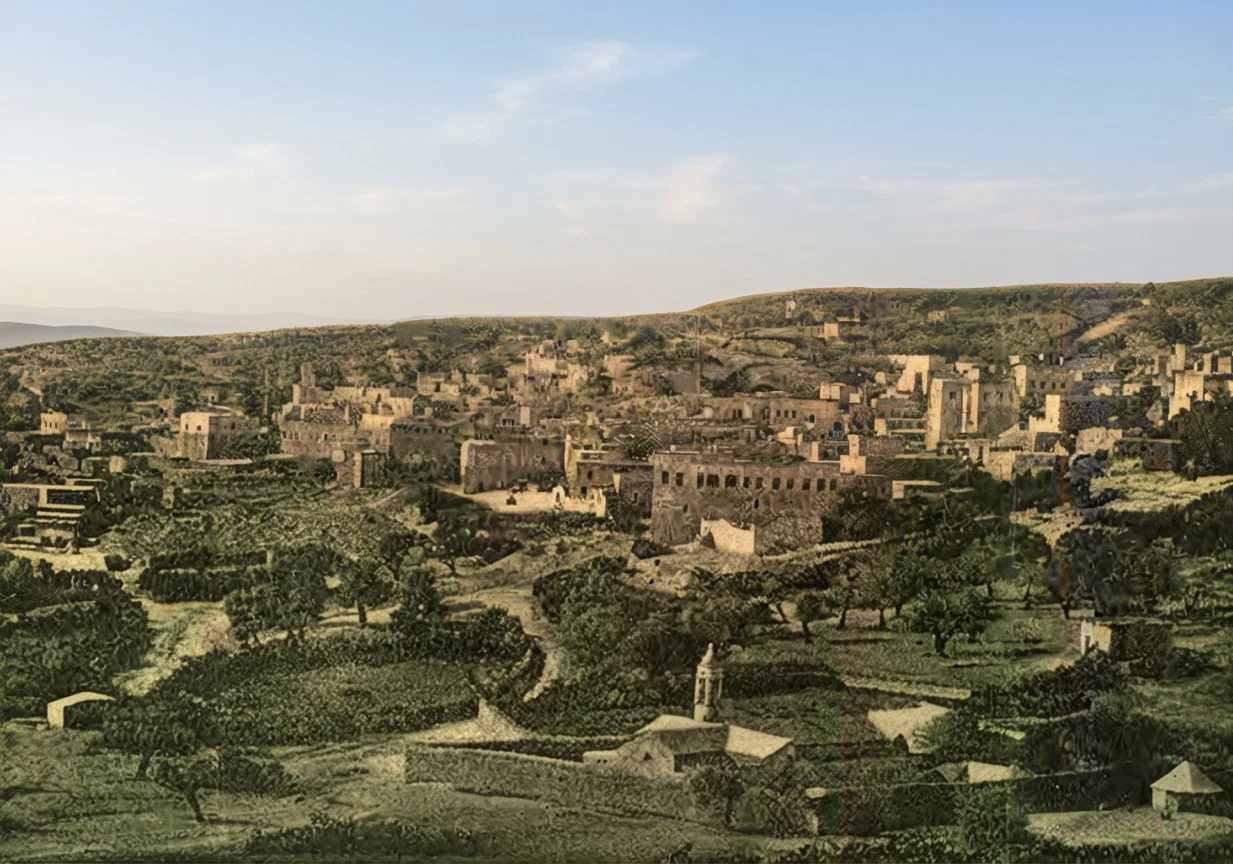
A View of Nazareth.
THE world would look for its Saviour among the great and renowned. Popular religion would look for its Saviour among the highest dignitaries of the church; and the kernel of the whole matter would be trust of men in man. All such trust is vanity, and can not reach beyond the curtain of the tomb. In such trust there can be no salvation; for the one in whom the trust is placed has made no atonement, not even for his own sins. God knew that such trust must lead souls to ruin, and so we have the lesson of Nazareth, teaching men to trust, not in the great of earth, not in environment, not in worldly influence, but in Him alone who was made our peace, our sanctification and redemption. Out of the moral darkness of that dark city shone the one clear ray of light that leads to God. On the murky waters of that stagnant pool blossomed the immaculate lily of God's purposes. It was utterly unlike its environment. With its roots in the soil of this earth, it reaches up and blooms in the atmosphere of heaven—linked to the human, yet breathing out the perfume of divinity.
AGAIN there is the lesson that God can make out of the most unpromising material the most precious gems for His eternal kingdom. Many go down in suicide every year, because they consider themselves of no worth to the world, and life of no worth to them, not realizing, or at least refusing to believe, that God can, out of their worthlessness, make that which will be of inestimable worth to all eternity. But God has shown that He can bring glory out of that which is despised, worth out of worthlessness, honor out of dishonor, and turn to His praise the wrath of man. For this reason let the discouraged soul look up. Is your strength gone and your courage weak? Remember this: "He giveth power to the faint; and to them that have no might He increaseth strength. Even the youths shall faint and be weary, and the young men shall utterly fall; but they that wait upon the Lord shall renew their strength; they shall mount up with wings as eagles; they shall run, and not be weary; and they shall walk and not faint." What a picture of strength, beyond anything possessed in human flesh. It is not for those who consider themselves strong; but for those who2know that they have no strength. The condition is that they "wait upon the Lord." So He brings strength out of weakness, because He is allowed to put His strength where our weakness had been. Paul said, "When I am weak, then am I strong." In other words, when he realized his own weakness, he went to the source of all true strength and obtained strength beyond anything he could hope for in himself.
AND just so it is in every other condition of life. The weak points may be made the strong points. In the place of an evil temper we may have kindliness; in the place of irritability, patience; in the place of gross indulgence, temperance; in the place of profanity, praise; in the place of avarice, benevolence; in the place of anxiety, peace; in the place of selfishness, service; and in the place of hatred, love. As Christ arose out of Nazareth, so may these desirable qualities arise out of hearts that had fostered their antitheses. Does some habit bind the soul and cause despair? God has taught you that you may triumph over that, and make that point a strong bulwark of defense. He can bring out of that unpromising soil a tree that will bear fruit unto life eternal. There is in this fact cause for truest joy and brightest hope, and that is the lesson of Nazareth.