[Rev. A. T. Pierson in Missionary Review of the World.]
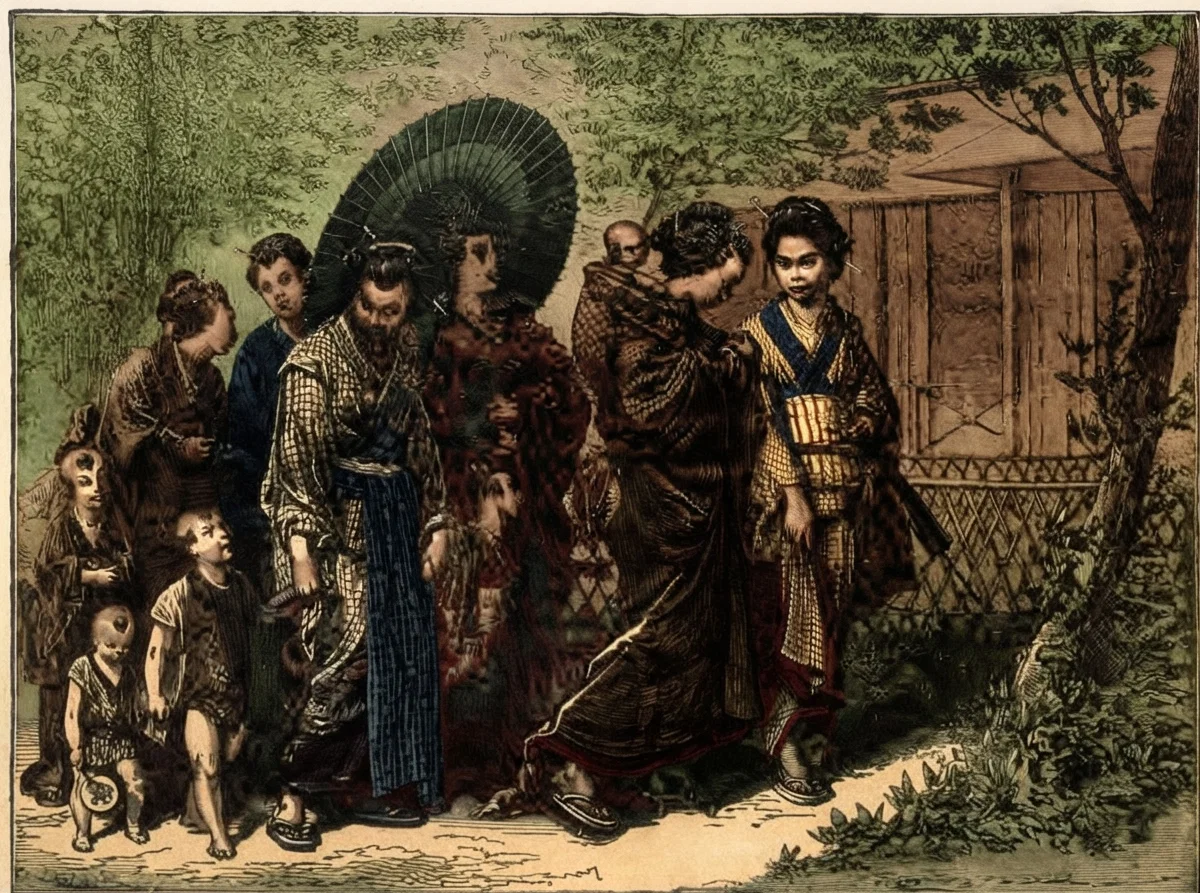
Home Life in Japan,
ONE chapter in the Second Book of the Kings (2 Kings 23: 1-24) contains a brief epitome of the greatest reformation recorded in Hebrew history. Josiah found at least ten forms of idolatry and iniquity polluting the Temple and people: Worship of Baal and Astarte; Asherah, or Phallic, abominations; Sodomites; Tophet, or Moloch; Chemosh of Moab; Milcom, of Ammon; Bethel, with Calf Worship, and the consulting of familiar spirits, and the offering of incense in high places. He destroyed all existing relics of idolatry, defiled idol altars and sites, and degraded priests of Jehovah who had corrupted His worship.
Turn, now, to confront the evils of our own day which call for a new reformation, and the problems which demand practical solution. First looking at the Orient, we find three generic forms of false faith:—
ANCESTRAL—Worship of deceased ancestors, including all human heroes lifted to divine honors.
ASTRAL—Sun, moon, stars, including the natural forces of the universe, and the material creation.
ANIMAL—Various forms of animal life, originally probably used as symbols of Divine creative power, etc., like the Egyptian Apis.
Under these three forms all false faiths may be arranged, as, for example: Under Ancestral, Confucianism, Mohammedanism, Buddhism; under Astral, Parseeism, etc.; under Animal, Brahmanism, Fetishism, etc.
For convenience in studying the great missionary problems, we may divide the world field into two parts—the Orient and the Occident; the one representing the territory where the dominant false faiths prevail and the latter the territory of at least a nominal Christianity, whence must come the missionary forces or the great campaign of the kingdom of Christ.
In oriental lands we find several gigantic obstacles to the spread of the Gospel, and, while various systems of heathen religion have certain features in common, like polytheism and idolatry, each has some one or more conspicuous characteristics which differentiate it from the others. For instance, Fetishism, the lowest form of idolatry, is one of the grossest forms of the worships of nature, as Parseeism, or fire-worship, is the most refined. Brahmanism is specially marked by its iron system of caste, and Buddhism by its essential deification of man, in Buddha. Mohammedanism is comparatively a pure system of belief, but corrupted by sensuality; and modern Judaism is a pure religion perverted into denial of the Messiahship of the very Christ which it foretold. Confucianism is a lofty, ethical system tainted with the worship of ancestors. Thus, every system has one or more distinguishing features which render it especially difficult to meet and overcome by the modern missionary forces.
In the Occident, even among the nominal people of God, more or less exact counterparts to these errors are found, constituting the main hindrances to missions at home, if indeed they are not more formidable than those encountered abroad. For example:—
The virtual worship of nature in scientific materialism and naturalism.
The Caste Spirit, in race prejudice, class antagonism, and social hatred.
The Rejection of Christ's Deity in Unitarianism and philosophic skepticism.
The Counterpart of Confucianism in dependence on ethical systems, tradition, etc.
Modern idolatry, as it appears in Christian lands, may be classified, therefore, substantially under three main heads:—
Worship of matter—materialism.
Worship of Mammon—wealth and worldly enterprise.
Worship of man—self-interest and self-indulgence.
In Christendom there is the Self Life as a principal motive, with this world as its field of operation, and present time as its period of opportunity; while, per contra, God commends unselfish love as the principal motive of missions, with the whole race of man as its field of operation, and with all eternity as its harvest hope and reward.
It is a remarkable fact, which should be emphasized as most significant, that, when we turn to these occidental lands and study the hindrances which, among so-called Christian peoples, impede or prevent the missionary conquest, we thus find every obstacle confronted abroad, to have its almost exact counterpart at home. The worship of nature corresponds to materialism, sometimes gross, sometimes refined, as in scientific skepticism; the caste system is reflected in race prejudice and class antagonism; the deification of Buddha, in hero worship; the sensuality of Mohammedanism corresponds to the awful corruption of sensual vice; Judaism, with its rejection of the Messiah, to the Christless creeds of a nominal Christianity. Ancestral worship has its counterpart in blind reverence for tradition; and idolatry generally, in the worship of Mammon. It is as if Christendom had imported the idols, superstitions, and debasing practices of heathendom, modified them, and called them by other names, still giving them a shrine and throne in the temple of God, as the Jews did with the strange deities of the heathen. It is another example of the repetitions of history. There is nothing new under the sun. The human nature which is in the heathen and pagan reappears in the Christian, and, so far as unsanctified, brings forth similar, if not essentially identical, fruit.
Some heathen obstacles are peculiarly formidable. Mohammedanism, called also Islam, Resignation, is theoretically entire submission to the will and word of God; practically it is fatalism, not faith. It has two fundamental creedal statements: "There is no God but God, and Mohammed is God's apostle." God has no offspring—"begetteth not, nor is begotten." Jesus Christ is a great prophet, and will come again to establish Islam everywhere. Angels are mediators between God and man. There are four archangels: Gabriel, Angel of Revelations, the Holy Spirit; Michael, Guardian of the Jews; Azrael or Raphael, Angel of death; Uriel, the Trumpeter of Resurrection. The duties are four: prayer, almsgiving, fasting, and pilgrimage. Prayer, five times in every twenty-four hours; almsgiving, legal and voluntary; fasting, during the whole month of Ramadan, from sunrise to sunset (they may eat from sunset to sunrise), and pilgrimage to Mecca.13
Caste is a term applied chiefly to class divisions in India—"a system of cellular structure, where the cells do not penetrate or communicate." It makes subdivision of labor so rigid that to go outside of the limits of one's employment is a forfeiture of social rank. In some cases even the touch of a lower caste defiles, and some sorts of food are defiled when the shadow of an inferior caste passes or falls over them. In India the principal castes are four—priestly, military, mercantile, and servile, with numerous subdivisions; and so stringent are the caste rules that Dr. Judson declared that to get a convert to accept Christ and come out for Him was like pulling the eye-tooth of a live tiger!