[In an address at the Union Baptist Church, Greenpoint, L. I., October 29, the pastor, Dr. R. H. MacCullough, delivered some strong anti-Roman sentiments. The following will give an idea of how he interprets the growing influence of Rome in American politics]:
We must always remember that Rome and her principles never change, and that Romanism has never been so emphatically Roman as it is now.
We are on the eve of aggressive clericalism in America. Catholics as a body have offered passive resistance to the school laws and all over the country to the public school. They are getting ready to make the most strenuous resistance of their lives against the American public school.
The Vatican greatly desires to establish a nuncio at Washington. The desire of the Vatican and of Cardinal Satolli, with his three visits to America, was to be appointed papal nuncio at Washington. The American government is not ripe for such a revolutionary act. Yet it is progressing favorably toward that end. The Vatican exhibit at the Louisiana Purchase Exposition, one of the costliest and most interesting, had for its purpose the exaltation of the sovereign pontiff in America. This government and the Holy See have been brought into very close relations during the past few years. The Taft commission to the Vatican was an epoch-making event. The treaty between the insular government in the Philippines and the papal delegation in the archipelago was an event of scarcely less significance. What has been done in a few short years in the way of rapprochement encourages the hope of still greater relations.
The question of the friars in the Philippines gives a striking illustration of the changed position of the United States. In 1776 the government in its infancy forbade the pope the nomination of a single prelate, and refused to make any kind of recognition of the Holy See. To-day, the outcome of the Philippine issue is that the pope has the official nomination of 100 prelacies within American territory, with the added triumph of having received American ambassadors at the Vatican. The mission of governor Taft, it is true, was represented by the government at Washington as without any official character, but this flimsy hooding of the facts can never bear examination. As the Independent observed, Judge Taft was equipped with credentials and empowered to negotiate with the Vatican as formally and completely as any other ambassador.
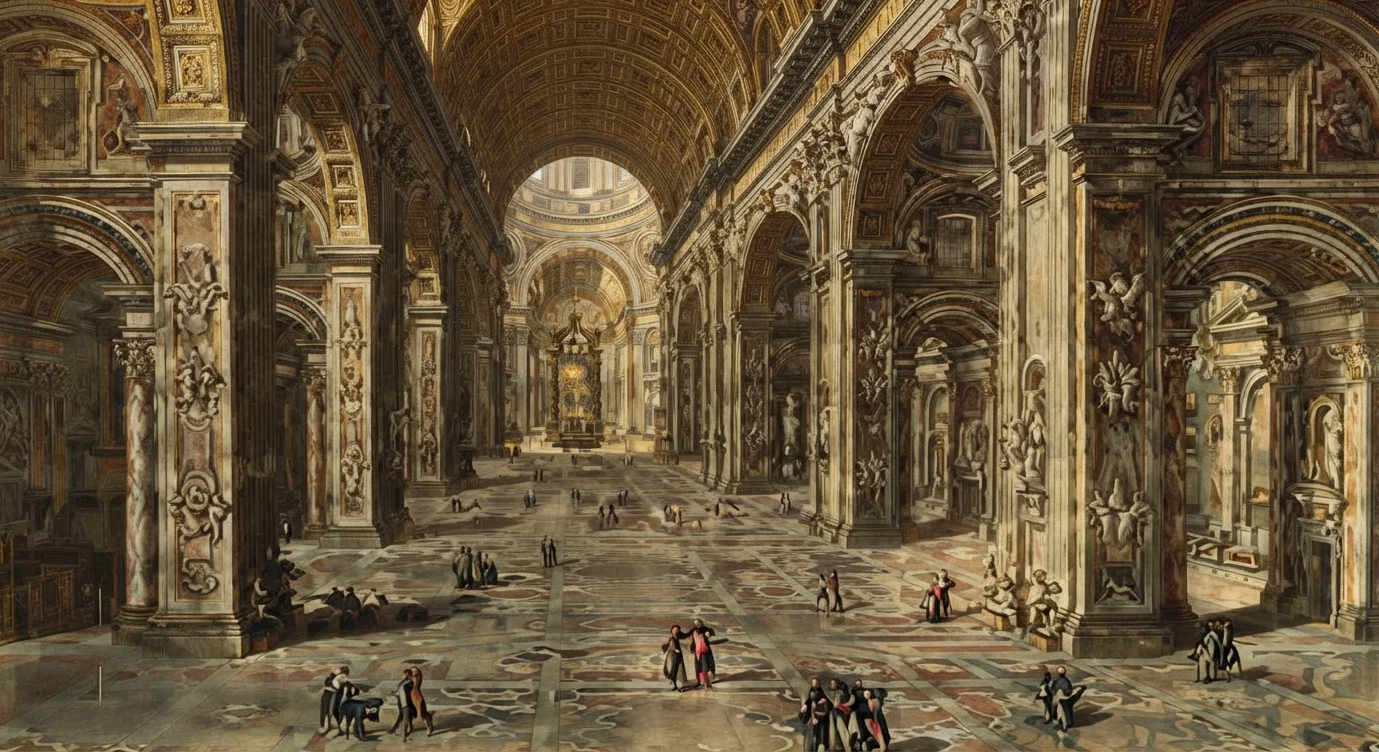
An Interior View of St. Peter's Church, Rome.
The conduct of the Catholic leaders in America at the beginning of the agitation against the friars was significant. Archbishop Ireland counseled prudence and forbearance as the course of the church, lest public apprehension should be aroused by the revelation of the power of the Catholic community, now solid and formidable in the heart of the American nation. His counsels, however, were not adopted by the Federation of Catholic Societies, then in session at Chicago. Bishop McFaul, of Trenton, led a bold arraignment of the American administration in the Philippines, declaring that it had been animated by Protestant fanaticism, and calling on the President to do his duty under the Constitution, and secure personal rights and property to the friars in the Philippines. This means that Catholicism in the United States feels itself sufficiently powerful to lay aside diplomacy.
A few years ago, and before the creation of the Taft commission, the suggestion of a papal nuncio at Washington would have raised a howl over the whole land. These are years of sudden and momentous changes in popular sentiment, and there is no telling what the future years will bring, for the papal authorities feel that a country with 12,000,000 Roman Catholics in the United States, 6,500,000 in the Philippines, and 1,000,000 in Porto Rico should not be without a representative of some kind at the Vatican. It would be as un-American to permit a nunciature at Washington as to enstate the pope in the White House. It can not be done without violating the Constitution of the United States.
But Catholic optimism has a wider vision. Archbishop Quigley has said: "Within twenty years this country is going to rule the world. Kings and emperors will soon pass away and the democracy of the United States will take their place. The West will dominate the country, and what I have seen of the western parochial schools has proved that the generations which follow us will be exclusively Catholic. When the United States rules the world, then the Catholic Church will rule the world." This is a prophetic bid for a Catholic president.
The Roman hierarchy is making itself solid in Washington, the center of our national government. They have the Indian Bureau there; the chief object is to influence legislation in favor of Rome. Cardinal Gibbons is only forty miles from Washington, and his contemporaries are fast friends with the President, and they graciously assist him in crowding the departments of government with Romanists, who owe their first allegiance to the pope of Rome.
Bishop O'Connell is in Japan on a diplomatic mission from the Vatican to establish a nuncio. A nunciature at Washington—are you ready for it, gentlemen? You answer, "No." You are right.