IMPORTANCE of PROPHECY

4%

Pacific Press Publishing Company · Mountain View, California · Oct 11, 1905

FromSigns of the Times, Vol. 31, No. 41.

Read the full edition

IMPORTANCE of PROPHECY

OBJECT-LESSONS OF PROPHECY

OBJECT-LESSONS OF PROPHECY

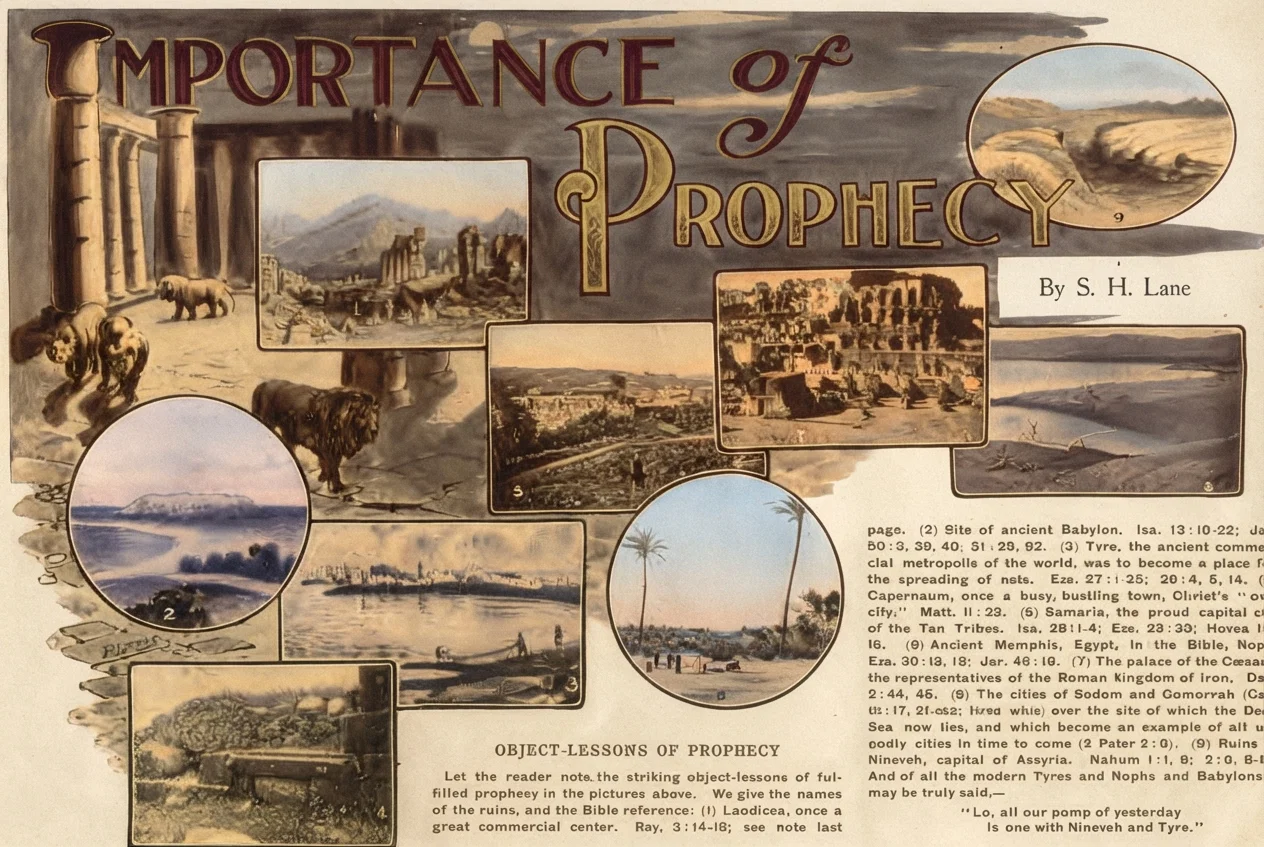
Let the reader note, the striking object-lessons of fulfilled prophecy in the pictures above. We give the names of the ruins, and the Bible reference: (1) Laodicea, once a great commercial center. Rev. 3:14-16; see note last page. (2) Site of ancient Babylon. Isa. 13:19-22; Jer. 50:3, 39, 40; 51:28, 62. (3) Tyre, the ancient commercial metropolis of the world, was to become a place for the spreading of nets. Eze. 27:1-25; 26:4, 5, 14. (4) Capernaum, once a busy, bustling town, Christ's "own city." Matt. 11:23. (5) Samaria, the proud capital city of the Ten Tribes. Isa. 28:1-4; Eze. 23:33; Hosea 13:16. (6) Ancient Memphis, Egypt, in the Bible, Noph. Eze. 30:13, 16; Jer. 46:19. (7) The palace of the Cæsars, the representatives of the Roman kingdom of iron. Dan. 2:44, 45. (8) The cities of Sodom and Gomorrah (Gen. 18:17, 20-32; 19:24, 25) over the site of which the Dead Sea now lies, and which became an example of all ungodly cities in time to come (2 Peter 2:6). (9) Ruins of Nineveh, capital of Assyria. Nahum 1:1, 8; 2:6, 8-13. And of all the modern Tyres and Nophs and Babylons it may be truly said,—
"Lo, all our pomp of yesterday Is one with Nineveh and Tyre."

Foretelling and Fulfilling

ALL Scripture, being given by inspiration of God, is profitable for doctrine, for reproof, for correction, for instruction in righteousness. 2 Tim. 3:16. It is therefore all important. This being true, one can not justly draw invidious comparison between different parts of the Scriptures.
Some portions are historical, and, as such, deal with the past. Other portions are prophetic, and deal with the future. If one portion of the Scripture is more important than another, it is the prophetic portion, as it deals with the future.
It is not in the wisdom of man to correctly foretell the events of the future. This wisdom abides only with the Father and His associated Son, Christ Jesus, and with those to whom they have revealed it. The all wise Creator declares that He reveals Himself to the children of men. He declared this through Moses. Num. 12:6. He says, "If there be a prophet among you, I the Lord will make Myself known unto him in a vision, and will speak unto him in a dream." He communicates by means of the Holy Spirit. This is clearly set forth in 2 Peter 1:21: "For the prophecy came not in old time by the will of man; but holy men of God spake as they were moved by the Holy Ghost." It is evident by this declaration that the prophecies of the Scriptures did not originate by the will of man, but men were moved upon to predict future events by the Spirit of God.

Christ in Prophecy

The Father and the Son are one in plan and action (John 10:30), and thus Christ is in the foretelling of future events through the prophets. The apostle Peter plainly declares this in his first epistle, first chapter. Speaking of the salvation of the soul, he says: "Of which salvation the prophets have enquired and searched diligently, who prophesied of the grace that should come unto you; searching what or what manner of time the Spirit of Christ which was in them [the prophets] did signify, when it testified beforehand the sufferings of Christ, and the glory that should follow." Verses 10, 11.
Thus the Spirit of Christ not only foretold His own sufferings, sad and heart-rending tho they were to be, but He carries our minds beyond the suffering to the glory that should follow, not only through time, but into the never-ending ages of eternity, where His praises will ever be sung, and His glory will never wane.

Prophecy and History Illustrated

It is evident from these scriptures that prophecy, when given, relates to the events of the future. Thus prophecy is history in advance. To illustrate: Should a seer in holy vision be enabled to behold some of the future political events of our own beloved nation, would we not, as citizens, become deeply interested in his predictions? If, in his foretelling of the future, he stated that in due time we, as a nation, would have war declared upon us by a foreign power; that our territory would be invaded by an alien army; that battle after battle would be fought; fields would be deluged with blood as the result of booming cannon and mortars, bursting shells, the whistling of the Minie ball, and clashing of the saber and bayonet in the hand-to-hand fight of the contesting armies. At times victory would grace our heroic maneuvers, and again defeat, sore and dreadful, would sadden the nation, and dampen our efforts. At last, in a mighty battle, fearful because of its carnage, victory perches upon our national banners, the war is ended; and the dove of peace spreads her wings over the nation, and prosperity greets us on every hand.
If each individual of the nation could be convinced that the predictions were true, with what absorbing interest would he watch every transpiring event, and fully understand that it was merely a blossom which would ripen only to pave the way for more important events, which would ultimately result in the defeat of the alien nation, and the complete victory of our own.
The foretelling of this scene would be prophecy, and the record of its fulfilment would constitute history.

What We May Know

The Word of God foretells the rise and fall of nations from the inception of earthly kingdoms and republics,—from the kingdom of Babylon to the wonderful government in which we live. Every event which is taking place in the world to-day is full of significance, and, to the student of prophecy, is a harbinger of the final consummation, when grace will give place to glory, and prayer to praise.
Just before Christ's passion, He stated to His disciples that some of them would not taste death till they saw the Son of Man coming in His kingdom. Matt. 16:28. A few days subsequently He took three trusted disciples, Peter, James, and John, and led them up into the steeps of a neighboring mountain, and was transfigured before them. In His transfiguration they saw Him as we shall see Him, if we are saved in the kingdom of glory. His face shone as the sun, and His raiment was white as the light. Suddenly there appeared on the scene two men. One was Elijah; he had been translated to heaven without tasting death. The other was Moses, who had led Israel's vast army from Egypt to Canaan.
When the kingdom of God is fully established, its subjects will be the redeemed of earth. That vast, numberless multitude will be made up of two classes. One class will be those who have passed through death, and through the resurrection of the just; they will shout victory over death and the tomb. This class was represented by Moses in the Transfiguration on the mount. The other class will be translated from earth to heaven without tasting death. These are represented in the mountain scene by Elijah.
This mountain view was a real scene. The blessed Master, Moses, Elijah, Peter, James, and John were all personally present. The mountain was a real one, and the bright cloud of glory which enshrouded both the earthly and the heavenly beings was also a real one. Peter was so enraptured that he desired to make three dwelling-places, one for his blessed Master, one for Moses, and one for Elijah, exclaiming, in his ecstasy of soul, "Master, it is good to be here!"
As he viewed the scene, he beheld the glory of God as it will exist in the soon-coming kingdom. He saw the heavenly King, Jesus, and he looked upon the representatives of the heavenly kingdom as they will exist in the final establishment of that kingdom. He felt so sure of this that years afterward, when writing to his beloved brethren, he says, in speaking of that kingdom, "We have not followed cunningly-devised fables, when we made known untoyou the power and coming of our Lord Jesus Christ, but were eye-witnesses of His majesty, . . . when there came such a voice to Him from the excellent glory; . . . and this voice which came from heaven we heard, when we were with Him in the holy mount." 2 Peter 1:16-18.

A More Sure Word

Peter was an eye-witness of that glorious scene. But the eye may mislead. It does not always correctly view the object looked upon. To illustrate: The two rails of a railroad track run parallel the entire length of the line, being the same distance apart all the way; but in appearance, a short distance from the beholder they seem to be approaching each other, and, if one were not aware of the fact that they do not, he would declare to the contrary.
Notwithstanding the fact that Peter had actually seen the glory of the coming kingdom, he declares we have a more sure Word of prophecy. And to emphasize its importance he asserts that we do well to take heed unto it as unto a light that shineth in a dark place; and it is to continue to shine until the arising of the Day-star. When a person is in a dark, dismal cave, enshrouded with darkness which has never been penetrated with the rays of the sun, he guards carefully and cautiously the lamp on whose ray depends his safety. Should that light be extinguished, a false step might plunge him into the abyss below, to be dashed to pieces on the rocks. He is wholly dependent on its beams for his guidance back to the brilliant entrance, where he emerges into the blazing sunlight, freed from the dangers of the dismal dungeon.
As we would guard the light which shines in an earthly dungeon, thus should we conscientiously guard the light of prophecy which, step by step, leads us through the wilderness of sin and wo in this world, and, step by step, points out the way to the better land.