GOD'S VIEW OF NATIONS

3%

Pacific Press Publishing Company · Mountain View, California · Oct 11, 1905

FromSigns of the Times, Vol. 31, No. 41.

Read the full edition

GOD'S VIEW OF NATIONS

MAN is finite; God is infinite. Man is fallible and erring in judgment. The infinite God knows no mistake. To man is not given to know the past and future, nor yet the present with perfect knowledge. The limitations of finite knowledge and human passions and prejudices do not permit a faithful record of even current events. Impartial human history, if such was ever written, can only be written after the actors and participants in the scene have passed away, and historians unbiased by the influences of that age, have come onto the stage of action. But not so with God. To Him the present is known in all its entirety, and in His knowledge the past and the future are as the present. His vision can traverse again with unerring accuracy the devious windings of the forgotten past, and can penetrate with equal clearness into the mysteries of the future. And God judges not as man, by outward appearances, by parade and pageantry, by the gilt and tinsel of outward adornment, but righteous judgment, a judgment that penetrates to the underlying principles, to the motives and purposes of human thought and endeavor.
And so God's view of the nations is the one absolutely correct view; His delineation of their nature and characteristics is the one true character sketch ever written. Such a delineation and such a character sketch we have portrayed by the prophet Daniel under the inspiration of the spirit of prophecy. In brief but concise outline is brought to view the history of the world from the days of Daniel to the end of time. Read carefully the seventh chapter of his prophecy.

The Vision

Daniel beholds the winds of heaven striving upon the sea. As a result of that commotion, four great beasts rise up out of the water. The first is a lion, having eagle's wings; the second, a bear which had in its mouth three ribs, and which raised itself up on one side; the third, a leopard possessing four wings and four heads; the fourth, a great and terrible beast with great iron teeth and ten horns upon its head. He beholds a commotion among the horns; a little horn is pushing its way up among the ten, and, in its determination to find a place for itself, it destroys and uproots three of its fellows. In this little horn are the eyes of a man and a mouth speaking great things.

The Explanation

Daniel is greatly troubled over this strange revelation, and seeks for instruction from his attending angel. This instruction is given so plainly that we can not mistake its meaning. Listen: "These great beasts, which are four, are four kings, which shallarise out of the earth." Verse 17. And to show that he means kingdoms instead of individual kings, he says of the fourth beast that it shall be the "fourth kingdom upon earth." Verse 23. But if these beasts are four kingdoms, the question naturally suggests itself, What kingdoms are represented by them? To this there is furnished an answer in the words of the angel. "Thus he said, The fourth beast shall be the fourth kingdom upon earth, which shall be diverse from all kingdoms, and shall devour the whole earth, and shall tread it down, and break it in pieces." Verse 23. In other words, the fourth beast is a symbol of the fourth great world-kingdom. Reasoning from analogy, we must therefore conclude that, if the fourth beast is a symbol of the fourth world-power, the third beast must be a symbol of the third world-power, the second beast a symbol of the second world-power, and the first beast a symbol of the first world-power from Daniel's time.
Have there been in the history of this world four great world-powers which answer to these symbols? For answer we have only to refer the student of history to the kingdoms of Babylon, Medo-Persia, Grecia, and Rome, which, in their day, have occupied this exalted situation, sovereigns of the earth.
This view is but confirmatory of the dream of Nebuchadnezzar in Daniel 2, set forth on this page. To King Nebuchadnezzar, a worshiper of images, but a seeker after the truth, these kingdoms are symbolized by the metals making up the image. To the prophet Daniel, wild beasts are chosen more fitly to represent the character of these same kingdoms. And how aptly this is done. How more
fittingly could God have symbolized the proud, rich, haughty kingdom of Babylon than by the king of beasts with the soaring wings of the eagle! What more fitting symbol of the cruel and blood-thirsty Medo-Persian nation could have been chosen than the bear. One side of this bear was higher than the other, showing the predominating Persian influence in the kingdom.
The Grecians, with Alexander at their head, stealthy, ferocious, swift, and terrible in their movements, struck terror to their foes, and by these elements of warfare gained easy, but far-reaching victories, even as the leopard springs unsuspectingly upon its prey. The leopard itself, swift and quick-footed, was not sufficient to represent the celerity of the movements displayed by the Grecians under Alexander; hence the wings of a fowl were added to its back to accelerate its movements. These did not represent the soaring pride as did the eagle's wings upon the back of the lion. The wings of a fowl assist in its movements along the face of the earth.
The leopard had four heads. A head, when used as a symbol, denotes power or government. Alexander enjoyed his victories but for a brief period. If great enough to subdue the Persians, he was not great enough to master his own passions. Falling a victim to his excesses, his kingdom was soon divided among four of his leading generals, Cassander, Lysimachus, Seleucus, and Ptolemy, as represented by the four heads.

The Fourth Kingdom

But now another scene in the drama of human events is about to be enacted. Slowly and silently upon the banks of the Tiber the kingdom of Rome
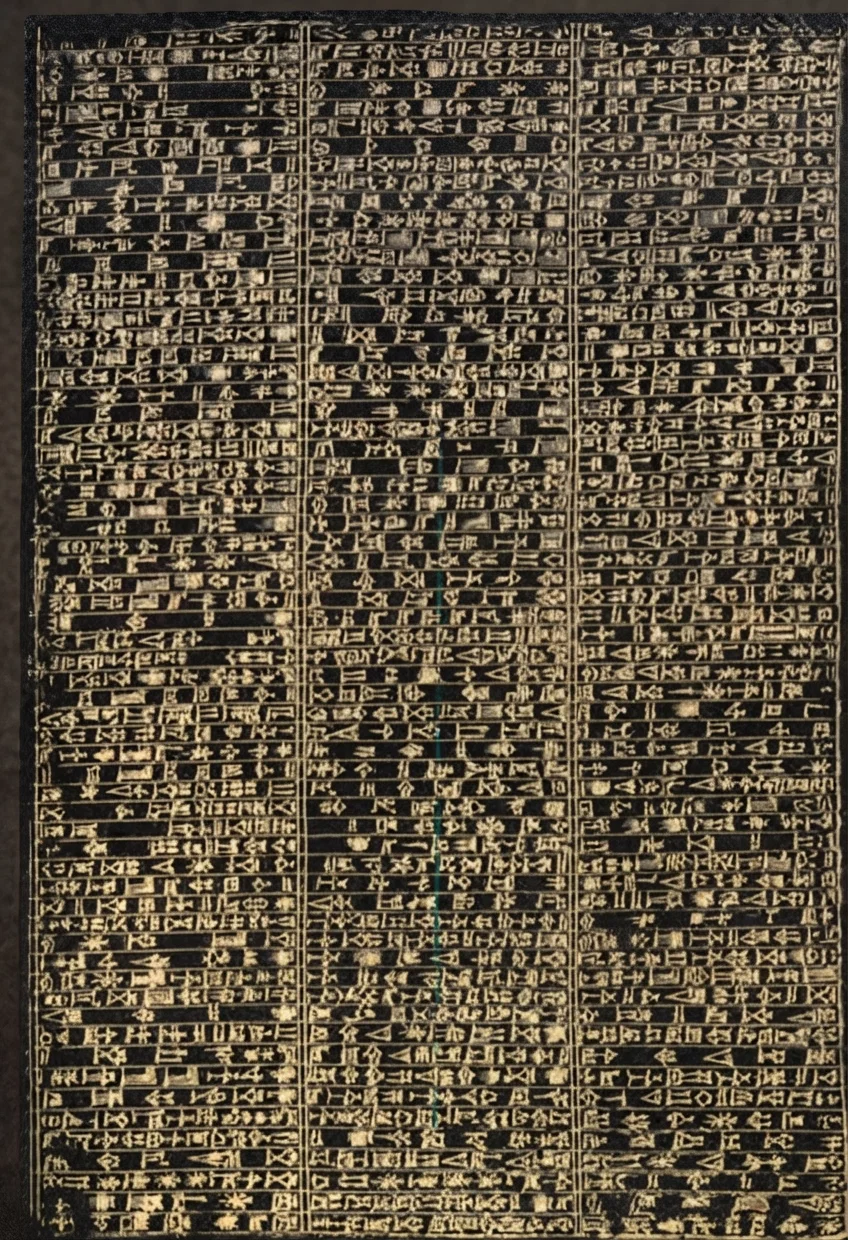
A black basalt book of Nebuchadnezzar, in the beautiful Cuneiform text.
is growing into the strength of maturity. It reaches out toward the south and toward the east, making tributary the surrounding nations and kingdoms. The possessions of Ptolemy fell under its power in A.D. 30. The kingdom of Seleucus became a part of the Roman possessions in A.D. 65. Other provinces became tributary in their turn, and soon we find the kingdom represented by the great and terrible beast holding the entire world in its grasp. It waxes strong and becomes great. The Augustan age is ushered in, the golden and glorious age of Roman history. In this age Christ the Lord was born, a most propitious time, when, freed from wars, rumors, and conquests, the whole world could give its attention to the gracious work of the Prince of Peace.

Divisions of Rome

But the greatness of Rome, her wealth and opulence, prove her undoing. Her decadence sets inswift and sure. Surrounding tribes, termed by her barbarians, which the skill and prowess of her arms had held in check in the past, now turn, and make her their prey. Whole tribes sweep in upon Roman territory, settle upon vast areas, and establish their tribal governments independent of Rome. Thus, in a few years, Rome is parceled out among these invaders, and between the years 351 and 476 the division of Western Rome into ten parts is completed, as indicated by the ten horns on the head of the beast. These kingdoms were the Allemani, Franks, Burgundians, Vandals, Suevi, Visigoths, Ostrogoths, Lombards, Heruli, Anglo Saxons.

The Little Horn

But now a new actor is introduced into the scene. The little horn arises to do its work. The Roman
Empire, through the professed conversion of Constantine, had become nominally Christian. Christian institutions and doctrines were fostered. Little by little the bishop of Rome had come to reason that, as the city of Rome had so long been the head of the civil world, in matters ecclesiastical the Roman Church should receive the same deference and respect from its fellow churches. Gradually these assumptions were admitted and recognized; but some there were who dared to dispute these lordly pretentions. Arius, a parish priest of Alexandria, advocated views which were pronounced by the bishop of Rome heretical, and Arius was cut off from his communion. The emperor was appealed to, and, for political reasons if none other, Arius was banished to the East. But the doctrines of Arius spread, and three of the ten kings—the Heruli, the Vandals, and the Ostrogoths—imbibed generally the views held by the Alexandrian priest. In the later claims of the Bishop of Rome to the chief bishopric and the head over all the churches, these three Arian powers strenuously disputed and opposed his supremacy. Before he could assume his lordly titles, it was necessary that these three opposing powers should be destroyed. This was finally accomplished in the year 538 A.D., when the Ostrogoths, the last of the opposing three, were driven out of the city of Rome, thus setting aside the last opposing obstacle to the supremacy of the Roman bishop.

The Work of the Little Horn

Further, in his explanation of the work of this little horn, the angel says, "He shall speak great words against the Most High, and shall wear out the saints of the Most High, and think to change times and laws; and they shall be given into his hand until a time and times and the dividing of time." Verse 25. That the Papacy has spoken great words against the Most High, reference need only be made to his boastful assumptions of "Lord God the Pope," "Christ's Vicegerent upon Earth," his claim to infallibility, and pretended power to forgive sins, as well as many other blasphemous titles and prerogatives belonging only to God, which he has arrogated to himself. That he has worn out the saints of the Most High, let the records of history testify in the relentless warfare which for centuries was carried on against dissenting Christians, resulting in the putting to death of fifty million of the followers of the Lord Jesus Christ.
As further evidence that this little horn represents the papal power of Rome, we may compute the exact time of the continuance of his persecuting power. Said the angel, "They [the people of God and laws of God] shall be given into his hand until a time and times and the dividing of time." A time is one year. In prophetic reckoning a day stands for a year. Eze. 4:4-6. Hence we have three times and a half time, or three and a half years, equaling twelve hundred and sixty days. A day representing a year would give us twelve hundred and sixty years, the time of continuance of this power. Beginning with 538, the year marking the beginning of papal domination, twelve hundred and sixty years would bring us down to 1798, and this year witnessed the downfall of the Papacy as a persecuting power. By the French power the pope was taken prisoner and carried into exile. Never since have his successors enjoyed the same prerogatives and privileges.

The Everlasting Kingdom

Once again the scene changes, and this time it is not the ushering in of another earthly power, but the setting up of the everlasting kingdom of our Lord and Saviour Jesus Christ. Says the record: "The judgment shall sit, and they shall take away his dominion, to consume and to destroy it unto the end. And the kingdom and dominion, and the greatness of the kingdom under the whole heaven, shall be given to the people of the saints of the Most High, whose kingdom is an everlasting kingdom, and all dominions shall serve and obey Him."
Thus, like a rapidly-changing kaleidoscopic view, the mind of the prophet is carried down through the successive stages of earth's history, from the glory and splendor of the Babylonian kingdom, through the vicissitudes of Medo-Persia and Grecia, and the breaking of Rome, to the setting up of the everlasting kingdom of our Lord and Saviour Jesus Christ. Its establishment is the next great, grand, and glorious event in this chain of prophecy.
And what a kingdom will be the kingdom of our God, glorious in majesty and enduring in might. Righteousness shall reign supreme; peace shall be its banner. Every citizen shall be a prince, every inhabitant a triumphant victor. And joy and gladness and song and praise shall shine forth from every face and speak from every tongue. "And the ransomed of the Lord shall return, and come to Zion with songs and everlasting joy upon their heads; they shall obtain joy and gladness, and sorrow and sighing shall flee away."