CHINA'S CURSE

6%

Pacific Press Publishing Company · Mountain View, California · Oct 11, 1905

FromSigns of the Times, Vol. 31, No. 41.

Read the full edition
CHINA'S CURSE
By A. C. Selmon, M. D.
As one passes along the narrow, dirty streets of a Chinese city, in addition to the various other odors, is the sickening odor that comes from the opium-smoking. If compelled to lodge for the night in a Chinese inn, the opium fumes are very stupifying. It is well called "China's curse," for the enormity of the evil can hardly be exaggerated. It is alarming that the heaviest users of the vile poison are the young men, the educated, and those in charge of the affairs of the government.
It is a very rare thing to find a mandarin who is not an opium user, and it is almost impossible to secure a well-educated man for a teacher, who is not an habitue.
In a promiscuous crowd of the people there will be seen a number who are greatly emaciated, the face expressionless and sallow, and features pinched; the eyes bleary, and eyesight very poor. The body is gaunt from poor nutrition. The hand is unsteady, and on the fingers will be seen the black stain that comes from rolling the opium. The man's gait is uncertain, and the whole appearance is that of a worn-out, useless body. And useless and worse than useless the man really is, smoking his drug until midnight or later, and sleeping until noon the next day. His business, if he has any, does not receive attention, and his only desire and care is to satisfy his craving.
Not only will there be seen men in this condition, but many boys, of twelve years old and upward, have followed the example of their elders, and are inveterate users at this early age. Among the well-to-do the percentage of women who are addicted to its use is by no means small. The same is true, to a certain degree, of opium as of tobacco and alcohol, that many use it who have a very strong constitution, and so do not show the ravages of the poison in so marked a degree.
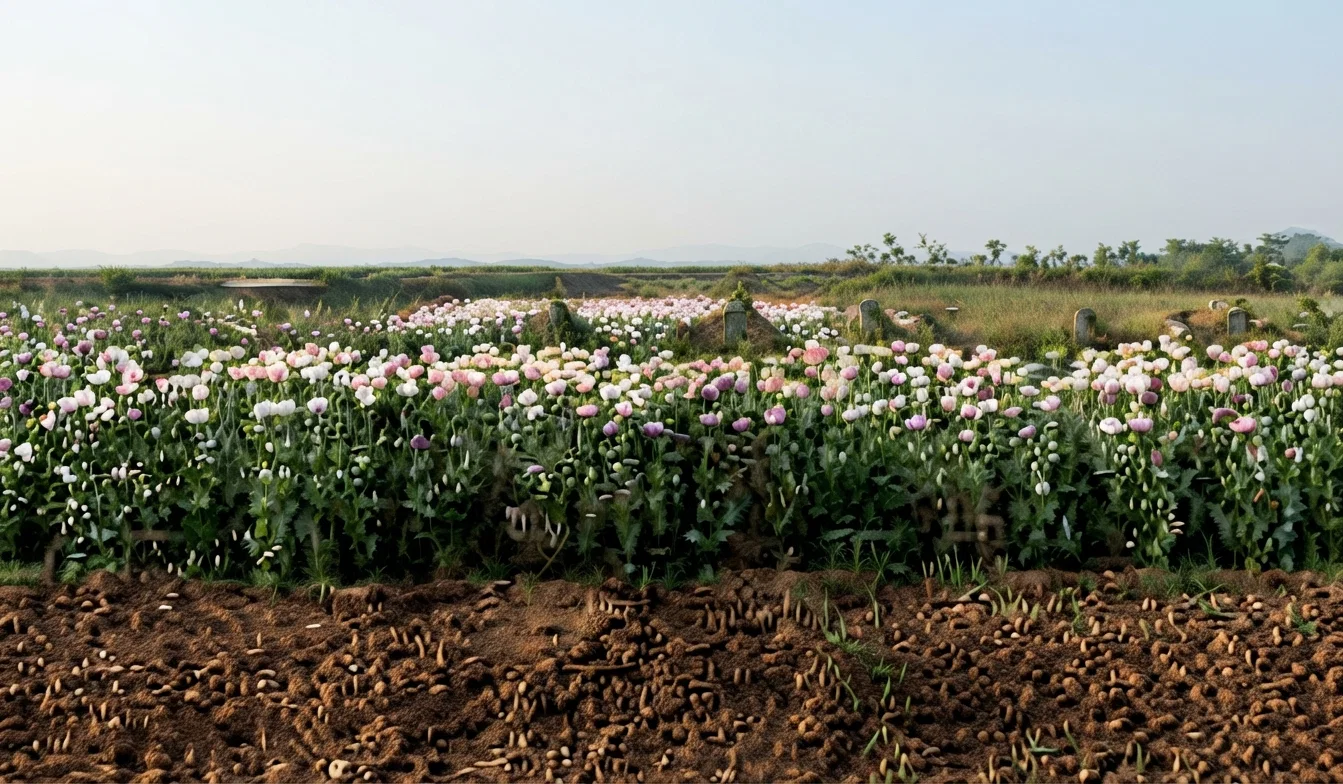
The farmers are led to cultivate the poppy, because it is more profitable than any other crop they can raise. In the province of Si-Chuen, in the west of China, there has been a very rapid extension of poppy cultivation. The principal crop formerly was wheat. An acre of wheat was made to yield twenty dollars or more. The same acre planted with poppies, while it would require considerable more work, would yield over thirty dollars.
The effect of this is seen in the increase in the price of wheat and rice. By poisoning the best talent of the nation, and by depriving the poor people of their necessary food, opium proves to be a double curse.
Below are a few figures from the English Consul General's report on the province of Si-Chuen:
"The province has a population of 40,000,000. Of this population three-tenths are urban, and seven-tenths rural. Out of this number about 2,400,000 adult males, and the same number of adult females, inhabit the cities; and 5,600,000 adult males, and the same number of adult females, inhabit the country. In the city at least 50 per cent. of the males and 20 per cent. of the females smoke opium, and in the country not less than 15 per cent. of the males and 5 per cent. of the females use it. This makes a little over 17 per cent. of the adults and 7 per cent. of the whole population of the province opium users.
"The average daily consumption of an habitue is about two-tenths of a Chinese ounce. This would give a yearly consumption of 127,750 piculs (about 17,000,000 English pounds).
"In one city, Chen-tu, it was found that there were 7,500 opium saloons, or one saloon to every 34 of the population of 306,423. The dens are open to men only, and the women have to smoke in their own homes."
It is called foreign opium by the Chinese, and is looked upon as a foreign curse. It was first imported into China from India, and the trade was encouraged by England, because of the great revenue. The Chinese soon awoke to the danger of the trade, as they saw the havoc that was being caused by it; and they declared its importation illegal, but it was still imported from India in spite of protests from the Chinese Government. The difficulty arising from the opium trade was one of the important causes of the Opium War of 1840-1843, between England and China.
England being successful in the war, the trade grew to immense proportions, and, at the conclusion of the second war between China and Great Britain, 1856-1860, the opium trade was legalized by treaty, and from that day until the present opium has been a great factor working against the prosperity of the Chinese people.
Hsiang Cheng Hsien, Honan, China.
Poppy Field, with Graves Beyond.