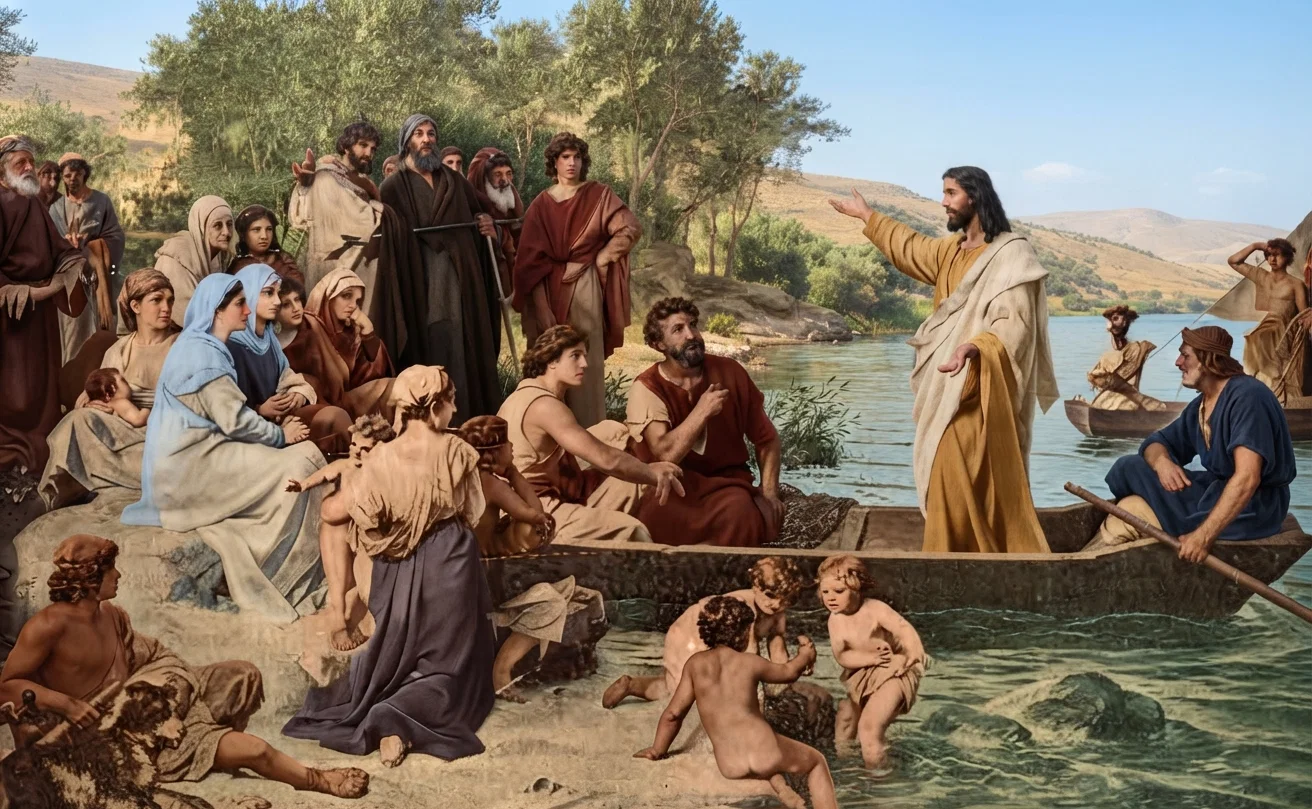
LISTEN, reader, to one of the simple lessons of our Lord; it is full of eternal importance to you. It was spoken by the lake-side of beautiful, blue Galilee, the Master in a common fishing boat, so as better to see the people; the congregation on the shore. The parable was a simple one, repeated before them many times every year:
CHRIST TEACHING FROM BOAT.
"Behold, the sower went forth to sow, and as he sowed, some seeds fell by the wayside, and the birds came and devoured them: and others fell upon the rocky places, where they had not much earth; and straightway they sprang up, because they had no deepness of earth: and when the sun was risen, they were scorched, and because they had no root they withered away. And others fell upon thorns; and the thorns grew up and choked them: and others fell upon good ground, and yielded fruit, some a hundredfold, some sixty, some thirty. He that hath ears, let him hear." Matt. 13: 3-9.
Slow of heart, the people did not understand its import; even His disciples did not, whom He had just ordained apostles. They come to Him and ask Him the meaning of the parable; and thus He gives it:
"When any one heareth the word of the kingdom, and understandeth it not, then cometh the evil one, and snatcheth away that which hath been sown in his heart. This is he that was sown by the wayside.
"And he that was sown upon the rocky places, this is he that heareth the word, and straightway with joy receiveth it; yet hath he not root in himself, but endureth for awhile; and when tribulation or persecution ariseth because of the word, straightway he stumbleth.
"And he that was sown among the thorns, this is he that heareth the word; and the care of the world, and the deceitfulness of riches, choke the word, and he becometh unfruitful.
"And he that was sown upon the good ground, this is he that heareth the word, and understandeth it; who verily beareth fruit, and bringeth forth, some a hundredfold, some sixty, some thirty."
---O---
No PARABLE goes "upon all fours." We must not force from it unnatural meanings. It is usually designed to teach one great lesson; and the truths of the lesson of this parable are that (1) "The seed is the word of God" (Luke 8: 11); (2) That the field or place of sowing is the human heart; (3) That the sower is Jesus Christ or His messengers; (4) That upon the condition of the heart, the reception of the word, is dependent the result of the harvest; (5) That we are responsible for the condition of the field. Study the parable with this thought in mind, remembering that the important thing is to hear aright.
---O---
FIRST, the wayside hearer: He has not time to listen. He catches a word here and another there. But the vital seed does not enter the soil. The beaten paths of loved pleasure and sin are too hard; and the devil, in whose service he has lived so long, sends his carnal agents of evil angels and unholy thoughts to cast out the seed. The Master is in His word, and He will not dwell in the heart which desires Him not.
---O---
SECONDLY, the stony-ground hearer has never broken up the soil nor gathered out the stones of sin, nor removed the evil in his nature. He wants the word and its blessings; he does not care to dig deep, or to know how much of useless stones cumber the ground of his heart. He is quick to hear, quick to respond, but there is no depth. The plowshare has not gone below the surface. The rain of God's refreshing falls upon the stony ground. The seed in the shallow soil, warmed by sun and stone, springs up, and gives wonderful promise of growth, but the hot sun of summer heat, the persecutions and hardship of a life of discipline, beats pitilessly down, and the growth withers, the promises fade, the hopes die. O, how many there are who thus start out hopefully in the Christian life, and after a little fail. They did not "break up the fallow ground" by heart-searching and repentance.4
---O---
THIRDLY, the thorn-ground hearer represents another class, which more greatly arouses our sympathies. They do receive the seed. It does germinate in their hearts. They love it and cultivate it to some extent, but they do not root out the constantly up-springing thorns of the carnal heart. The cares of the world press in. O, how many weary, work-worn mothers and fathers feel them! The deceitfulness of riches with its snares on every side tempts the ambitious. "The pleasures of life" (Luke) tempt the young; and cherished, they choke the seed. "The lusts of other things entering in, choke the word, and it becometh unfruitful" (Mark), or "bring no fruit to perfection" (Luke). They do give promise. The soil of the heart can bear; but the thorns of ambition, pride, pleasure, lust, are allowed to grow, and the fruit perishes half-grown. It is unutterably sad.
---O---
THERE is yet another class, those who hear the word; who receive it as the word of God; who let that word enter into the very depths of their souls; who, when the word reveals the hardness, break it up by confession; when it shows the stones, gather them out; when it reveals unholy ambition, let the power of the word destroy it; when the deceitfulness of riches lures, set over against them the riches of God's glory; when lust and pleasure clamor for the mastery, subdue them by the two-edged sword and the shield of faith; who let the searching, burning, surging power of the word purify the soul, and implant within it the righteousness and power of God, and so develop "trees of righteousness, the planting of Jehovah, that He may be glorified." Let the word into the heart; let it have free course there, and it will bear fruit; for "no word of God shall be void of power."
---O---
How different was the teaching of Jesus Christ from that of present-day methods. They often begin with the smallest circumstance and endeavor to lead up by successive steps to greater truths. Frequently the greater things are greater only in the elaborate formulas and calculations which surround them. These elaborate processes raise man no higher in the moral scale, save no life, benefit no soul, save to afford a kind of mental discipline. But Jesus takes the simplest thing and by it lifts the mind to the sublimest heights, enlarges it with the thought of God, and gives the soul an outlook never known before. The common seed becomes a symbol of the word of God. The stony, thorn-filled soil of earth beneath the feet is a symbol of the sin-filled, sin-loving, human heart. But if that heart is yielded to the Master Sower, broken up by confession, and the Seed received by faith, its power will change the life and bring forth fruit unto God. And God will demonstrate that to every soul, peasant or prince, sinner or scientist, or scientist-sinner, for all need the quickening power of the word. Friend, how do you hear?