IV. CHINESE EDUCATION

5%

Pacific Press Publishing Company · Mountain View, California · Apr 3, 1907

FromSigns of the Times, Vol. 33, No. 14.

Read the full edition
CHINA
CHINA

IV. CHINESE EDUCATION.

THE extraordinary addiction to letters, the general prevalence of literary habits among the middle and upper classes, and the very high preeminence which from the remotest period has universally been conceded to all persons of literary attainments, constitute a striking peculiarity of the Chinese.
Where but in China, indeed, could a person ever witness a literary examination in which grandfather, father, and son, all at the same time compete for the coveted prize, the degree, which in China corresponds to royalty in other lands? What nation, be it ever so advanced in science and art, can like China boast of scores of enthusiastic and vigorous students who have perseveringly and patiently traveled the scholastic road for sixty, seventy, and even eighty years? By actual count, the province of Anhui in the year 1889 reported thirty-five competitors over eighty years of age, and eighteen over ninety.
The bible of the Chinese race, the classics, which every schoolboy is required to learn by heart, is indeed

the Very Foundation

of the civilization of this race, and of the empire itself. Amid all the rebellions, social upheavals, and dynastic changes, this has kept them a nation. It is the magic web, which, running all thru China's social and political life, binds her millions, tho of different customs and speech, into one national unit, giving to this race a national life, not only unique, but in many respects stronger and more unified than either Europe or America can boast of. Politically China has repeatedly been subdued by invading hosts, but these foreign dynasties, once seated on the throne of Chinese power, never escaped being in turn conquered by China's educational life.
Like everything else in China, education is hoary with age, coming as it does from the golden age of Chinese history: according to the book of Rites (1200 B.C.), China's educational system was in full swing soon after the time of Moses. It seems quite clear that China easily led all the nations of remote antiquity in the matter of intellectual progress.
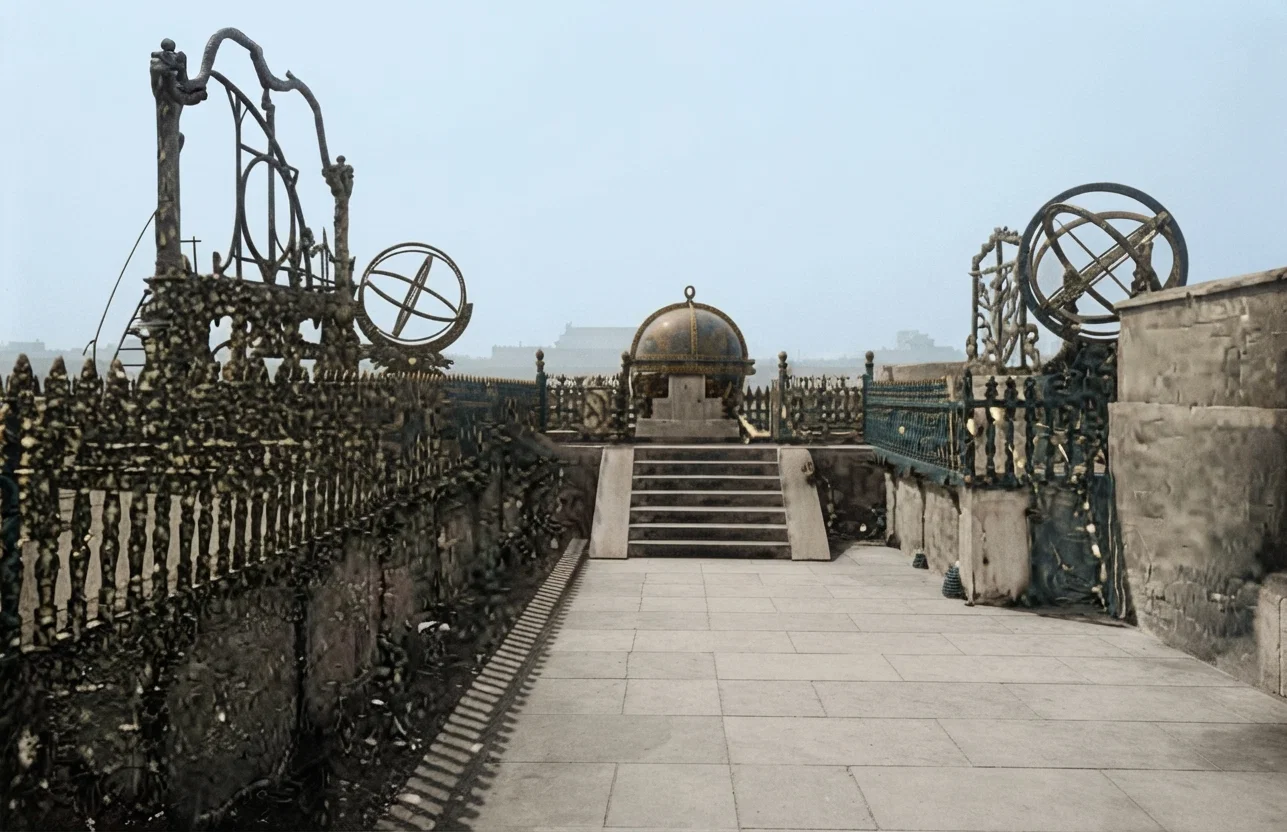
Chinese Observatory near Peking.

Ancient System Gone.

The reader should not fail to deal with these paragraphs as a bit of Chinese history, for the reason that China's system of literary examination, which dates from the Han Dynasty (about 180 A.D.), passed away by imperial authority in October, 1905. With one stroke of the vermilion pencil this elaborate and time-honored system, for so many centuries the pillar and stay of China, was swept aside, and that too, without any apparent remonstrance or protest. This sweeping away of the examination essay, the purpose and fulfilment of all Chinese education, has necessarily involved the entire educational fabric, so much so that within the last year the intellectual atmosphere of China has become heavy with new and modern educational ideas. Old examination halls are being leveled to the ground, and schools after the foreign model are rising to take their place. Temples once the abode of idols and imaginary spirits, are being made to serve the purpose of schoolhouses.
But our present concern is with what was. The new intellectual China of the past few months is beyond the scope of this article.

Method in Education.

First, then, as to method in Chinese education. Broadly speaking, the appeal is to one sole faculty of the mind, the memory. Reason and originality have no place at any point in this long and wearisome educational road. After the first three or four years the understanding is allowed to play a part, but until that time the little learner is held to his task of saying over and over a formidable array of baffling characters the meaning of which is quite unknown to him; not even are the sounds familiar to him, for the simple reason that he is now learning the classical language which is almost as different from the language of the fireside as Latin is from English. From daylight till dark, with sufficient intermission for meals only, the little Celestial, day after day and month after month, continues his monotonous task. There is neither recess nor variation in study—it is one continuous grind from one year's end to the other.
Later, as the scholar advances, a little light is allowed to break in upon his mind. By degrees the hitherto strange and bewildering characters are explained to the industrious and persevering boy. In this fact is found the otherwise inexplicable intellectual condition of the Chinese people; namely, that while a large percentage of Chinese men can read, only a small fraction of that number can understand what they read, for the reason that, owing to poverty, they were not able to pursue their studies beyond the initial stage. Of those who can read, or more properly, pronounce the characters, perhaps not more than one in twenty can really understand the meaning of the characters.

No Class System.

In a Chinese school there is no class system. Each boy constitutes a class all by himself, making as many classes as there are boys in the school, thus allowing free and full scope for individual diligence and aptitude. Each scholar studies aloud in his seat until he has learned his lesson, when he is required to "back it"—to come up to the teacher's desk and stand with his back turned while rehearsing it. All study is doneat school, as the home would be too distracting, and, too, the fireside, instead of being an aid to the work of the school, would rather have a tendency in the opposite direction. Unlike the American home, there is no newspaper, no helpful story books to act as a stimulus to the aspiring boy; for it need scarcely be said that in the matter of education the girl is not so much as thought of. The schoolroom is almost sure to be a gloomy, dark place with the most scanty furnishings possible—no maps, no charts, no globes, diagrams, or blackboards; but instead of these valuable aids to study, there is the constantly burning incense of the god of letters and Confucius. What may seem even more strange is the fact that in no case is there to be found a stove or any other convenience for heating the poorly ventilated room during the cold, wintry days of the higher latitudes.
What, then, is the subject-matter of the Chinese school? It is not what a Westerner would expect to find, such as arithmetic, geography, history, and the sciences. The Chinese school has nothing to do with such subjects. With truth it has been said, 'The vast majority of the educated men in China do not know to this day what is the meaning of the most common terms in our vocabulary, and much less do they know the use and value of the things designated, or how they are to be studied.' The Chinese scholar is indeed a student of antiquity, and all of his mental efforts have to do with the past, the remote past. The Chinese golden age is in the dim past, and all affairs are, or should be, dealt with in the light of that ideal and glorious past.
J. N. ANDERSON.
[This interesting article on Chinese Education will conclude next week, to be followed by another of equal interest.]