WITH THE SOLDIERS IN JAPANESE HOSPITAL AND PRISON.
By Missionary Herald
UNDER date of January 12, Dr. Pettee, from Okayama, reports some of the opportunities he has had for service in connection with both Japanese and Russian soldiers:
‘I had the privilege last month of spending a few days in Hiroshima and Matsuyama, two of the great military centers of Japan. At Hiroshima there are seven great hospitals, each containing on an average 1,200 sick and wounded soldiers. The chief of the whole local military medical staff, Dr. Onishi, is a sincere Christian, and was formerly a member of the Tottori Kumi-ai church. By his favor the missionaries and Japanese Christians of various denominations have free access, at certain hours of the day, to the hospitals, where they are doing a large amount of helpful ministry by means of song and preaching services, tract distribution, and personal conversation. The work is now well organized, and is very effective, considering the lamentably small number of skilled workers.
‘I give my attention to hospital No. 7, mainly because half a score of the older lads in the Okayama Orphanage had received the appointment of storekeepers and barbers for this one hospital compound. Altho assisted by two or three Hiroshima Christians, the boys are kept on the jump all day, except for a few minutes at meal times, supplying the wants of 1,300 invalid soldiers just home from Manchuria. The lads who are making a marked success of the venture, and are winning laurels for themselves and their institution, are Christian Endeavorers.
‘I gave two entertainments with my phonograph, made two formal speeches, and held personal conversation with a number of the wounded men. I was impressed, as every such worker is, with the patience of the sufferers, and their earnest desire to recover, and return to the front. The poor fellow who sat directly in front of my phonograph horn at one of the entertainments had no hope, however, of again facing the Russian foe in battle, as he had lost both his legs, amputated above the knee. He was evidently very fond of music, and involuntarily kept time to the stirring marches with his mangled stumps. One of the most pathetic sights in those hospitals is to see men with one or both feet amputated (or in process of amputation) because of frost bites. Such men lay out all night—in a few cases for two or three days—after being wounded. They lay on the hills around Port Arthur in plain sight of both armies, but could not be rescued, as a flag of truce was not allowed. Fortunately, that barbarous period of the long siege is over. Even before the final capitulation occasional armistices had been arranged, and many of these sufferers rescued.
‘Thanks to a special permit from the minister of war, to Miss Parmelee's good standing at the local barracks, and to a Christian officer who took our party in charge, we were able to cut red tape off short, and secure admission at once to the long wooden sheds hastily constructed behind Matsuyama castle hill, where fully 900 Russians are held as prisoners of war. Officers and men gave us a warm welcome, and were profuse in their expressions of pleasure and gratitude.
‘The first record was purposely unannounced, and it broke the men all up as soon as they recognized the familiar strains of their grand old martial tune, ‘The Russian Hymn.’ Every man was on his feet in an instant, and tears and sobs, as well as smiles and chuckles, were in abundant evidence. Such expressions as: ‘It was very kind of you to take this trouble,’ ‘We haven't had such a pleasure since we left Russia,’ ‘I could shut my eyes and think I was in Moscow or Petersburg,’ ‘This is a real Christmas treat for us,’ more than repaid one for the bother of carrying a heavy phonograph 160 miles on its mission of cheering comfort.
‘Hastily formed impressions should be offered with great hesitancy, but I can not help remarking that I was most favorably impressed with the refinement of some of the officers, but less pleasantly with their apparent inability to recognize the military necessities of the situation, and to adapt themselves to the irksome trials incident to a state of even lenient imprisonment. Several have lost their reason as the result of ennui and homesickness. The Japanese are treating them better than they do their own soldiers, but at best the situation is a cheerless one, and very few of the Russians care to while away the time profitably by work or study. May this, as well as other distressing results of the war, soon cease by the coming of peace and freedom. The missionaries in those cities should be specially remembered in these days of added burdens and well-nigh overwhelming responsibilities.’—Missionary Herald.
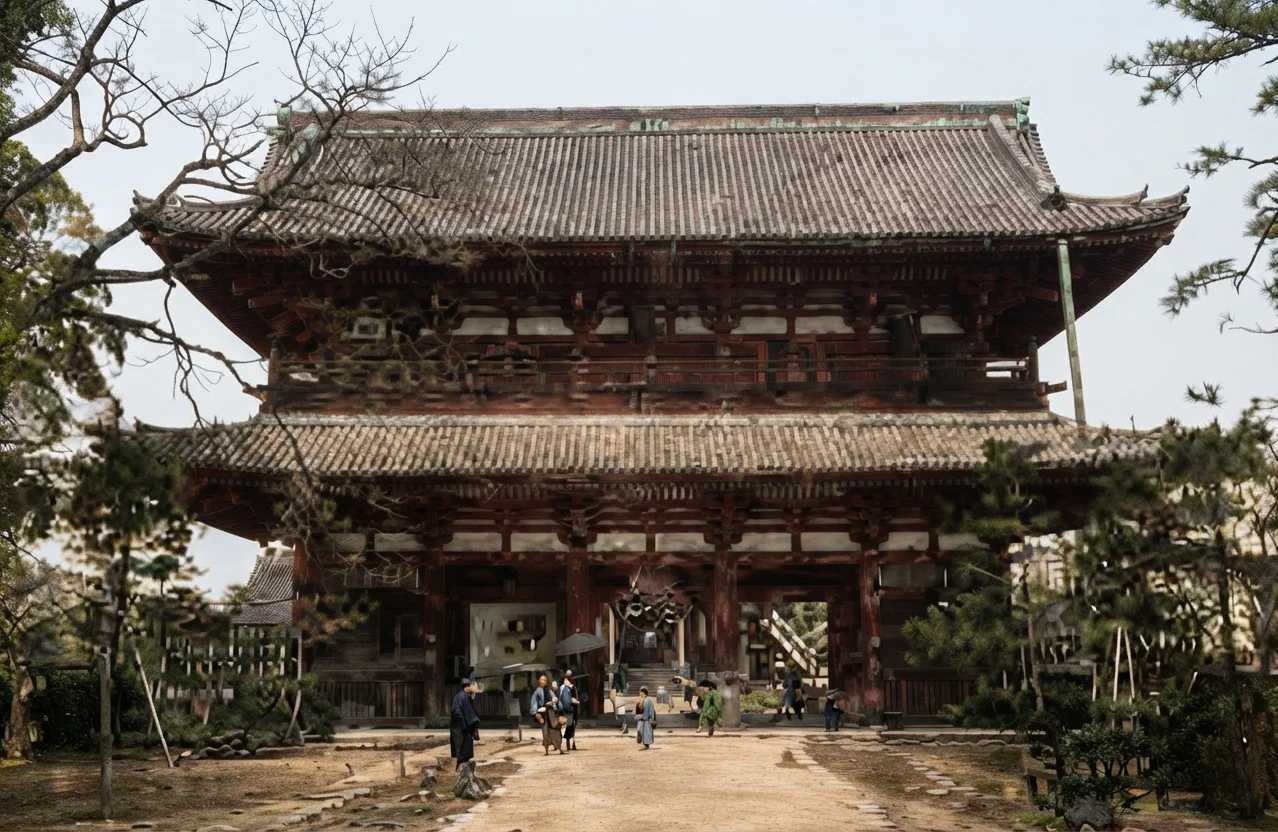
A Temple in Which the Japanese Pay Homage to Buddha.