China's Bereavement

9%

Pacific Press Publishing Association · Mountain View, California · Feb 10, 1909

FromSigns of the Times, Vol. 36, No. 6.

Read the full edition

China's Bereavement.

It had been expected for some time that the Empress Dowager who was nearing her seventy-fourth birthday would not have many more years to manage the affairs of China. It was also known that the Emperor's health was in a feeble state. But the news of the death of both within twenty-four hours of each other came as a surprise to all in the Empire of China.
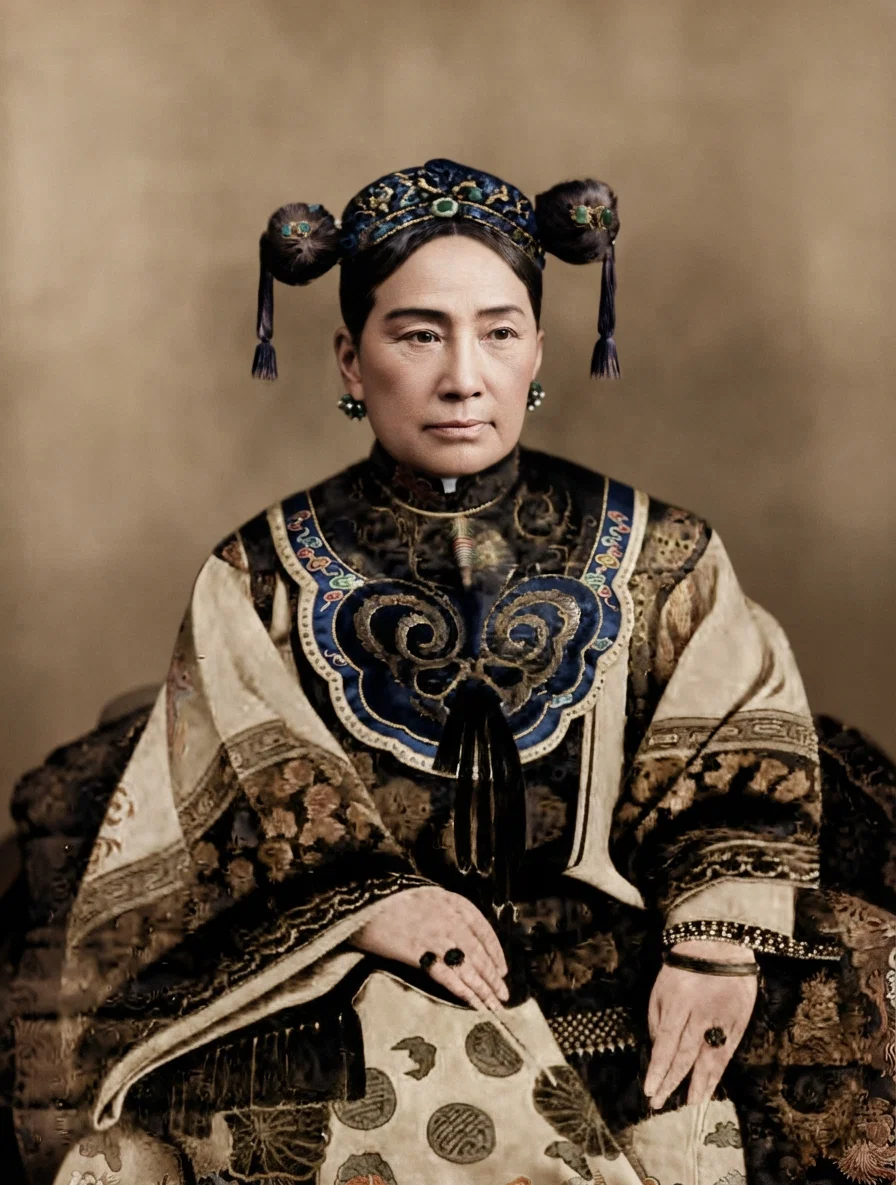
The Late Empress Dowager of China.
The death of the Emperor Kwang Hsü, who was in the thirty-fourth year of his reign, occurred on the 14th of November, and that of the Empress Dowager, the following day, November 15. The Dowager Empress was elected to a high place in the royal family in the reign of the Emperor Hsien Feng, who was the Emperor of China from 1851 to 1862.
Upon his death she was appointed regent over his son, T'ong Chi, who reigned for thirteen years, ending his reign in the year 1875. T'ong Chi had no sons, neither had he any brothers, so the Empress Dowager appointed her nephew Kwang Hsü to succeed T'ong Chi to the throne, she still holding the reins of government in her own hands, since Kwang Hsü at this time was but eleven years old. Too, it is a rule according to the Chinese "Book of Rites" that the heir to the throne can not manage the affairs of the government until eighteen years of age; nor can a prince memorialize the throne until he has attained this age.
As Kwang Hsü became older the empress gradually gave him power and responsibility until the year 1887, when he had the affairs of government in his own hands. During his younger years every opportunity was given him for acquaintance with affairs of state, both at home and abroad. And since his reign was synchronous with this period of modern enlightenment the spirit of reform took hold upon him, and he, seeing that China's future depended upon an awakening from the old paths, put forth every effort to model his kingdom after those of other Western nations. But just at the time when he was about to effect some of these reforms, his plans were revealed to the Empress Dowager and some of the conservative princes, with the result that Kwang Hsü was compelled to abdicate his power of the throne, and since the year 1898 was emperor only in name, the affairs of the government being in the hands of the Empress Dowager.

Reverses During His Reign.

At the time when Kwang Hsü became emperor, China had barely recovered from the ravages of the T'ai P'ing Rebellion. Before ten years of his reign had elapsed, China was again engaged in war with France. In 1894 the war with Japan resulted in the independence of Korea and the cession of the Island of Formosa to Japan. This again was followed by the Germans seizing Kiao Chow, a point of land off the eastern border of the Province of Shantung. The Russians soon occupied the Liaotung peninsula, and a portion of the southern province of Kwang-tung was leased to Great Britain. These misfortunes were followed by that of the Boxer uprising, with the payment of indemnities incurred by this, and the war of 1904 on Chinese territory between Russia and Japan. So he was not able to transmit to his successor the same territory that he received. And this series of reverses was a matter of deep grief to the emperor, who was represented as a man of gentle and quiet disposition, of high purposes, ever willing to learn, and anxious for the good and progress of his country.
The most influential character, however, in China during the last half century has been the Empress Dowager. Having during the greater portion of this period the affairs of the government in her own hands she became the most powerful personage and perhaps the most skilled in manipulating official matters of any one in the empire. She was a woman of unusual talent and well versed. Many important statesmen had their career and passed away during her reign,—such as Li Hung Chang and Liu Kun Ye. Her last official act was to appoint the new emperor who was the nephew of Kwang Hsü, being the son of his younger brother, Prince Chun. Since Pu Yi is but a child two years old, his father was appointed regent over him and will be during the few years to come the supreme ruler in China. It will be recalled that Prince Chun, the present regent, was the special envoy sent by the Chinese government to Berlin to offer apology for the assassination of the German Ambassador in 1900. He is a man of progressive ideas, and has chosen as his two chief counselors Chang Chi Tung and Yuan Shi K'ai, two of China's greatest and most respected statesmen, as well as being strong advocates of reform. The last wish of the late emperor was that China should make haste in adopting the Western form of government, and it was his wish that his younger brother's son should succeed him to the throne. The latter has already been effected, and there is very little doubt but what the other request will be rapidly carried out, for now there seems to be nothing left to obstruct the policies of the reformatory party of which the present regent is the chief promulgator.
Everything is reported as being quiet in Peking, and arrangements are being perfected for the burial of the late Empress Dowager and the Emperor. Meanwhile all the officials in China have been commanded to go into mourning for one hundred days. This mourning ceremony will be universally observed by all subjects of the Chinese Empire, they being required to remove the red button from their hats, red being a sign of joy, and it be replaced by white or blue—Chinese colors for mourning. Wherever red is ordinarily used, whether on a bridal chair or as a covering of an umbrella that precedes an official procession, or as decorations on a newly opened store, the use of this color is forbidden for one hundred days. Further, it is required of all officials that they shall not shave their heads during this time, and it is expected of every loyal Chinese subject that he shall also acquiesce in this matter. In front of all large stores will be found banners and crapes of white having written on them in blue characters expressions of mourning. The various legations of foreign countries will for twenty-seven days lower their flags to half-mast. Throughout the country the leading officials of each district must for three days gather their subordinates morning and evening for seasons of weeping. Marriages and feasts and all occasions of hilarity are forbidden during this one hundred days. Previously when emperors died, it was not so easy to carry out the rites of mourning, owing to the lack of rapid communications to the different parts of the empire; and it was sometimes weeks before some of the lower officials would receive the news. But to-day the decrees reach all parts of the empire during the same day.
The official name given to the new emperor by which his reign will be designated is "Hsuen Tong," which translated means "continuation of glory." So next year the Chinese calendar will be the first year of the reign of Emperor Hsuen Tong. With the few experienced statesmen as his counselors and a large number of foreign trained officials already at his command, we believe the outlook is very encouraging for the adoption of a constitutional government for China, and the development of her governmental policies along those followed by other governments in the formation of a strong army and navy. Judging from the present indications the affairs of state are well under the control of the Imperial House at Peking. As to how these reforms will be a betterment to the people in general, we can not say, but we know that the spirit of the time is that every nation is trying to outdo the other in its preparation for war. And we feel that that which bestirs China most of all towards adopting Western methods is that she may learn how to fight successfully so as to protect her territory from future ravages such as have taken place dur-