BEFORE the "fountains of the deep were broken up" and the flood of waters covered the face of the earth, God gave the wicked inhabitants of the old world ample opportunity to repent. Noah uttered his voice in warning, but he seemed to the careless multitude as one that mocked. But at length Noah and his believing household were shut up with God in the ark, and those who despised the voice of mercy received the merited fruitage for their seed-sowing of sin and stubbornness.
History is but a repetition of itself. The Bible has given us a faithful transcript of the past in order that we may not covet the wages of unrighteousness and fall after the manner of those of old. We have had revealed to us the record of the Flood, yet altho we stand upon the threshold of a more awful catastrophe, many are not preparing themselves to heed the counsel of God and flee the wrath to come.
There are many honest hearts in every part of the world, who have not yet fully accepted the light illuminating God's Ten Commandments. But these are living up to all the light they have and at the proper moment will unite with those who keep the law of God, and have the testimony of Jesus. The Catholic Church has greatly modified the commandments in all catechisms, but some other churches are not loath to abbreviate the ten words spoken from Sinai amid the outburst of the elements.
In Spanish America those bound by Catholic tradition and superstition — and these are the great majority — are taught by the priests to "guardar los días de fiesta;" to keep holy church feast-days, not only Sundays, but many others as well. May 28, the people of this city, Ambato, and of Ecuador in general, observed the day commemorating the ascension of our Saviour. As a rule, church days are days of gluttony and drunkenness, so that all sacredness, if there is any, is completely lost sight of. Some, indeed, are conscientious in their observance of days, and observe them to the Lord, but others, here as at home, consider the holier the day the better it is for yielding to the lustings of the flesh.
The Catholic Church teaches a "día del juicio," or day of judgment, when God will come to judge the quick and dead. Many believe that this day will soon come, and quite a number give as their reason the fact that animals and plants and trees, at one time scarcely touched by harmful insects or germs, are now greatly plagued by them. Each locality has its particular pest, tick or worm, locust or ant, parrot or puma. In Ecuador the principal product, the cacao bean, or chocolate, has more enemies than any other, and each year the pests which attack it increase in number and variety.
With man exposed to contagions of the worst type; with beasts and vegetable life exposed to attacks generally different from those to which man succumbs, yet quite as fatal, we can with reason see why many are beginning to believe in a near and personal Judgment.
The great majority in Ecuador are ignorant and utterly unable to read. A great many of the principal men in this locality and in others have and do read Las Señales, our paper from Chile. The poorer class must derive their idea of a day of wrath from observations of nature or from hearsay; the educated class, many of them very liberal in their opinions, can read the warnings of Christ's coming, and the signs which precede that event. Many do read, and read with approval.
As I write this I can look out of the door and see the mountains covered with volcanic ash. About us we can see three volcanoes, two active and one silent, — I say silent, instead of extinct, for no one can say for a certainty that the inactivity will be for long.
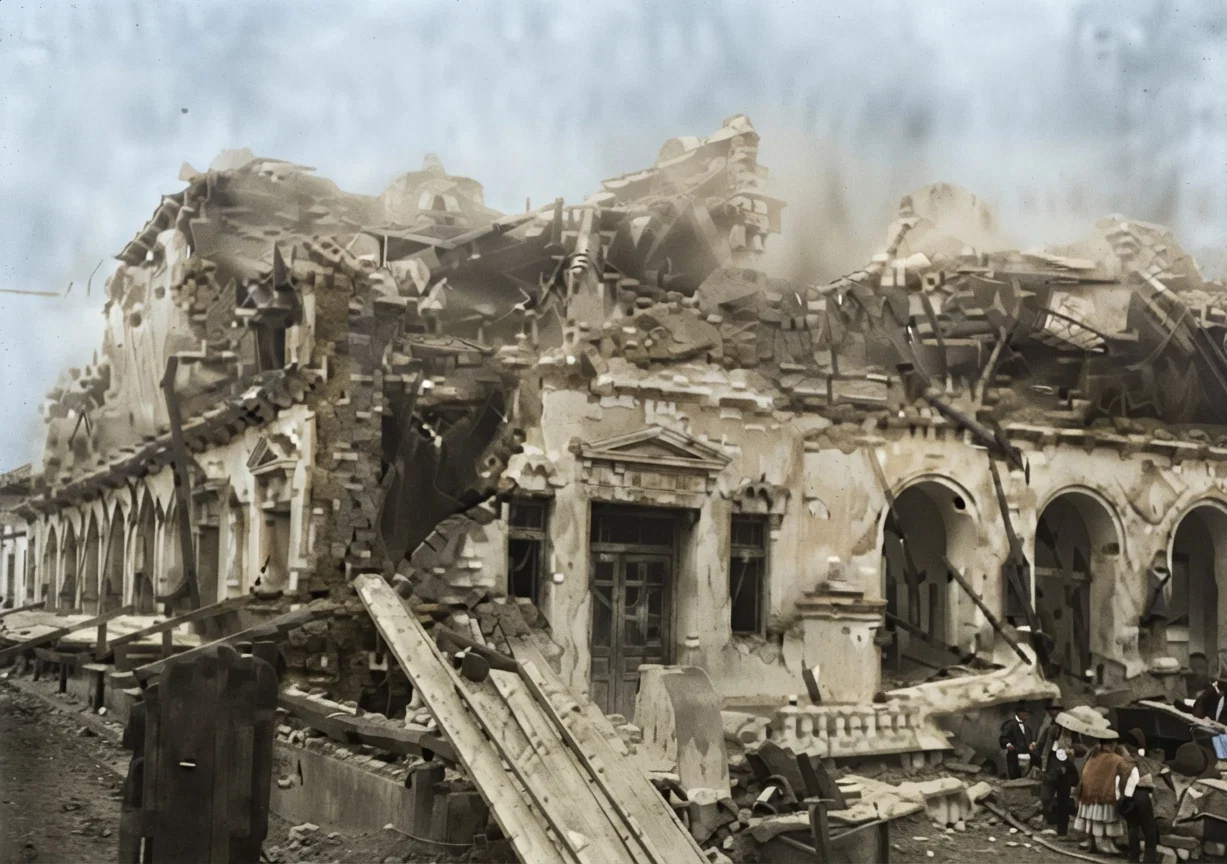
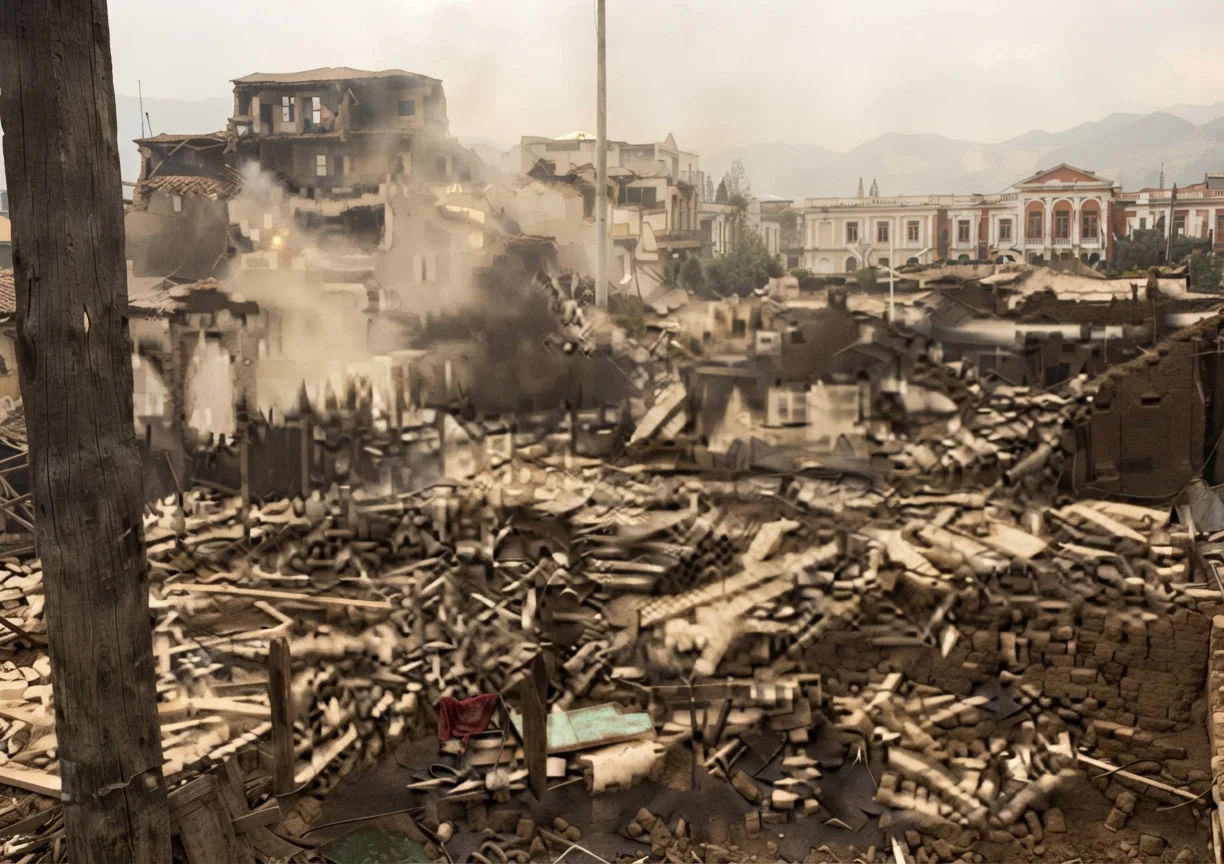
After a South American Earthquake.
Nature in all parts of the world is too convulsed, and in too uncertain a state. The former two, Cotopaxi and Tunguragua, have thrown out so much ashes, sand, and lava during the last century and in previous ones that the neighboring districts are covered with it. Cotopaxi was in violent eruption in 1534. The Indians thought that nature fought against them, and gave up the struggle against the Spanish invaders. For two centuries it was quiet and then again broke forth. For twenty-six years it terrified the district about Quito. It sent out a rain of sand and ashes which covered vegetation, and lessened the fertility of the land. From 1870 to 1880 it was active again, and did considerable damage. Tunguragua was active also during the last century; Cotopaxi still belches forth smoke and often ashes and cinders, but there is another volcano, Sangay, further distant than Cotopaxi, more active, in fact, one of the volcanoes in most violent commotion in the whole world.
What a South American Earthquake Does.
Ecuador has had some violent earthquake shocks. Gonzalo Pizarro was frightened by an earthquake in 1541, as he was marching with his victorious army to Canelos, a city east of Quito in the Amazon Valley.
Quito was partially destroyed in 1587.
On Sept. 2, 1628, after another strong shock the municipal body elected Santa Teresa patroness of the city and special protectress against damage from earthquakes, but more disasters from this cause occurred, so that in 1651 the image of Nuestra Senora de Guadalupe (Our lady of Guadalupe) was publicly carried through the streets as was customary in times of calamity. However, earthquakes continued, and after these the people of Quito elected St. Michael, Archangel, also, as patron, thinking that the disasters would cease.
In 1660, the strongest shock yet felt occurred. The people seem to have lost a bit of their confidence in their images, for we hear of no new elections. In 1661 and 1662, the churches and edifices in Quito fell.
In 1678, another strong temblor occurred; in 1687, Ambato was stricken; in 1698, 6,500 people were buried in the ruins of Ambato, Latacunga, and Riobamba. In 1736, the churches of Latacunga were destroyed. Latacunga lies between Ambato and Quito.
In 1755, Quito experienced another earthquake shock; houses fell, and two years were required to rebuild the city.
In 1757, 400 persons perished in Latacunga.
In 1797, 4,000 people perished in Riobamba. Riobamba lies between Ambato and Guayaquil.
In 1859, Quito was ruined by an earthquake. The churches lost their towers, some of which have never been restored.
In 1868, August 15 and 16, occurred the greatest earthquake ever felt in Ecuador, a little to the north of Quito in the Provinces of Imbabura and Carchi. The president of the time, Garcia Moreno, places the number of deaths at from 15,000 to 20,000. The shock was felt in Guayaquil, but this city, altho experiencing many earthquakes, is to all appearances free from losses because the houses are, unlike the houses of the Sierra, of bamboo, plastered within and without, or of other kinds of wood.
In 1871, islands of from thirty to ninety feet in height appeared off the coast of Manabí.
In 1889, the coast rose in elevation, but little or no damage has been done by earthquake shocks alone along the coast. However, Guayaquil has had three disastrous fires, which destroyed the whole city, but its citizens, energetically, have built a new Guayaquil after each burning.
Hurricanes are rare in Ecuador. In 1877, occurred the last one of importance. They have occurred about once in thirty or forty years. As the banana and plantain have very shallow roots, and are planted in loose, moist soil, a strong wind would uproot all plants. As it is, they fall in some parts during a gentle breeze. The loss of these fruits would cause an economic revolution in the life of the people of the coast where the plantain and banana grow, as these fruits are the daily bread of the inhabitants of the lowlands as much as roasted barley flour is for the people of the mountains.
Only great calamities which personally affect them lead them to think more of the great day of wrath, and then, as a rule, they appeal to their images of the Virgin Mary, of Christ, of Joseph, or some other saint.
The Lord has spoken to this generation to repent, but few are accepting the solemn message of warning, and many, walking in their own lusts, are saying, "Where is the promise of His coming? For since the fathers fell asleep all things continue as they were."