N our last issue, at the time of the writing of the note, we stated that an armistice had been signed between Turkey and the Balkan allies with a view to peace. We were a little premature in saying that. The next day it looked as if the whole matter of the armistice was off. But at this present writing, the armistice has been signed by Turkey and all the allies except Greece. Greece is still using her naval power to secure some advantages in the rear of Constantinople. But the tone of the despatches from the East is that doubtless Greece will acquiesce, and peace conditions will be considered.
It is very difficult, indeed, to get anything upon which one can depend, from the seat of war. We have had it stated over and over again that Austria is mobilizing its forces on the Servian frontier, and as many times denied. So it has been stated that Russia is gathering her forces near the Austrian frontier, but this has been denied. The latest is that 300,000 Austrians are ready to enter Servia at a moment's notice, and that the Servians have called out all of their reserves, old men and boys; and this may be denied to-morrow. One report will say, as it does on the day on which this note is written, that there is great danger of war between Austria and Servia; and the same day and in the same paper is another report that the great powers of Europe are generally agreed in giving Austria a commercial port—not a military one—on the Adriatic Sea, and that this, it is thought, will heal the Balkan troubles and secure peace; and in this arrangement Albania, or at least a part of Albania, will be given its independence. All these things are conjectural.
The proposed peace conference is to meet in London. When that is over, we shall know just what may be depended upon for a little while. And it is only a little while. We have had patched-up peace contracts between the powers of Europe and the Balkans again and again, made, seemingly, only to be broken.
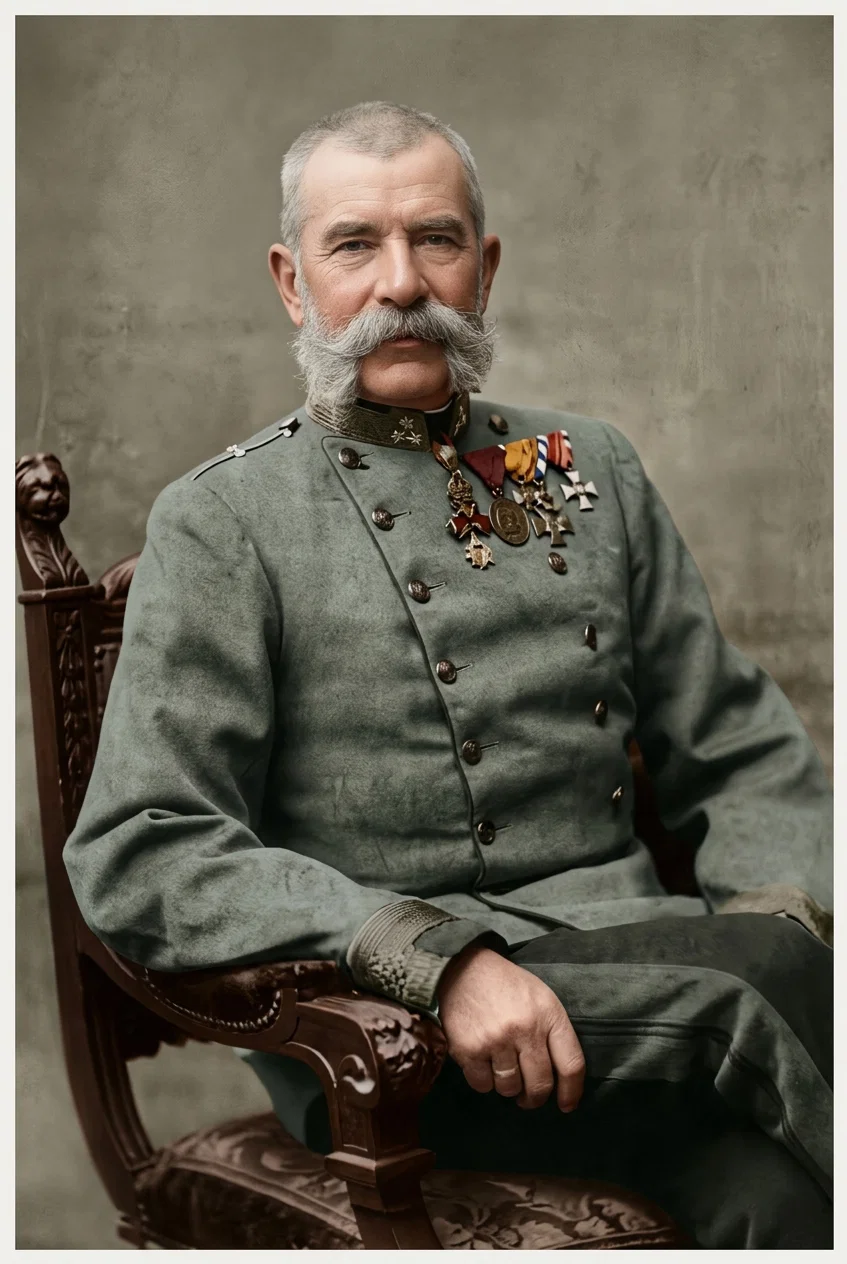
Francis Joseph, the venerable Emperor of Austria-Hungary, who has been disturbing the tranquillity of Europe by his demands upon Servia
It takes such a little thing for an excuse to break through all such compacts, especially on the part of such powers as Russia, Turkey, and the Balkan allies.
It has also been reported that Bulgaria and Servia are anxious that Turkey shall become one of the allies. This, of course, implies a great limitation of Turkey's territory, giving to her Constantinople and Adrianople, a center held by Turkey before she conquered Constantinople. And this, too, is conjectural. After all, the Turkish government is evidently disposed to do as near right as many of the other governments of the East. Her great difficulty lies in the conglomerate mixture and the inconsistent system of government which she possesses. Her worst foes for hundreds of years have been her own pashas and beys and minor officers, who are so independent in their own territory as to oftentimes utterly reject any actions which may be taken by the general government.
Great Britain's new Ambassador to the United States, Sir Cecil Arthur Spring-Rice, the successor of Mr. Brice. He is fifty-three years old, and has had a distinguished career in diplomatic service. He was in Washington, in 1886, as third secretary, and there again in 1893. He has held posts at Brussels and Tokyo, Cairo, Berlin, Constantinople, St. Petersburg, Teheran, and Stockholm. (From "Harper's Weekly")
A survey of the whole situation, however, shows this, that what God has said in Jeremiah 25, in Joel 3, in Revelation 16, and other prophecies is preeminently true; that we are living in that time when the whole earth is preparing for war, when not only the great powers, but the little powers, are preparing, when the world-wide cry is going forth: "Prepare war, wake up the mighty men, let all the men of war draw near; let them come up: beat your plowshares into swords, and your pruning-hooks into spears: let the weak say, I am strong."
The nations are becoming awakened. They are all tending toward that last great war which the Word of God calls Armageddon. The Holy Land itself will be the scene of the last great conflict, centering there, but world-wide in its influence. Only those whose faith is placed in the Lord Jesus Christ will pass through these final calamities in safety. For these wars are not simply of one nation against another, but they are all against God and His truth. For it is said, "These shall war against the Lamb, and the Lamb shall overcome them, for He is Lord of Lords, and King of Kings; and they also shall overcome that are with Him, called and chosen and faithful." Rev. 17: 14.
Wilhelm, Emperor of Germany, who, while mobilizing his troops, is said to be working for peace