MYSTERIOUS TIBET

7%

Pacific Press Publishing Company · Oakland, California · May 18, 1904

FromSigns of the Times, Vol. 30, No. 20.

Read the full edition

MYSTERIOUS TIBET.

TIBET, one of the possessions of China, comprising a great division of the Chinese Empire, is a country of which very little is definitely known. Surrounded by high mountains, it has been to a great degree isolated from the rest of the world. Tibet is a corruption of the Chinese name; the people themselves call it the "land of Bod." The Kwanlun Mountains bound it on the north; on the east are the Chinese provinces of Szchuen and Yunnan; Assam, Buhtan, Nipal, and Gurhwal separate it from Burma and India on the south; while on the west its boundaries are not sharply defined from the territory of Kokonor. Little Tibet does not properly belong to Tibet, tho it is claimed by Chinese geographers. The greater part of the surface consists of high tableland (elevation 11,510 ft.), divided into three parts by mountain ranges; the valley of the Indus on the west, between the Hindu Kush and Himalaya Mountains; the high desert land, almost uninhabitable, and wholly unknown, lying between the Kwanlun and Himalaya Mountains; and the basin of the Yaru-tsangbu on the east, consisting of high ridges, and deep gorges, mountains and valleys. Numerous peaks of perpetually snow-capped mountains are to be found, of which Mt. Kailasa (26,000 ft.) is the highest.
The principal river, the Yaru-tsangbu, drains the whole of southern Tibet between the first and second ranges of the Himalayas, and is supposed to empty into the Brahmaputra, tho explorations have not yet been extensive enough to decide the truth. All the large rivers of southern and eastern Asia find their source in Tibet. In the central part are numerous lakes. The climate is varied, but in general the air is pure and excessively dry. Snow and ice last for most of the year, but in the middle of summer the valleys, even between the snowy mountains, are excessively hot. In the southern part moisture and vegetation are found, and sheep, goats, and yak are raised.

The Government

is conducted by two high commissions appointed at Peking, but these confer with, and are guided by, the two grand officers of the Tibetan hierarchy, the Dalai-Lama, and the Teshu-Lama; the former is known generally as the Grand Lama. The power is practically in the hands of the priests or lamas, so numerous as to give Tibet the name of the "kingdom of priests." The southern frontier is strongly fortified, and communication with the states intervening between Tibet and India is forbidden. On the Chinese frontier the same strictness is exercised, for the policy of exclusion is fostered alike by the Lamas and the Chinese—the one because they wish to preserve their religious supremacy and fat offices, the other because they wish to retain their political power, faint tho it be. Lhasa, the capital, has only once been visited by an Englishman,—Mr. Manning, in 1811,—and its location has but recently been agreed upon to be approximately in lat. 29° 39' 17" N., and long. 91° 05' E. It stands in a fertile plain, at an altitude of 11,700 feet, encircled by mountains. It is noted for the number of its monasteries, bonzes and lamas, filthy streets and mean buildings. The population is estimated at from 40,000 to 80,000, and the population of the whole of Tibet is estimated by Russian authorities at 6,000,000.
The people belong to the Mongol race. They are not so highly civilized as the Chinese, but are more so than the Mongols. Physically they are somewhat of slender build, with brown hair, slightly oblique eyes, swarthy and beardless. They are a mild-tempered, genial, kind, and friendly people, and intensely religious. In no other country is so much deference paid to the priests; the proportion of believers in the religion is also greater than in most countries. Their religion consists of two kinds; the old original religion called the "Bod," of which little or nothing definite is known; and that form of Buddhism called Lamaism. The social customs of the people differ greatly from those of their neighbors on the east and south, particularly in the position which women hold. Here polyandry is the custom instead of polygamy, the wife being usually espoused by brothers. In general, education is restricted to the priests, but the women, who conduct most of the traffic, learn writing and arithmetic. In some of the northern provinces the chieftainship is held by the women.
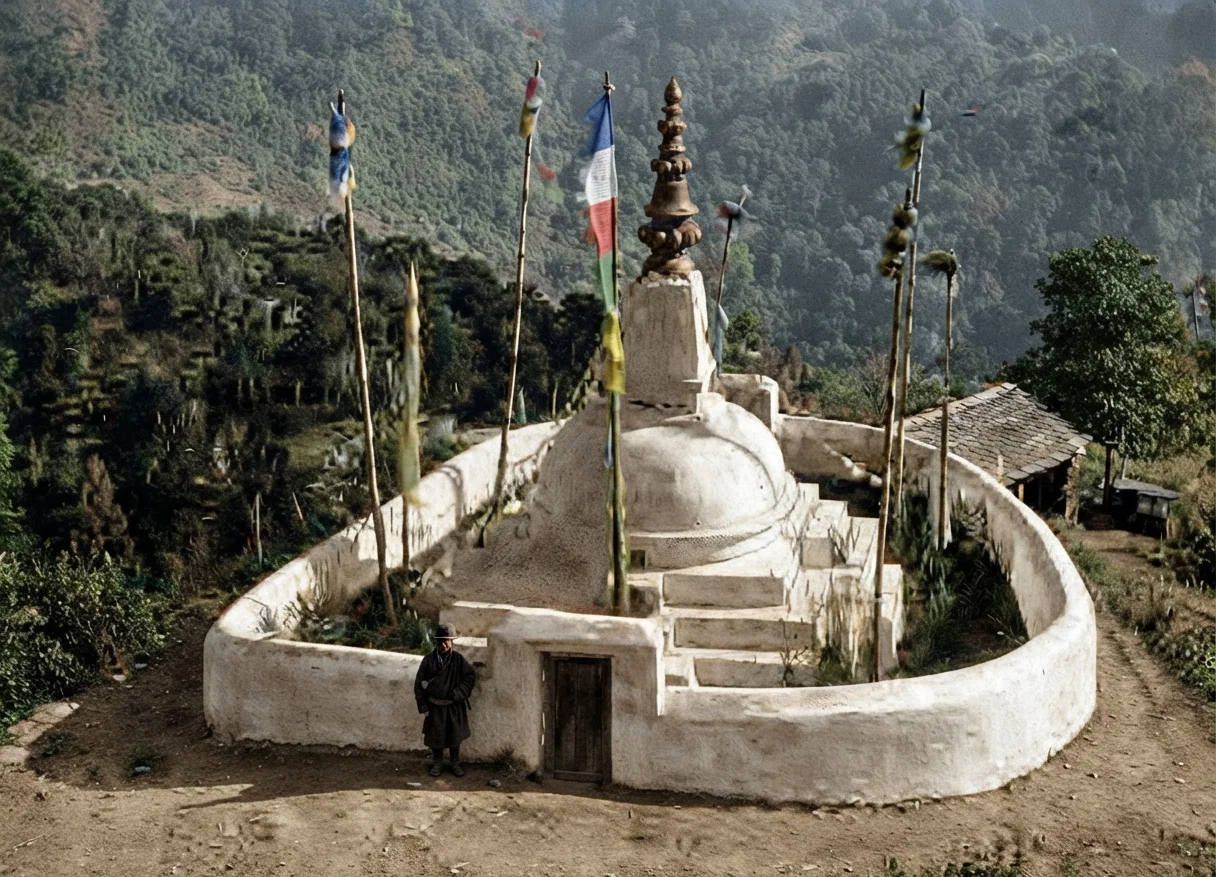
A Tibetan Tomb at Darjeeling.
The language of Tibet is derived from the Sanskrit. It is alphabetical, and reads from left to right. Thirty consonants are recognized, with four additional vowel signs. Their literature, as well as many of their customs, has been influenced to a great degree by China.

Missions

are not permitted in Tibet. In former times the Roman Catholic Church made noble efforts to enter the forbidden land, and was for a time successful. In 1330 the apostle of Tartary, Odoric Forojuliensis, traveled in Tibet, and found missionaries already in the city of Lhasa, who had gone there, it is supposed, early in the preceding century. In the 17th century a mission was commenced from India, and the reigning prince was favorable to the new religion; but his apostasy was made the pretext of his overthrow. Various attempts at evangelization have been made since that time. The most noteworthy one was in 1845, when Fathers Gabet and Huc penetrated to Lhasa after a journey of eighteen months, only to be arrested by the Chinese officials, who sent them prisoners to Canton. From that time the Société des Etrangères has made numerous attempts, both by way of India and China, to enter the kingdom; but after suffering persecution, and the massacre of their priests, they have given up the effort, and occupy now only the confines of Tibet, where they work among the Chinese and such Tibetans as are there found.
The Moravian Brethren occupy three stations in Little Tibet (see Leh, Poo, and Kyelang), where they are waiting for opportunity to enter Tibet. One or two attempts have been made at great risk, but have proved ineffectual. They have studied the Tibetan language, and there are now several works which will aid the future missionaries to Tibet when the country is opened. A Tibetan-English grammar, a Tibetan grammar, and a New Testament in Tibetan have all been published. The missionaries of the C. I. M. in Szchuen and Yunnan are also waiting to possess the land.—Encyclopedia of Missions.

Priest-ridden.

Tibet, now of special interest on account of the British expedition in that mysterious land, possesses so many lamas that it is practically priest-ridden. At the head of the hierarchy are the grand lamas, who all claim to be Buddha reincarnate. Every lamasary has such a priest-god, and there is one called Chang Kia Foo, who lives at Peking. Beneath these high priests there are hundreds of lamas who profess to be the reincarnated spirits of Buddhist saints. Then there are lamas in whom are supposedto dwell the founders of monasteries, and lamas in whom good men live their lives over again. The priests constitute such a large portion of the population that many of them are compelled to go about the country begging from door to door.
There are many features about lamaism which strongly resemble the doctrines of the Roman Catholic Church. The ceremonial of worship, the burning of incense, the chanting of hymns, are so closely similar to these services in the Roman Catholic Church, that Father Huc, who succeeded in visiting Lhasa in 1839, reached the conclusion, in his "Souvenirs," that the wandering lama from whom Tsong Kapa drew his inspiration, was in reality a Jesuit missionary. Other travelers, however, declare that the lamas are wofully corrupt; that, while professing celibacy, they are very immoral; that they eat the flesh of the dead, and have a passionate thirst for blood. Many, he says, use a hypnotic power over their parishioners, and obtain wealth by various modes of extortion.
Unlike some professing Christians, who expect their Sunday piety to last through the week, the Tibetans pray most of the time. Whether they are at work or at pleasure, whether squatting on the floor of their houses, or on a journey, they continue their supplications. In order that religion will not prove too inconvenient, these pious people have prayer flags, and prayer wheels, by which orisons are rendered automatically. A prayer wheel, for example, is a sort of spool, covered with cabalistic inscriptions, which a lama has written and sold, and should the faithful be walking along the street, or conversing with a boon companion, he can keep saying his prayers by constantly turning the wheel. Prayer flags are likewise covered with supplications, which are believed to prove efficacious when waved in the air.—Protestant Observer.