BUENOS AIRES

4%

Pacific Press Publishing Company · Oakland, California · Aug 24, 1904

FromSigns of the Times, Vol. 30, No. 34.

Read the full edition

BUENOS AIRES.

HERE we will leave you to wander at will through Argentina's capital city. Another world seems to have dawned upon us. The straight, well-paved streets, the network of trams, cabs, carts, automobiles, private carriages, and pedestrians, seem to indicate that the world moves, even in South America. Here the principal lines of railway terminate, the suburban trains run swiftly in and out, and the freights and steamboats bring in the agricultural and stock-raising products which represent the chief industries of the country.
Ex-United States minister Barrett, in a recent speech in New York, calls this the New York of South America, and compares it to a youth whose robustness and rapid growth attract the admiration of all who behold him. Aside from some of the western towns in the United States, the increase in population has been exceptionally rapid, having risen from 177,000 to 900,000 in the last twenty-four years.
The other towns of the republic are so nearly represented by this one, that when you have seen one, you may be said to have seen all.
The houses can not be distinguished one from another, but present one solid front to the pavement like those of English and Scotch towns. But through the street doors potted plants, palms, and ferns are nearly always visible, indicating a yard or garden inside. This yard is paved with tiles, would be called a court in the east, but is here designated patio. There are often two or three patios, one back of the other, and the rooms are in a row, running back from the front, and usually derive all their light and air from tall doors, composed mostly of glass, which open into the patios. A great deal of time is spent in the patio, taking maté, chatting with friends, etc. In the afternoon, however, the women who are at leisure make themselves presentable with careful hair-dressing and plenty of powder, and lean from the windows to see and be seen. The only windows in the house, of course, open onto the sidewalk.
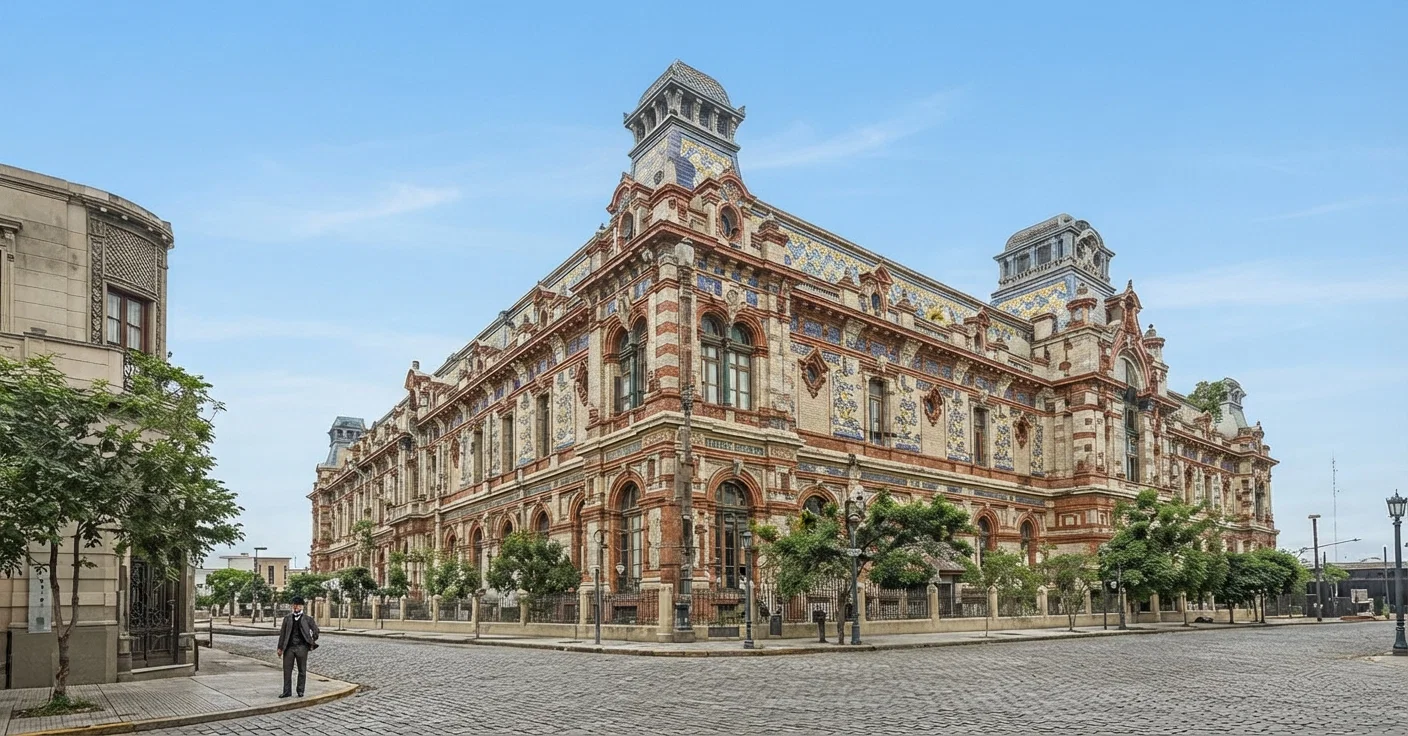
Water Deposit, Buenos Aires, Argentina.
The shops are quite imposing, some of them running through from square to square with their enormous show-windows decorated very attractively, and offering for sale anything and everything in their line which money can buy, altho it must be confessed that considerable money is required to buy these.
There are thirty-four markets located in different parts of the city, from which the food supplies come. During the year 1903, 2,748,922 unfortunate animals were slain and consumed by these carnivorous people. The fruit markets are beautiful, and have nearly all the varieties of fruits and vegetables found at home, in their seasons, which are, of course, the reverse of the seasons in the northern half of the world. The Central market is said to have thelargest wool dock in the world, and an idea of the business carried on there may be gotten by the figures which show it to have received 200,000,000 kilos of different products, mostly wool and cereals, during the month of April. Here everything is measured by the metric system, and described in the Spanish language.
The earlier efforts of foreigners in learning Spanish are often very amusing to their friends who have but recently been over the road themselves; but the polite gravity of the natives under such provocation, and their tactful way of setting one right without ostensibly correcting him, inspire wonder and admiration. It is to be hoped that intercourse with such a large per cent. of foreigners as immigration continually lands on these shores, renders them less sensitive than what they would otherwise be, to the mutilation which their beautiful language suffers at our hands from day to day.
But to one thing they never do seem able to accustom themselves, and that is foreign peculiarities in dress. A woman wearing a sailor hat or a rain cloak seldom fails to elicit comments on the part of the passer-by, and the children quite likely greet her with a chorus of “man’s hat,” or “thatch roof.” Here only the most faultlessly attired wear hats at all, so that a peculiar or shabby head-dress attracts immediate attention.
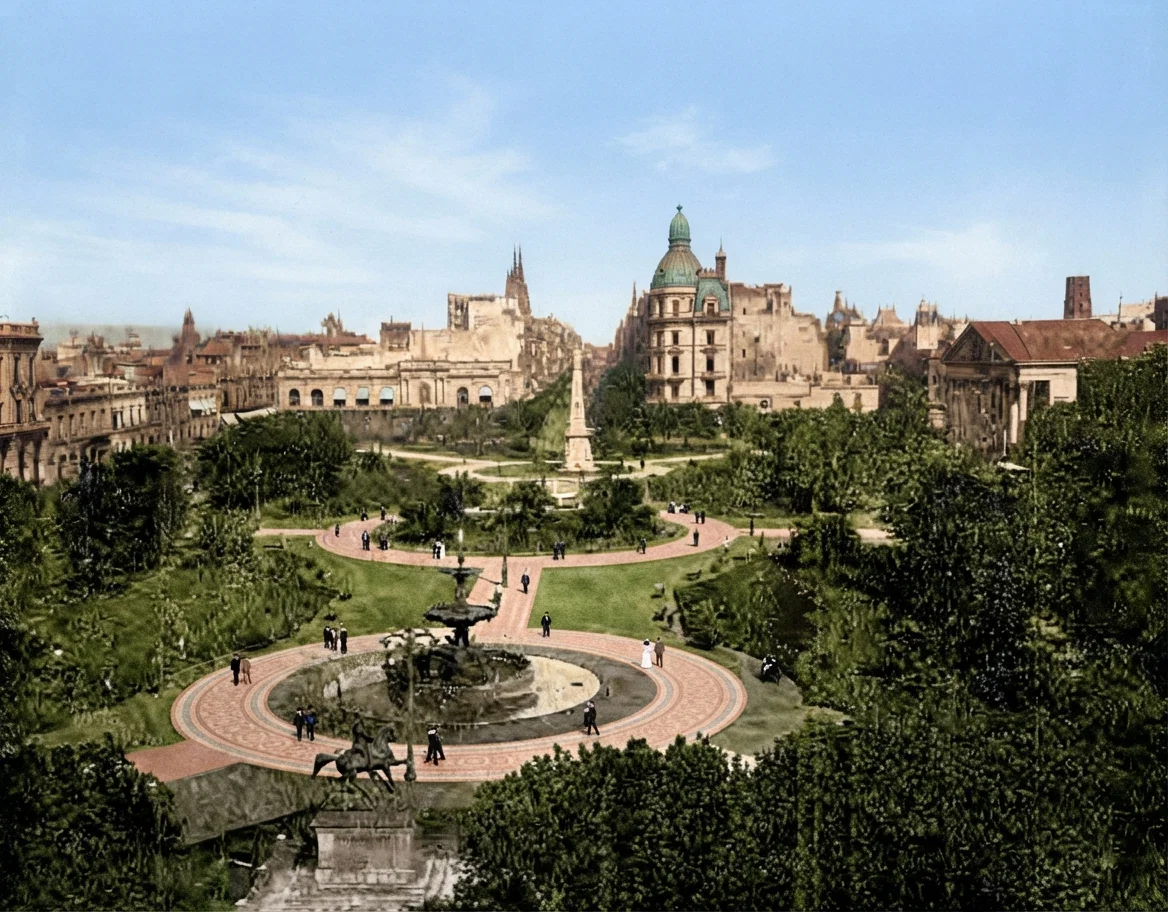
A Plaza in the City of Buenos Aires, Argentina.
Buenos Aires boasts of having one of the best systems of water supply in the world. The water is pumped from the River Plata a little above the city, and conveyed to huge tanks in the northwestern part of the town, where it is thoroughly filtered before being given to the public.
The buildings are all low, usually one story, and tram lines cross the city in every direction. Some commodious automobiles are also being brought into use as public conveyances. Every few squares they bring the passenger to one square devoted to horticulture, which breaks the monotony in a very pleasant way. These diminutive parks are termed plazas. There are also several large, well-kept parks, and a zoological garden.
There are six free municipal hospitals in the city, in all of which advice is given gratis. The British, French, German, Spanish, and Italian communities each have their respective hospitals in addition to the above. There are also several establishments where baths of all kinds can be had, and electricity, Röntgen rays, and massage applied.
Education is free, and supposed to be compulsory, but option is granted between educating the children at home or in a private or public school. How strictly the school law is enforced may be judged from the fact that more than one-half of the inhabitants can neither read nor write. The law permits of religious instruction either before or after regular school hours, and the Catholic priests improve their opportunities in this respect, only those children whose parents request it, being dismissed before the religious instruction is given.
The city university has departments in law, medicine, the sciences, etc.
In the colonial days (1613), when three lawyers arrived at the port of Buenos Aires, the population was so stirred that the town council issued the following decree:—
Considering that their coming is useless and can only cause disturbance by reason of the difficulties which they will create among the citizens, we declare and order that these three personages be strictly prohibited from remaining in this town, except by special order from his Majesty, the king of Spain.
But times have changed since then. Out of a total of 2,500 students in the universities of Buenos Aires and Cordoba in 1897, 1,172 were studying law. Two of the most prominent signs that one sees, passing through the city, are “abogado,” lawyer, and “medico,” physician. But those who have occasion to deal with them, assure us that the old town council sized them up about right.
The Argentines monopolize the professions to the exclusion of the trades. The Prenza, one of the leading dailies here, erected a new building a few years ago, and advertized for master workmen in the different branches, giving the preference to Argentines. But they were not to be found, and the building (the end of which may be seen at the right of the street leading out of the plaza) was erected by foreigners. The Statue of Liberty upon the top of the building is one hundred and eighty-one feet above the street, with a powerful electric reflector whose rays are visible at a great distance. This paper offers many advantages to its patrons in the way of museum, library, post-office, and medical and judicial departments. A writer in the English Review of Reviews estimates it to have the best equipped office of publication of any newspaper in the world.
There are forty churches and twenty chapels in the city, the most of which are Roman Catholic. In each of the Catholic churches mass is celebrated every day, beginning very early in the morning. On Sundays mass is repeated every hour of the day. The Methodists have two churches and several other places of worship in the city. The Presbyterians, Anglicans, and Lutheran Germans also have each a church.
The religion of the country is the Roman Catholic, which is supported by the government, and is one of the necessary qualifications for occupying the highest office of state, the presidential chair. Altogether there are about 27,000 Protestants and 6,000 Jews in the country, the remainder being Roman Catholics. But, unlike the North American Catholics, their religion here sets as lightly upon them as it is possible for it to do; and the saddest part of it is that among those who have come here from more enlightened homes in Europe and North America, there is a strong tendency to conform to the senseless customs and practises prevalent here, instead of holding up and cherishing the greater light for which they are responsible.
Buenos Aires, Argentina.