"THERE, now!" said Dora Lee, as she stepped from the little sitting-room into the kitchen, with pail and scrubbing-cloth in hand, "I believe this house is clean from one end to the other. If we only had a carpet for the front room, and new wall paper, and some white muslin curtains for the windows, it would be real nice and cozy. Seems as tho we might have a rag carpet. Grandma's house has a carpet in nearly every room in it, and some of them are just as pretty as boughten ones. Don't you s'pose we can make one, mother?"
Mrs. Lee, or Mattie Lee, as every one called her, looked up at her daughter's direct question with a wan smile on her pale face. "I did try to make one a long time ago," she answered with a sigh. "But I was sick a long time, and the rags were put away. When I got better I did not get them around again, there was so much else to do. After Frank and Bertie and Bessie were born I never could get any time."
"I remember it," said Dora; "Katie and I were little things then, but we thought we could help sew rags, but our rags wouldn't hold together. But I am fourteen now and Katie is twelve. We will sew all the rags if you will only cut them. Katie and I have talked it all over, and we mean business."
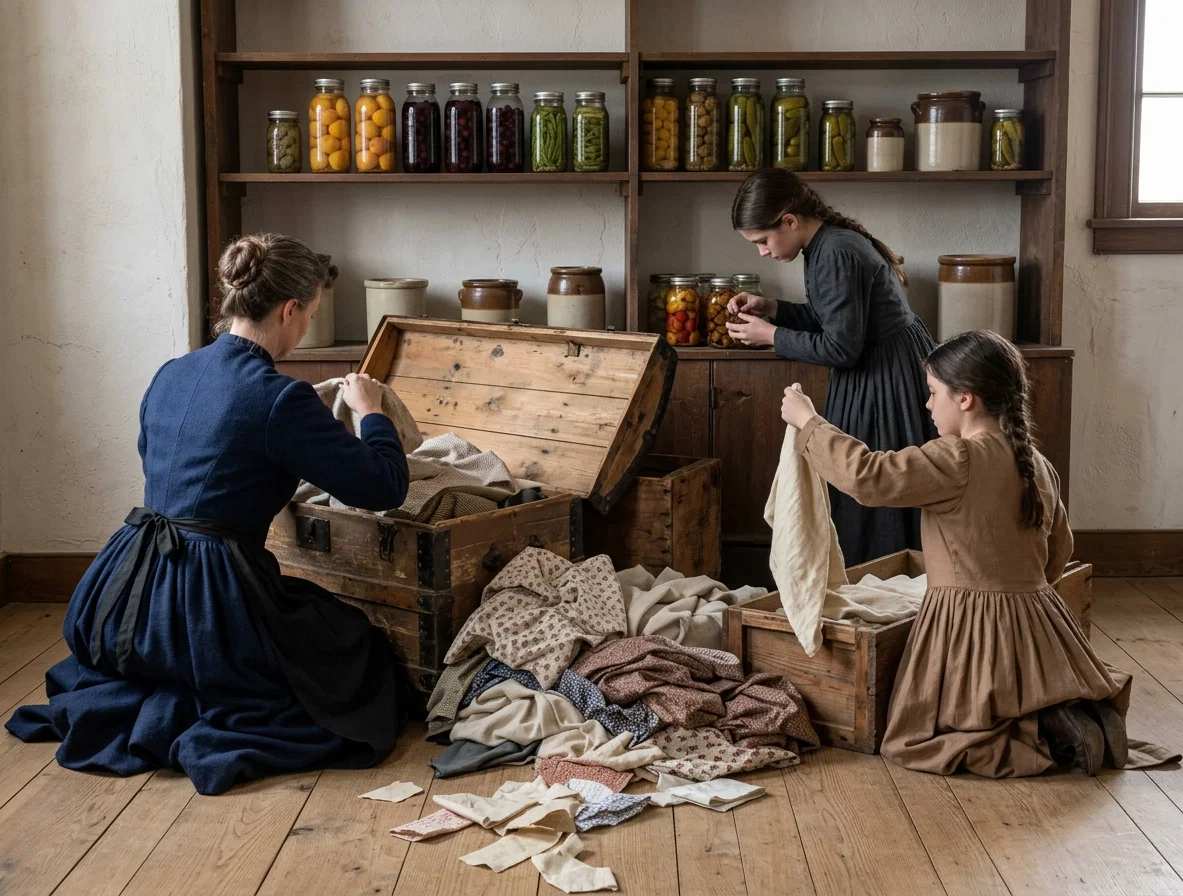
“The next day they ransacked trunks.”
"Well, dears, we might try it." And Mattie looked with a motherly pride at her two bright-faced girls with a more cheery, hopeful look on her face than it had worn for a long time. "If," she added anxiously, "I can get the money to buy the warp and to hire the weaving done. You know, my children, it is sometimes hard to get necessary things to eat and wear."
Dora and Katie knew that very well, and they also knew the reason why. Their meals were often scanty, and their clothes were so shabby that if it had not been for the presents that came so frequently from grandma's they would often have been without a decent suit of apparel in the house. They had often seen their mother weeping as tho her heart would break, and they knew it was because their father, Frank Lee, spent a great part of his wages at Hughes' tavern, for intoxicating drinks.
Frank Lee drank occasionally when Mattie Dixon married him, but as he worked hard, and provided fairly well for his family for several years, she felt no uneasiness.
But of late his visits to the tavern had been growing more frequent, and, as a consequence, he had grown morose and selfish, and the home comforts had sensibly diminished. The children learned to shun his presence when he returned from town, with flushed cheek and unnatural eye. Mattie, too, wept silently, for she had found that reproaches only angered him. Mattie was a frail little woman, illy fitted to bear the burden of poverty and the care of six small children.
Dora had grown strong and self-reliant from having to act as nurse and housekeeper in her mother's frequent illnesses. Into her sympathetic ear Mattie confided the sorrow of her life, which she felt too weak to bear alone. Dora was courageous and hopeful. "Don't cry, mother," she would say. "We'll have a prohibition law one of these days, and then Hughes will have to shut up his old rum-hole, and go to work for a living."
The great joy of the children's lives was going to Grandma Dixon's to stay a few days or a few weeks. There was seldom a time when there was not one of the children there, tho since Dora and Katie had become such a help at home, their visits had been shorter and less frequent. They keenly felt the difference between their own meagerly-furnished home and Grandma Dixon's white farmhouse, with its bright carpets, lace curtains, and well-supplied table.
Grandma felt sorry for Mattie and the children, and it was seldom that they came home without some addition to their wearing apparel and some dainty for their mother.
Since Dora's last visit her longings had taken shape in a resolve to have a rag carpet like grandma's.
"Perhaps," she said softly to her mother, "if the house was pretty and comfortable pa would like to stay at home better."
Tears came into Mattie's eyes, and a ray of hope into her heart. She entered into Dora's scheme with almost childish enthusiasm.
The next day they ransacked trunks and boxes and barrels, where they found plenty of material for their purpose. In fact, as Katie remarked, "more rags than anything else."
The cutting and sewing went steadily on for some weeks. Grandma promised to help about the coloring. Even Frank seemed quite interested, and praised the girls for their industry. Perhaps he felt a little self-reproach for his neglect and unkindness toward those nearest and dearest to him. At any rate, he worked more steadily and squandered less. Mattie seemed her old light-hearted self once more.
About the time the rags were weighed for the last time, and pronounced sufficient, Frank had finished a good job (he was a mason), and came home with plenty of money in his pocket.
"Now, Mattie," said he with a gay smile, throwing some bills into her lap, "here's the money for your carpet. Perhaps it will get the paper too."
"Frank, you are just as good as you can be!" said Mattie impulsively, throwing her arms around his neck.
"O, nonsense!" said Frank, but there was a mist in his eyes as he left the room. A sense of his unworthiness came over him, and he resolved to do better, to break the chains that bound him to so vile a habit, and to do his duty more faithfully to the little flock intrusted to his care.
That evening he seemed more like his old, cheery self, as he laughed and played with the little ones. The children were all delighted, and Mattie thought she had never been happier in her life.
For several weeks Frank came home with money in his pocket, or his hands filled with necessary supplies. It was in early autumn when the carpet came home from the weavers. It was unrolled on the floor for a general inspection.
"It is really prettier than I thought it would be," said Dora with a satisfied air.
"It is just beautiful," said Katie enthusiastically. "It is just as pretty as grandma's," was Lulu's comment, which, in Lulu's estimation, was the highest compliment that could be paid.
"It's a daisy," cried Frankie; and he would have turned summersaults on it if his mother had not held him back.
Bertie signified his appreciation of it by lying down and rolling over it.
"Pretty, pretty," lisped baby Bessie, patting the red and yellow and green stripes with her chubby fingers.
Mattie was as pleased as the children. Altho she11had been married fifteen years, this was the first carpet she had ever had.
Mrs. Harvey, a near neighbor, the most stylish of their acquaintance, came in the next day. "I really must compliment you, Mattie," said she; "I have seldom seen a prettier rag carpet. If you wanted to sell it, I would gladly give you sixty cents a yard for it, tho the usual price is fifty cents. I would like it for my dining-room."
"We don't want to sell it," said Mattie quickly. So the matter was dropped.
They decided to do the fall cleaning and to paper the little sitting-room before making the carpet. Frank had yielded to temptation more than once. In truth, he had not decided to quit drinking altogether, only to be very temperate, and spend more for his family, and less for himself.
Mattie worked beyond her strength during the papering and cleaning, and this, with the mental strain caused by anxiety for her husband, threw her into a slow fever, with frequent fainting spells. To relieve these a bottle of brandy was procured. Frank watched over her anxiously until she grew better, and slept naturally. He felt worn and exhausted, but could not eat or sleep. While striving to crush the restless craving within, it flashed into his mind about the brandy bottle on the stand by his wife's bedside. The demon within urged him on, and he arose from the old lounge in the kitchen, where he was trying to rest, and stole noiselessly into the room where his wife lay quietly sleeping.
(Concluded next week.)